Hear from Our Customers
You’re working with expensive materials. One crack ruins the piece, blows the budget, and pushes your timeline back days or weeks.
Traditional glass cutting methods create heat. Heat creates stress. Stress creates cracks, chips, and edges that need grinding, polishing, or scrapping entirely.
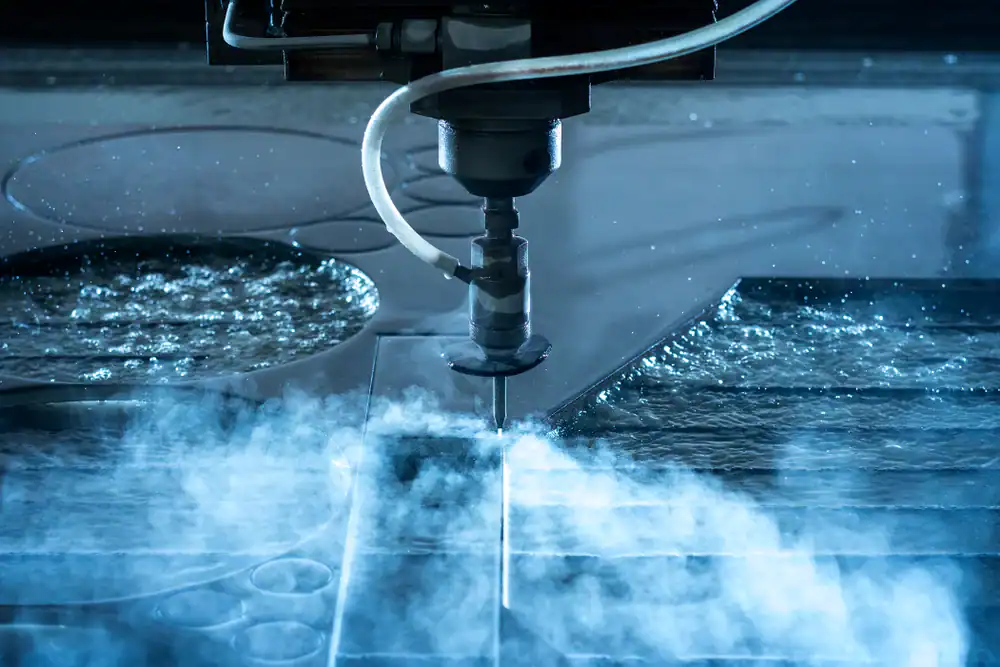
Waterjet cutting removes all of that risk. The stream is cold. There’s no blade vibration, no thermal expansion, no micro-fractures forming along the cut line. You get smooth edges, tight tolerances, and the exact shape you specified—whether that’s a simple rectangle or a complex architectural pattern with curves, angles, and cutouts. The process works on glass up to 12 inches thick, and because the kerf is so narrow, material waste drops significantly. Less waste means lower costs and fewer headaches when you’re working with custom or imported glass.
Tri-State Waterjet brings precision fabrication to Hampton Bays and the surrounding Long Island area. We work with architects, contractors, designers, marine fabricators, and anyone else who needs glass cut right the first time.
Hampton Bays sits in a region with dense construction activity, high-end residential projects, and a strong marine industry. That means demand for custom glass—storefronts, yacht windows, decorative panels, shower enclosures, architectural features. We’ve built our process around that demand. You send us your design file or specs, and we program the CNC system to match it exactly. No guessing, no hand-tracing, no “close enough.”
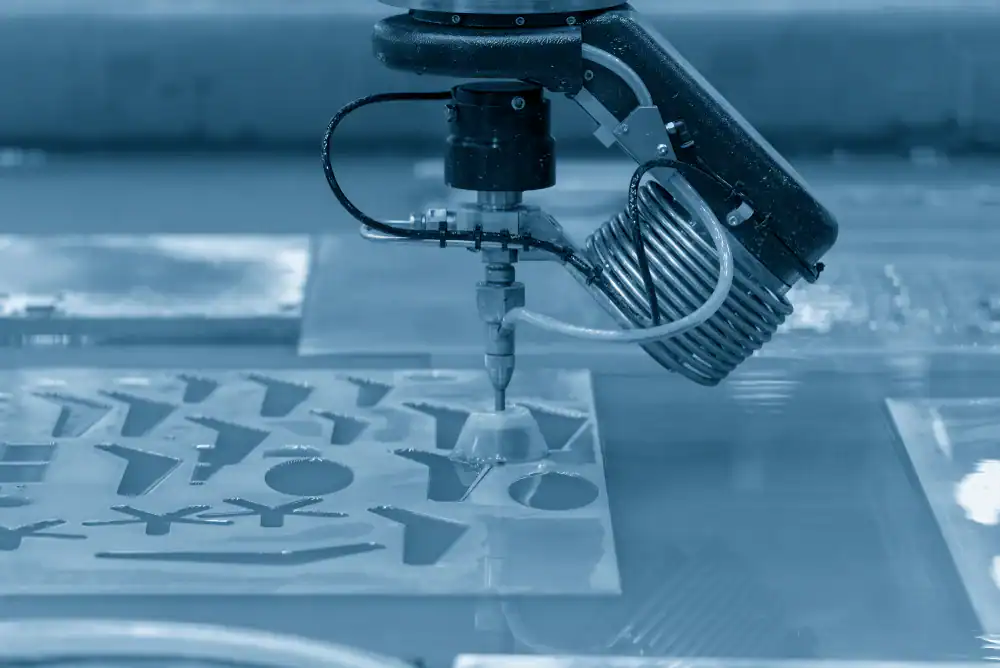
You start by sharing your design. CAD files work best, but we can also work from dimensioned drawings or templates. Once we have the specs, we program the CNC waterjet system to follow your exact cut path.
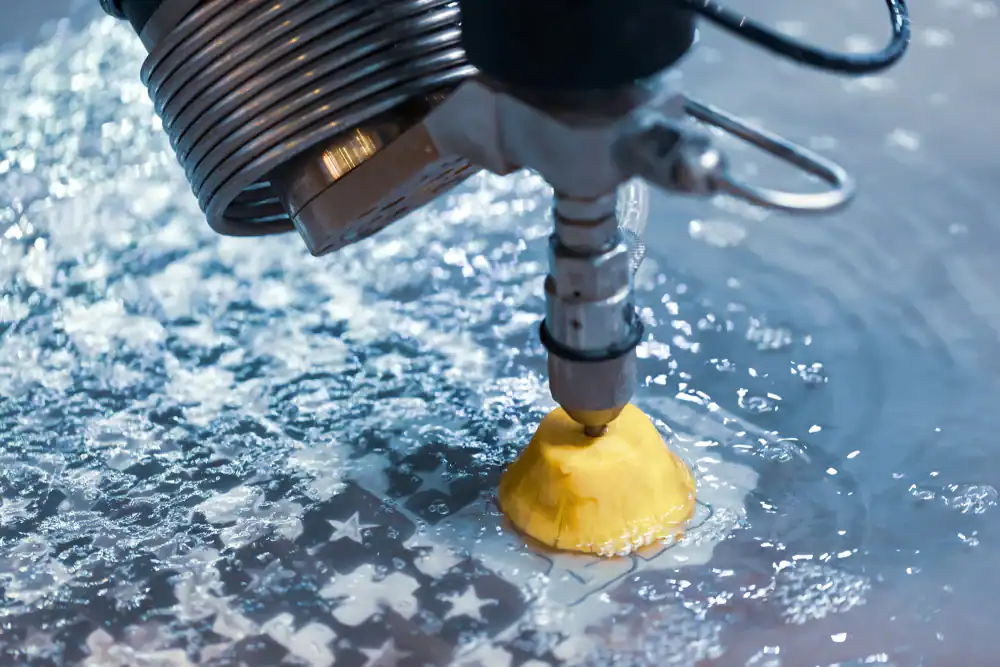
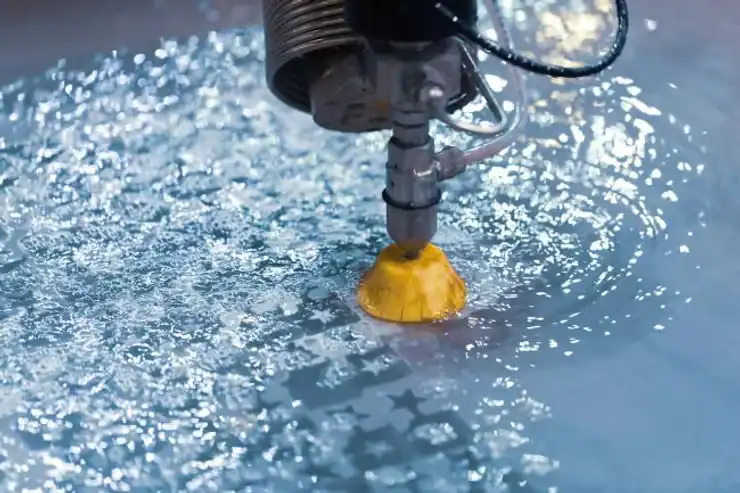
The machine uses a stream of water mixed with fine abrasive garnet, pressurized up to 90,000 PSI. That stream cuts through glass without generating heat, which means no thermal distortion and no risk of stress cracks. The cutting head follows the programmed path with precision down to fractions of a millimeter, handling straight cuts, curves, interior cutouts, and intricate patterns equally well.
After cutting, the edges come out smooth and clean. In most cases, you won’t need any secondary finishing unless your application requires a polished edge for aesthetic reasons. Setup time is minimal, so turnaround stays quick even for custom one-off pieces or small production runs.
Ready to get started?
You get cuts that match your design file exactly. Complex shapes, tight inside corners, multiple cutouts in a single panel—all handled without switching tools or methods.
You avoid the cracking and chipping that comes with mechanical scoring or sawing. The cold-cutting process eliminates thermal stress entirely, so even tempered or laminated glass can be cut without shattering. Edges come out smooth enough that many applications don’t require grinding or polishing, which saves time and keeps costs down.
Hampton Bays and the broader Long Island market see a lot of high-end architectural work—custom homes, waterfront properties, commercial storefronts, marine applications. Waterjet cutting supports that market by handling the materials those projects demand: thick glass panels, curved or angled cuts for modern designs, decorative patterns for interior features. The process is also environmentally cleaner than traditional methods. No toxic fumes, no chemical coolants, and the abrasive garnet can often be filtered and reused.
Tempered glass is tricky because it’s designed to shatter completely if you try to cut it after tempering. If you need a custom shape in tempered glass, the cutting has to happen before the tempering process. Waterjet works perfectly for that—you cut the shape first, then send it out for tempering.
Laminated glass is different. It’s two or more layers of glass bonded with an interlayer, usually plastic. Waterjet can cut through laminated glass cleanly because there’s no heat to melt or distort the interlayer. The stream cuts through both the glass and the laminate in one pass, leaving a clean edge without delamination.
If you’re not sure whether your glass type works with waterjet cutting, just ask. We’ll walk you through what’s possible based on your material and what you’re trying to build.
CNC waterjet systems can hold tolerances around ±0.01 inches, which is tight enough for most architectural, decorative, and functional glass applications. The cutting stream is extremely narrow—often less than a millimeter wide—so you can create fine details, sharp inside corners, and complex curves without losing accuracy.
If your design includes very small radii or extremely tight tolerances beyond standard CNC capability, we’ll flag that during the quoting process. In most cases, though, the system handles intricate patterns without issue. We’ve cut everything from decorative panels with flowing organic shapes to precise industrial components with multiple mounting holes and exact dimensions.
The key is starting with a clean design file. The more precise your CAD drawing or template, the more precise the final cut. If you’re working from a hand sketch or rough concept, we can help translate that into a cut file that works.
We can cut glass up to 12 inches thick using high-pressure waterjet systems running at 60,000 to 90,000 PSI. Most projects don’t require anything close to that thickness, but it’s useful to know the capability exists for specialty applications like aquarium panels, structural glass floors, or heavy marine glazing.
Thicker glass takes longer to cut because the stream has to penetrate deeper, but the process stays consistent. There’s no heat buildup, no risk of cracking from thermal expansion, and the edge quality remains smooth even on thick material.
For standard architectural or decorative glass—typically ranging from 1/4 inch to 1 inch thick—cutting speed is fast and setup time is minimal. If you’re working with something outside that range, we’ll give you a realistic timeline and let you know if there are any material-specific considerations.
Waterjet cutting leaves a smooth, clean edge that’s safe to handle and often ready to install without additional work. The edge won’t be as polished as what you’d get from a dedicated glass polishing process, but it’s far smoother than what mechanical scoring or sawing produces.
For applications where the edge will be visible and aesthetics matter—like tabletops, decorative panels, or high-end architectural features—you might want a polished edge. That’s a separate finishing step, but it’s quick because the waterjet edge is already smooth and uniform.
For applications where the edge will be framed, sealed, or otherwise hidden—like shower enclosures, windows, or laminated panels—the waterjet edge is usually fine as-is. You save time and money by skipping secondary finishing entirely. If you’re unsure whether your project needs polished edges, we can show you samples or talk through what the finished piece will look like.
Waterjet cutting typically costs more per linear foot than basic straight cuts done with a glass scorer, but it saves money in other ways. You get less material waste because the cuts are more precise and there’s no breakage from scoring and snapping. You avoid the cost of secondary finishing in many cases because the edges come out clean. And you eliminate the risk of scrapping expensive glass due to cracks or chips.
For complex shapes, intricate patterns, or thick glass, waterjet is often the only practical option. Traditional methods either can’t handle the geometry or they introduce too much risk of breakage. When you factor in the cost of wasted material, rework, and delays, waterjet usually ends up being the more cost-effective choice for anything beyond simple rectangular cuts.
Pricing depends on material thickness, design complexity, and project size. A single custom piece with a lot of curves and cutouts will cost more per square foot than a production run of identical panels. If you send over your specs, we can give you a clear quote based on what you’re actually trying to build.
Turnaround depends on the complexity of the design, the thickness of the glass, and how many pieces you need. Simple cuts on standard-thickness glass can often be completed within a few days. More intricate designs or thicker materials take longer because the cutting process itself is slower and programming the CNC system requires more detail.
Setup time is minimal compared to traditional methods because there’s no need to create custom tooling or jigs. We program the cut path directly from your design file, load the glass onto the cutting bed, and let the machine run. That means even one-off custom pieces can be turned around quickly without the overhead of custom fabrication setups.
If you’re working on a tight deadline, let us know upfront. We’ll tell you what’s realistic and whether we can prioritize your job to meet your schedule. For larger production runs or ongoing projects, we can also discuss scheduling to keep material flowing as you need it.
Useful Links
Other Services we provide in Hampton Bays