Hear from Our Customers
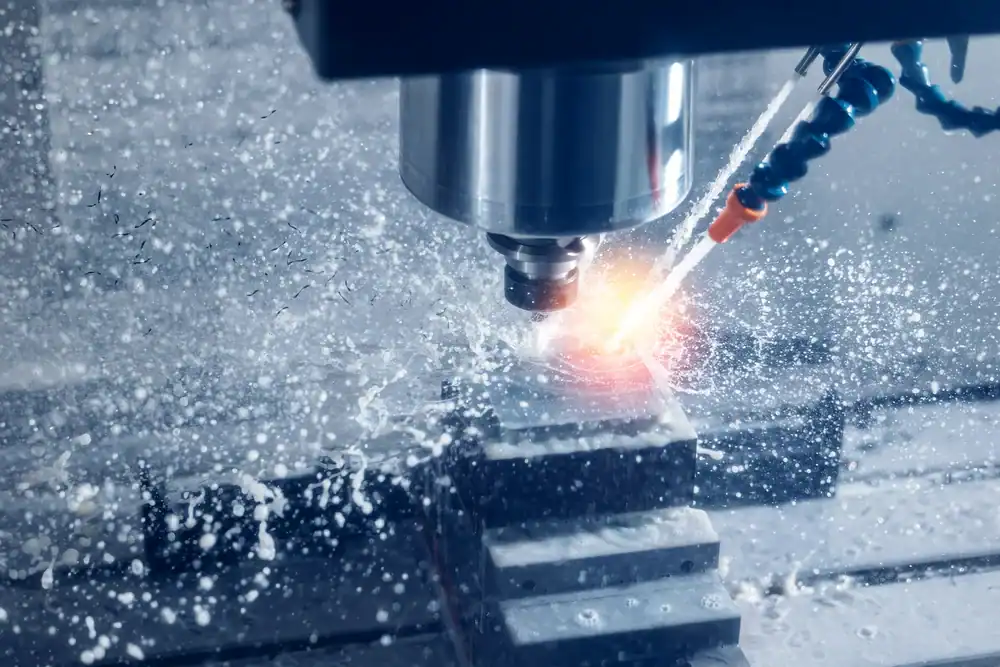
Traditional glass cutting leaves you managing cracks, chips, and the constant risk of ruining expensive material. You’re stuck with limited design options because most tools can’t handle the complexity your project demands.
Glass waterjet cutting in New Cassel, NY changes that. The cold-cutting process means no heat-affected zones, no thermal stress, and no cracks forming along your cut lines. You get exceptional edge quality that needs minimal finishing work, which saves you time on every piece.
The real advantage shows up when you’re working with thick glass or intricate patterns. Waterjet technology handles up to 12 inches of glass thickness and cuts shapes that would be impossible or prohibitively expensive with traditional methods. You’re not limited by what a manual cutter can do or what a saw blade can handle.
Speed matters when you’re on a deadline. CNC glass waterjet cutting in New Cassel, NY runs faster than conventional techniques while maintaining the precision your architectural, automotive, or design work requires. Less time cutting means faster turnaround for your projects.
We operate in New Cassel, NY, serving the industrial and commercial market across the tri-state area. We run 2-axis and 3-axis CNC machinery designed specifically for the precision work that architectural firms, manufacturers, and design studios need.
New Cassel’s industrial sector includes over 134,000 square feet of active manufacturing space, and the demand for precision fabrication continues to grow. We’ve built our operation around fast turnaround times and tight tolerances because that’s what keeps projects moving in this market.
Our facility handles custom glass waterjet cutting in New Cassel, NY for clients who’ve worked with Ralph Lauren, Coach, and Port Authority. The work requires accuracy, consistency, and the ability to meet deadlines without compromising quality.
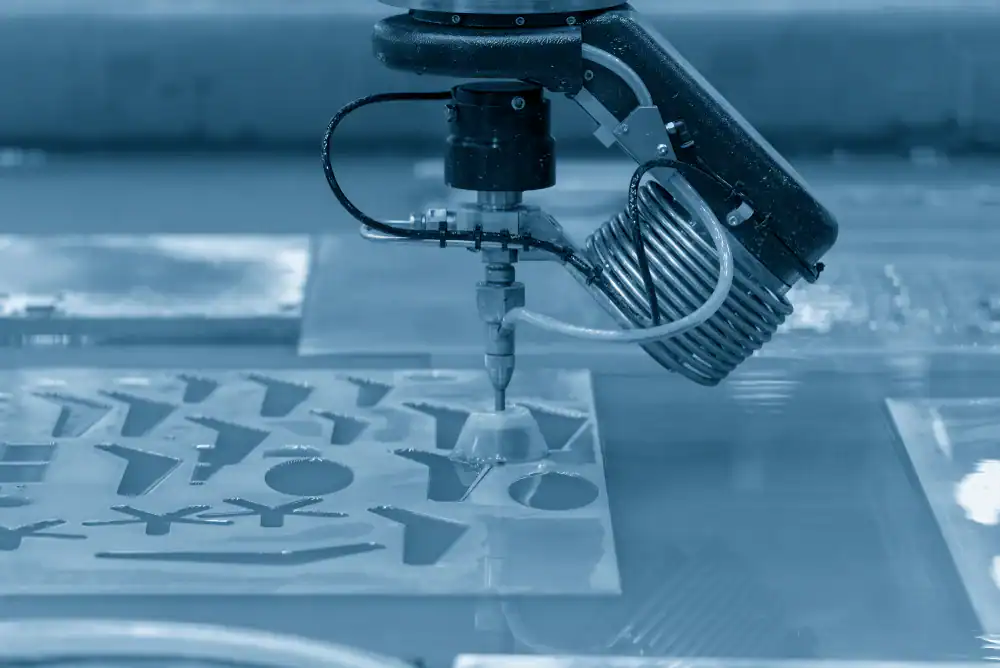
You start by sending us your design specifications. CAD files work best, but we can work with technical drawings or detailed sketches if that’s what you have. We review the design to confirm feasibility, material requirements, and any potential issues before cutting begins.
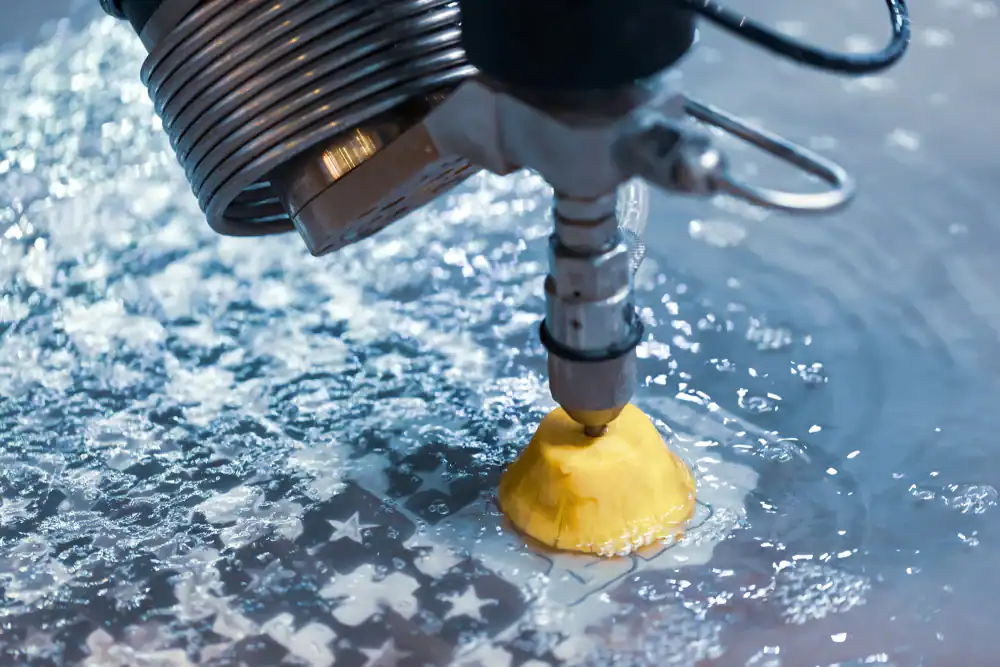
Once the design is confirmed, we program the CNC waterjet system with your exact specifications. The machine uses a high-pressure water stream mixed with abrasive particles to cut through the glass with precision that manual methods can’t match. There’s no contact between the cutting tool and the glass surface, which eliminates the pressure points that cause cracking.
The waterjet follows your programmed path, cutting complex curves, tight inside corners, and intricate patterns without generating heat. This cold-cutting process is what prevents thermal distortion and maintains the structural integrity of the glass throughout the entire piece.
After cutting, the edges come off the machine clean and smooth. Depending on your application, you might need minimal finishing work or none at all. We inspect each piece to confirm it matches your specifications before it leaves our facility.
Ready to get started?
Architectural glass waterjet cutting in New Cassel, NY handles the facade panels, interior partitions, and decorative elements that define modern building design. The process cuts through laminated glass, tempered glass, and specialty materials without compromising their structural properties.
Industrial applications require different considerations. Industrial glass waterjet cutting in New Cassel, NY processes components for automotive windshields, aerospace windows, and manufacturing equipment where precision directly impacts safety and performance. The narrow kerf width minimizes material waste, which matters when you’re working with expensive specialty glass.
Residential glass cutting services in New Cassel, NY cover custom countertops, tabletops, shower enclosures, and decorative pieces. Homeowners and contractors need cuts that fit exact measurements in existing spaces, and waterjet technology delivers that accuracy without the risk of shattering expensive slabs during fabrication.
The versatility extends to thickness and material type. We process optical glass, quartz, borosilicate, and fused silica using the same waterjet system. You’re not limited to standard thicknesses or simple rectangular cuts—the technology adapts to whatever your project requires.
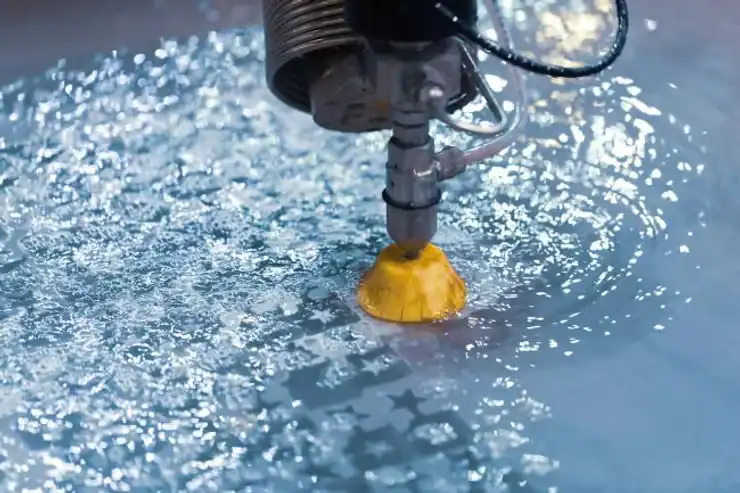
Waterjet cutting handles virtually every type of glass you’d use in commercial, industrial, or residential applications. That includes standard float glass, tempered glass, laminated glass, optical glass, quartz, borosilicate, and fused silica.
The process works across different thicknesses too. We’ve successfully cut glass up to 12 inches thick, though most architectural and design projects use material between 1/4 inch and 2 inches. The cold-cutting method doesn’t change the material’s properties, so tempered glass maintains its strength and laminated glass keeps its layers bonded.
Specialty applications like aerospace components or scientific equipment often require materials with specific optical or thermal properties. The waterjet process doesn’t generate heat, which means those properties remain unchanged through the cutting process. You get the exact material performance you specified.
The waterjet stream cuts through glass without making physical contact with the material surface. There’s no blade pressing down, no tool vibration, and no friction generating heat. Those are the three main causes of cracking and chipping in traditional glass cutting.
The high-pressure water mixed with fine abrasive particles erodes the glass along a precise path. Because there’s no mechanical pressure applied to the surface, you don’t get the stress concentrations that cause cracks to propagate. The process is especially effective for inside cuts and complex shapes where traditional methods would require multiple scoring and breaking steps.
Edge quality comes out clean because the abrasive action is consistent across the entire cut depth. You’re not dealing with the rough edges that come from breaking glass along a score line or the heat-affected zones that laser cutting creates. Most pieces need minimal edge finishing, and some applications can use the parts as-cut.
Turnaround depends on project complexity, material thickness, and current production schedule. Simple cuts on standard glass thickness typically run within 3-5 business days from design approval to finished parts. More complex projects with intricate patterns or specialty materials might take 7-10 business days.
Rush jobs can be accommodated when your timeline demands it. We run CNC equipment that operates efficiently, and because waterjet cutting is faster than traditional methods, we can often compress schedules without sacrificing quality. Communication matters here—the earlier you can get us your specifications, the better we can plan production.
Large production runs follow a different timeline. Once the first piece is approved, subsequent parts run quickly because the CNC program is already proven. We can discuss specific scheduling needs when you reach out with your project details.
CNC-controlled waterjet systems maintain tolerances within ±0.005 inches on most glass cutting applications. That level of precision handles the detailed architectural work, automotive components, and custom design pieces that require exact specifications.
The technology excels at intricate patterns because the waterjet stream is narrow—typically between 0.020 and 0.040 inches in diameter. You can cut tight inside radiuses, sharp corners, and complex curves that would be difficult or impossible with conventional glass cutting tools. The CNC programming ensures every piece matches your design exactly.
Three-axis capability adds another dimension for edge beveling and angled cuts. If your project requires something beyond straight vertical cuts, the equipment can tilt the cutting head to create precise angles. This matters for architectural applications where glass panels need to fit together at specific angles or for decorative work requiring beveled edges.
Waterjet cutting typically costs more per linear foot than simple straight cuts with traditional scoring methods. But that comparison misses the bigger picture of what you’re actually paying for across the entire project.
Traditional methods require multiple steps for complex shapes—scoring, breaking, grinding, polishing. Each step adds labor time and creates opportunities for material waste when pieces break incorrectly. Waterjet cutting completes the entire cut in one operation with minimal finishing needed. When you factor in reduced labor, less material waste, and fewer rejected pieces, the total project cost often favors waterjet technology.
The real cost advantage shows up on complex projects. Shapes that would require expensive custom tooling or extensive hand-finishing with traditional methods get cut directly from your CAD file. You’re not paying for tool creation, and you’re not absorbing the cost of skilled labor hand-finishing every edge. For architectural projects, automotive components, or custom design work, waterjet cutting usually delivers better value than the alternatives.
CAD files give us the cleanest path to production because they translate directly into CNC machine code. DXF and DWG formats work best, though we can handle most standard CAD file types. The precision in your design file carries through to the finished piece.
If you don’t have CAD files, we can work with detailed technical drawings that include exact dimensions and specifications. PDF drawings with clear measurements can be converted to machine code, though this adds a step to the process. The key is having accurate dimensions and clear indication of what needs to be cut.
For custom or artistic projects, detailed sketches with measurements can work as a starting point. We’ll typically create a CAD drawing from your sketch for approval before cutting begins. This ensures you see exactly what the finished piece will look like and gives you a chance to make adjustments before we commit material to the machine.
Useful Links
Other Services we provide in New Cassel