Hear from Our Customers
You’re looking at glass that needs curves, tight corners, or decorative patterns that scoring and snapping just won’t handle. Maybe it’s an architectural feature wall, a custom shower enclosure with radius cuts, or branded glass panels for a commercial lobby. Whatever the design, you need edges that don’t chip and cuts that match your CAD file exactly.
Waterjet cutting gives you that precision without the heat that causes micro-cracks or the rough edges that need hours of polishing. The stream is thin enough to minimize waste on expensive glass stock, and the process is cold—no thermal stress, no warping, no secondary cleanup on most jobs.
Your project moves faster because the cuts come out clean. You’re not dealing with edge failures during installation or explaining to a client why the pattern doesn’t line up. The glass arrives ready to install, with smooth edges and the exact dimensions you specified.
We operate right here in New Hyde Park, NY, serving architects, contractors, and manufacturers across Nassau County who need glass cut correctly the first time. We’re not a middleman—your files go straight to our CNC machines, and our team reviews every design before programming to catch issues that would cost you time and material.
New Hyde Park sits in a market where precision matters. Residential projects in Garden City and Great Neck expect flawless finishes. Commercial builds in Mineola and Westbury can’t afford delays from re-cuts. We handle both, along with industrial glass waterjet cutting in New Hyde Park, NY for manufacturers who need repeatable accuracy across production runs.
You’re working with a shop that understands the difference between a tolerance and a suggestion. We’ve cut glass for feature walls, custom cabinetry, signage, and specialty applications where traditional methods would have failed or required extensive finishing work you don’t have time for.
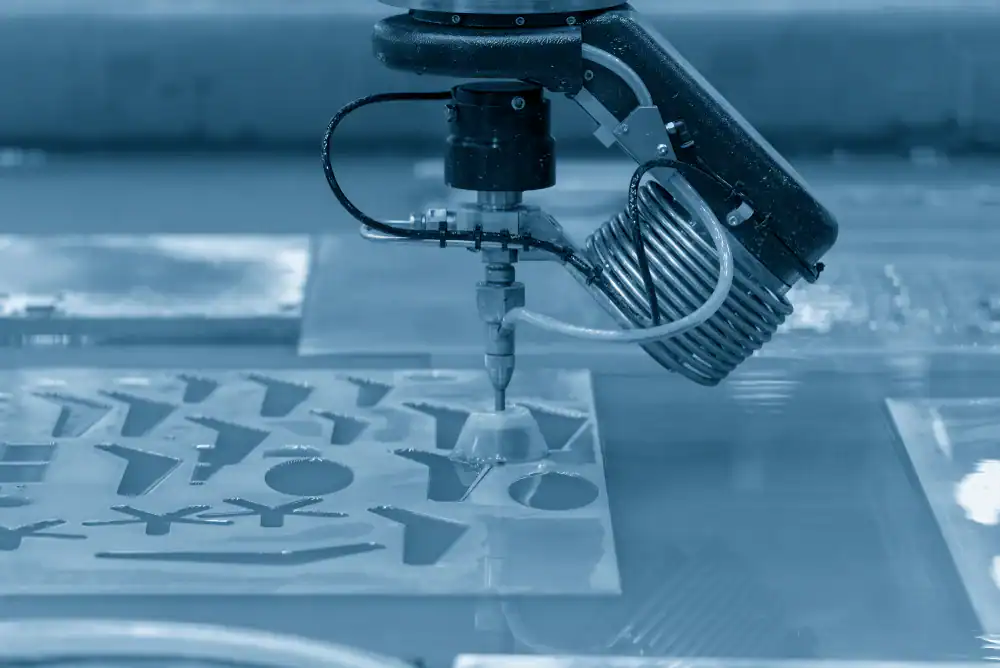
You send us your CAD file or design specs—DXF, DWG, or even a detailed sketch if that’s what you’re working from. Our team reviews it for any potential issues: inside corners that are too tight, features that might compromise structural integrity, or dimensions that don’t account for material thickness. If something looks off, we’ll flag it before we start cutting.
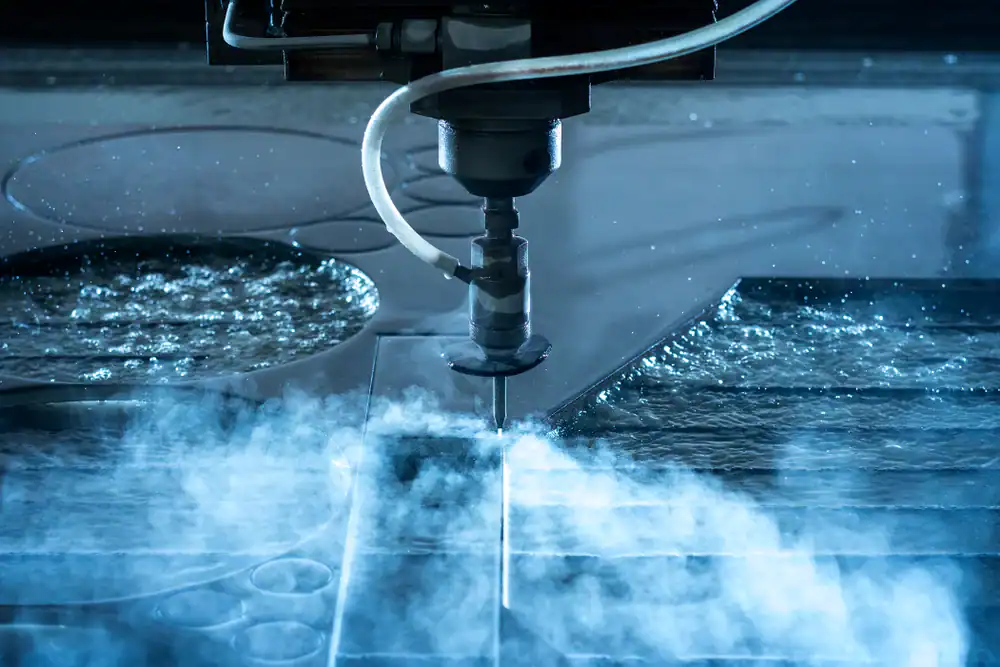
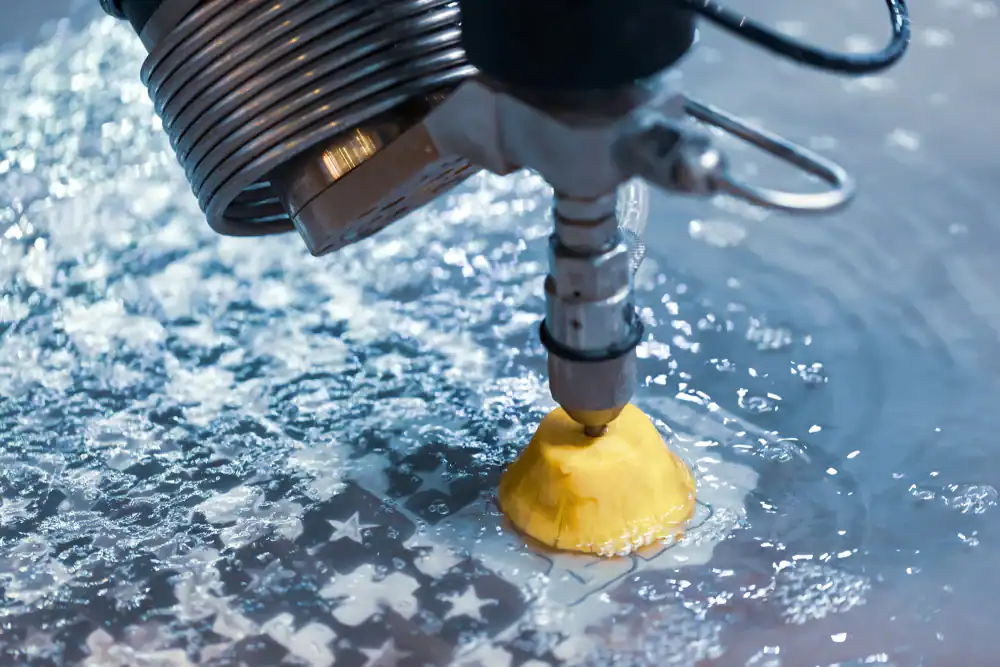
Once the file is verified, it goes to our CNC waterjet system. The machine uses a high-pressure stream mixed with fine abrasive to cut through the glass with precision measured in thousandths of an inch. There’s no blade contact, no heat buildup, and no vibration that could cause stress fractures. The waterjet follows your design exactly, handling curves, angles, and intricate patterns that would be nearly impossible with traditional scoring methods.
After cutting, most pieces are ready to go. The edges come out smooth enough that secondary finishing is rarely needed unless your application requires a specific polish level. You get glass that fits your project specifications without the chipping, cracking, or rough edges that slow down installation and create callbacks.
Ready to get started?
You’re getting cuts that handle complexity traditional methods can’t—tight radiuses, sharp internal angles, decorative patterns, and intricate logos or text cutouts. The process works on tempered glass, laminated glass, and specialty materials without the risk of shattering during fabrication.
In New Hyde Park, NY and surrounding Nassau County areas, we’re seeing increased demand for custom glass in both residential and commercial projects. Homeowners in Floral Park and New Hyde Park want unique kitchen backsplashes with waterjet-cut patterns. Businesses in Mineola need branded glass partitions. Contractors working on mixed-use developments in Garden City require architectural glass waterjet cutting in New Hyde Park, NY for lobby features and exterior accents.
The edge quality matters more than most people realize until they’ve dealt with a chipped edge during installation or a crack that spreads from a rough cut. Waterjet cutting produces clean edges that reduce installation issues and eliminate the need for extensive grinding or polishing. You’re also minimizing material waste because the narrow cutting kerf means more usable pieces from each sheet, which matters when you’re working with expensive glass stock or trying to match existing materials.
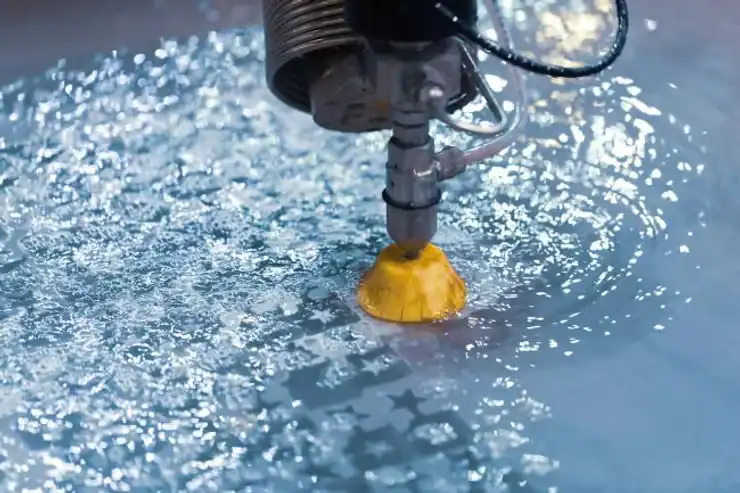
Waterjet cutting handles most glass types you’d use in architectural, residential, or industrial applications—float glass, tempered glass, laminated glass, low-iron glass, textured glass, and specialty materials like borosilicate. The process works because there’s no heat and no direct tool contact, which means you’re not introducing thermal stress or vibration that causes cracking.
Tempered glass is tricky because it can’t be cut after tempering without shattering, so waterjet cutting happens before the tempering process. You’d provide the cut specifications, we’d cut the glass to shape, then it goes to tempering. Laminated glass cuts cleanly through both the glass layers and the interlayer without delamination issues you’d see with other methods.
Thickness isn’t usually a limiting factor for most architectural and residential applications. We’ve cut glass from thin 3mm sheets up to thick 25mm+ panels. The key is matching the cutting parameters to the material—pressure, abrasive flow, and cutting speed all adjust based on what you’re working with.
Waterjet cutting typically holds tolerances within ±0.005″ to ±0.010″ depending on material thickness and complexity, which is significantly tighter than what you’d achieve with manual scoring and breaking. Traditional methods might get you within a sixteenth of an inch on straight cuts if the operator is skilled, but curves and complex shapes introduce more variation.
CNC control means repeatability. If you need fifty identical pieces, they’ll all match within those tight tolerances. That consistency matters when you’re installing glass panels that need to align perfectly or fitting custom pieces into existing frames where there’s no room for error.
The edge quality is where you really see the difference. Waterjet cuts produce smooth edges with minimal micro-cracking compared to the chips and rough surfaces common with scoring methods. Most applications don’t need additional edge polishing unless you’re going for a specific aesthetic or safety requirement. You’re saving time on secondary operations and reducing the risk of edge failures during handling or installation.
Yes, and that’s one of the main reasons to choose waterjet over traditional methods. The cutting stream is thin—typically 0.020″ to 0.040″ depending on the nozzle—which allows for tight inside corners, small radius curves, and detailed patterns that would be impossible to achieve by scoring and snapping.
We’ve cut decorative patterns with features as small as an eighth of an inch, company logos with fine detail, and architectural panels with complex geometric designs. The limitation isn’t usually the machine capability but rather the structural integrity of the glass itself. Very thin bridges between cuts or extremely delicate features might not survive handling even if they can be cut.
That’s why the design review step matters. We’ll look at your file and flag anything that might be too fragile for practical use. Sometimes it’s a matter of slightly increasing a dimension or adjusting a corner radius to maintain strength without compromising the overall design. You get the intricate look you want with glass that’s actually usable in the real world.
Turnaround depends on complexity, quantity, and current shop schedule, but most custom glass waterjet cutting in New Hyde Park, NY projects run between three to seven business days from approved design to finished pieces. Simple cuts with standard glass might be faster. Complex patterns, specialty materials, or large production runs take longer.
Rush service is available when your project timeline demands it, though that affects pricing. If you’re a contractor with an installation date that can’t move or an architect with a client presentation coming up, we can often accommodate tighter deadlines by adjusting our schedule.
The design review and approval process is usually the variable that affects overall timeline. If your file is clean and dimensions are confirmed, we can move straight to programming and cutting. If there are questions about tolerances, edge finishing requirements, or material selection, that conversation needs to happen before we start. Faster approvals mean faster turnaround, which is why we recommend getting files to us as early in your project planning as possible.
Waterjet-cut glass edges come out smoother than traditional cutting methods, but whether they need additional finishing depends on your application and safety requirements. The cutting process produces what’s called a “ground edge”—smooth enough for many installations but not polished to the level of a seamed or beveled edge you’d see on exposed glass edges in furniture or decorative applications.
For architectural installations where the edge will be captured in a frame or channel, waterjet edges are typically ready to install as-cut. There’s no sharp scoring line or chips that could cause installation issues or future cracking. For applications where people might come in contact with the edge—glass shelving, tabletops, or partition panels—you’d want additional edge treatment for safety.
We can coordinate edge finishing if your project requires it, or the glass can go to finishing as-is if you’re handling that step separately. The key advantage is that you’re starting with a much cleaner edge than traditional methods produce, which means less material removal during finishing and better final results. You’re not trying to polish out chips or grind away rough spots—you’re just refining an already-smooth surface.
Waterjet cutting costs more per linear foot than basic straight cuts with a glass scorer, but that’s not the right comparison for most projects that actually need waterjet. You’re looking at waterjet because traditional methods can’t do what you need—complex curves, tight tolerances, intricate patterns, or materials that are difficult to score and snap reliably.
The real cost comparison includes the full process. Traditional methods might seem cheaper until you factor in the higher scrap rate from failed cuts, the labor time for secondary edge grinding, and the risk of cracks developing during or after installation. Waterjet cutting produces more usable pieces from your material, delivers cleaner edges that need less finishing, and significantly reduces the risk of edge failures that create expensive callbacks.
For production runs, the cost per piece drops because setup time is distributed across multiple parts. For one-off custom pieces, you’re paying for precision and capability that saves you from compromising your design or dealing with installation headaches. Most clients find the cost difference is justified by the time saved, the reduced waste, and the confidence that the glass will actually fit and perform as intended.
Useful Links
Other Services we provide in New Hyde Park