Hear from Our Customers
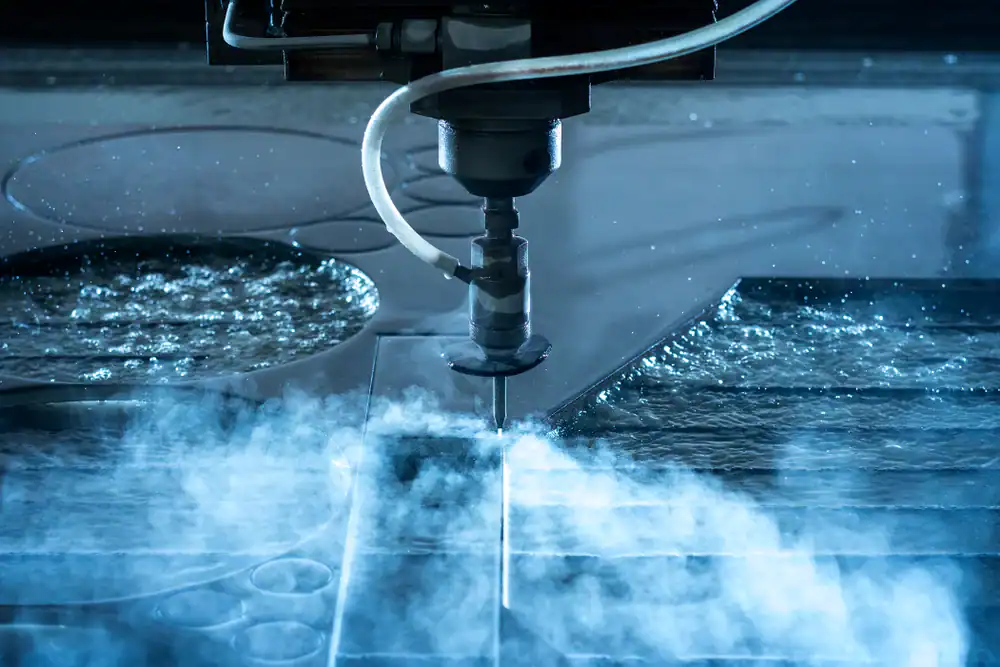
You’re looking at a design that requires curves, tight radii, or interior cutouts in glass. Scoring tools can’t do it. Laser cutting might work, but you’re risking micro-cracks from heat or watching laminated glass delaminate under thermal stress.
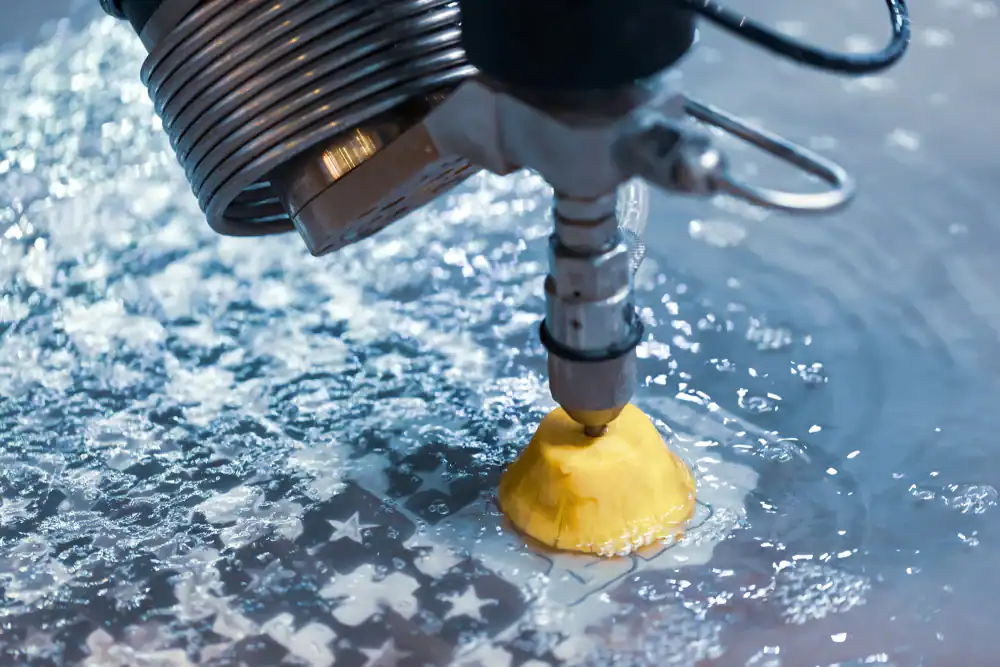
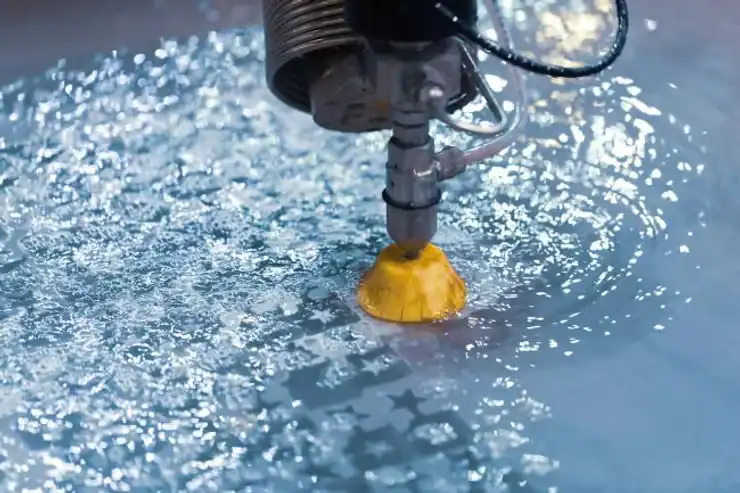
Waterjet cutting uses high-pressure water mixed with fine abrasive to cut through glass without generating heat. That means no thermal distortion, no internal stress fractures, and no burnt edges. The stream is thinner than a strand of spaghetti but cuts with enough force to handle everything from delicate 3mm decorative glass to 200mm thick architectural panels.
You get clean edges that often don’t need secondary finishing. You get complex geometries that would be impossible or prohibitively expensive with traditional methods. And you get higher success rates because the material isn’t fighting against heat or mechanical stress that causes it to crack mid-cut.
We operate out of West Islip and serve architects, contractors, and fabricators throughout Long Island, including Seaford, NY. We run CNC-controlled waterjet systems with dynamic taper compensation and precision motion control, which means your cuts stay square and accurate even on thicker materials.
Our team reviews every design file before it goes to the machine. We’re looking for potential issues like tight tolerances that might cause edge chipping or design elements that could create weak points in the glass. That review process catches problems early, before you’re dealing with scrap material and missed deadlines.
Seaford’s mix of residential renovations and commercial builds means we see everything from custom shower enclosures to architectural glass facades. We understand the local market and the timelines contractors are working against.
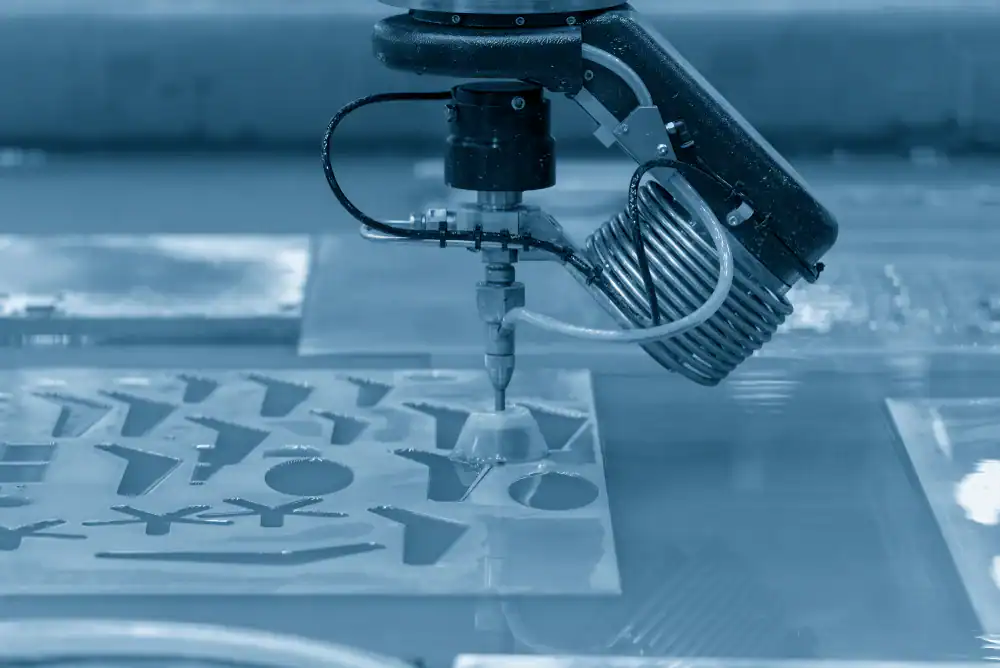
You send us your design file—DXF, DWG, or AI formats work. If you’re working from a sketch or template, we can help translate that into a cuttable file. Our design team reviews it for manufacturability, checking things like minimum feature sizes and edge distances that could cause issues during cutting.
Once the file is approved, it goes to our CNC waterjet system. The machine positions the cutting head using servo motors that move in increments of thousandths of an inch. High-pressure water (up to 60,000 PSI) mixed with garnet abrasive cuts through the glass in a continuous stream. The CNC programming controls speed, pressure, and head angle to maintain edge quality across the entire cut path.
For laminated or tempered glass, we adjust parameters to account for internal stresses and layer adhesion. The goal is a clean cut without delamination or fracturing. After cutting, we inspect dimensions and edge quality. Most parts come off the table ready to install—no grinding, no polishing, no secondary operations unless you specifically need them.
Ready to get started?
Precision cutting with tolerances between ±0.003″ and ±0.005″. That level of accuracy matters when you’re fitting glass into metal frames or matching multiple pieces in an installation. CNC control means repeatability—if you need ten identical pieces, they’ll actually be identical.
Material versatility across float glass, tempered glass, laminated safety glass, borosilicate, and decorative art glass. Thickness range from 3mm up to 200mm. The process works on materials that would crack under mechanical cutting or warp under laser heat.
Edge quality that’s smooth enough for most applications without additional finishing. You’re not dealing with the rough edges from scoring or the heat-affected zones from laser cutting. For architectural glass waterjet cutting in Seaford, NY, that translates to faster project timelines because you’re eliminating secondary operations.
Design flexibility for curves, angles, interior cutouts, and complex geometries. If you can draw it in CAD, we can cut it. That opens up options for custom architectural features, decorative installations, and specialty components that traditional glass cutting methods simply can’t produce. Seaford’s growing commercial corridor along Merrick Road has seen increased demand for custom glass storefronts and interior partitions—projects where design flexibility directly impacts the final aesthetic.
Tempered glass can’t be cut after the tempering process—it’s under too much internal stress and will shatter if you try. Any cutting or shaping has to happen before tempering. If you need tempered glass with custom shapes, we cut it first, then it goes to a tempering facility.
Laminated glass is a different story. It’s made of two or more layers of glass bonded with an interlayer (usually PVA or EVA). Traditional cutting methods often cause delamination where the layers separate at the cut edge. Waterjet cutting minimizes that risk because there’s no heat to soften the interlayer and no mechanical stress pulling the layers apart.
We adjust water pressure and cutting speed based on the laminate thickness and interlayer material. The abrasive stream cuts through all layers simultaneously, creating a clean edge with minimal delamination. You might see slight interlayer exposure at the cut edge, but it’s typically within acceptable limits for most applications. For exterior installations or anywhere moisture intrusion is a concern, edge sealing is recommended regardless of cutting method.
Laser cutting uses focused heat to melt or vaporize material. For metals and some plastics, that works well. For glass, it creates problems. The localized heating causes thermal stress, which can lead to micro-cracks that propagate over time. You’ll also see heat-affected zones where the material properties change near the cut edge.
Waterjet cutting is a cold process. No heat means no thermal stress and no micro-cracking. The abrasive stream mechanically erodes the material, which is actually how glass wants to be cut. You get cleaner edges and higher structural integrity in the finished piece.
Laser cutting is faster for thin materials and straight cuts, but it struggles with thicker glass and can’t handle the same range of materials. If you’re cutting borosilicate or art glass with varying densities, laser heat creates uneven stress patterns. Waterjet handles those materials without issue. The trade-off is speed—waterjet is slower—but for projects where edge quality and material integrity matter more than cycle time, it’s the better process.
Our systems can cut glass up to 200mm (about 8 inches) thick. Most architectural and industrial applications don’t require anything close to that—you’re typically looking at 6mm to 25mm for standard projects. But the capability is there for specialty applications like aquarium panels, blast-resistant glazing, or heavy industrial components.
Cutting thicker glass takes longer because the abrasive stream has to erode through more material. We also adjust the cutting parameters—higher pressure, slower traverse speed, sometimes multiple passes—to maintain edge quality through the full thickness. Thicker materials are more prone to taper, where the cut width at the bottom is slightly different from the top. Our systems use dynamic taper compensation to angle the cutting head and counteract that effect.
For residential glass cutting services in Seaford, NY, you’re usually dealing with thinner materials—shower doors, tabletops, decorative panels. Those cut faster and with tighter tolerances. But knowing the equipment can handle the thick stuff means you’re not limited if a project requires it.
CAD files are ideal because they eliminate interpretation errors. If you have a DXF, DWG, or AI file, send it over. We’ll import it directly into our CNC software and verify dimensions before cutting. That’s the most accurate path from design to finished part.
If you don’t have a CAD file, we can work from detailed measurements, sketches, or templates. You’ll need to provide exact dimensions, radii for any curves, and locations for holes or cutouts. Our design team can create a CAD file from that information, but there’s more room for miscommunication. We’ll send you a proof drawing to approve before cutting to make sure we’re interpreting everything correctly.
For simple shapes—rectangles with a few holes—measurements work fine. For complex geometries with multiple curves and angles, a CAD file saves time and reduces the risk of errors. If you’re working with an architect or designer, they can usually export a compatible file format from whatever software they’re using. If you’re a contractor without design software, give us a call and we’ll walk through what information we need to build the file on our end.
Cutting time depends on material thickness, design complexity, and edge quality requirements. A simple rectangular piece in 6mm glass might take 10-15 minutes. A complex architectural panel with multiple interior cutouts and curved edges in 19mm glass could take several hours.
Lead time from file submission to finished parts is typically 3-5 business days for standard projects. That includes design review, machine setup, cutting, and quality inspection. Rush jobs can often be accommodated if you’re on a tight deadline—we just need to know upfront so we can schedule accordingly.
For larger production runs or ongoing projects, we can discuss dedicated machine time to ensure consistent turnaround. Custom glass waterjet cutting in Seaford, NY often involves one-off architectural pieces or small-batch specialty components, so we’re set up to handle both quick-turn single parts and scheduled production work. If your timeline is the driving factor, let us know when you request a quote and we’ll tell you what’s realistic.
Float glass (standard window glass) cuts cleanly and is the most common material we work with. It’s available in various thicknesses and is cost-effective for most applications. Low-iron glass (sometimes called starphire or ultra-clear) cuts the same way but gives you better clarity for display cases or high-end architectural installations.
Laminated safety glass works well as long as you account for potential interlayer exposure at cut edges. Borosilicate (like Pyrex) is harder and more heat-resistant than float glass, but waterjet handles it without issue—you just cut slower. Art glass, stained glass, and decorative glass with varying densities or embedded materials can be tricky with other cutting methods, but waterjet’s cold process doesn’t create differential stress, so you get clean cuts without cracking.
Mirrored glass and coated glass (like low-E or tinted) cut fine, though you need to be careful with edge handling to avoid chipping the coating. Frosted or textured glass works as long as the texture doesn’t interfere with securing the material during cutting. The main limitation is tempered glass, which has to be cut before tempering. If you’re not sure whether your material is suitable, send us the specs and we’ll let you know what to expect.
Useful Links
Other Services we provide in Seaford