Hear from Our Customers
Your marble arrives at the job site and fits perfectly the first time. No grinding down edges that don’t line up. No explaining to your client why the inlay pattern is off by an eighth of an inch.
That’s what precision marble waterjet cutting in Massapequa Park, NY gets you—parts that match your CAD file exactly, edges that need minimal finishing, and complex curves that traditional saws can’t touch. When you’re working with expensive slabs, you can’t afford trial-and-error cutting or the material waste that comes with it.
The cold-cutting process means no thermal stress on the stone. Marble doesn’t get brittle edges or hidden microcracks that show up later. What you cut today installs clean tomorrow, whether it’s intricate backsplash patterns, radius countertops, or custom architectural elements that need to align across multiple pieces.
We run a Flow Mach 500 CNC system that reads your design files directly—DXF, DWG, STEP, IGES—and cuts them without interpretation errors. Our in-house design team reviews every file before it hits the cutting bed, catching issues that would cost you time and material if they made it to production.
We’ve been serving contractors, designers, and fabricators across Long Island and the greater NYC area with the kind of precision that architectural and commercial projects demand. Massapequa Park, NY sits in a market where high-end residential renovations and commercial builds expect flawless execution, and that’s exactly what CNC marble cutting delivers.
You’re not working with a shop that eyeballs measurements. You’re working with a facility that measures success in thousandths and has the equipment to back it up.
You send us your design file—whatever format your CAD software exports. Our design team opens it, checks for potential cutting issues, verifies dimensions, and confirms that what you’ve drawn can be cut the way you intend. If something looks off, we’ll flag it before we start.
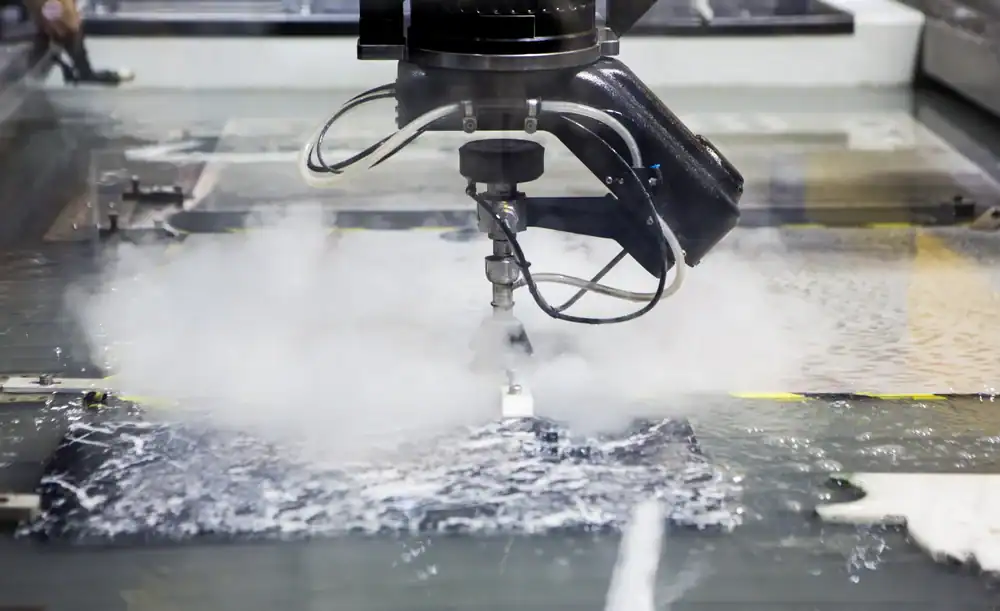
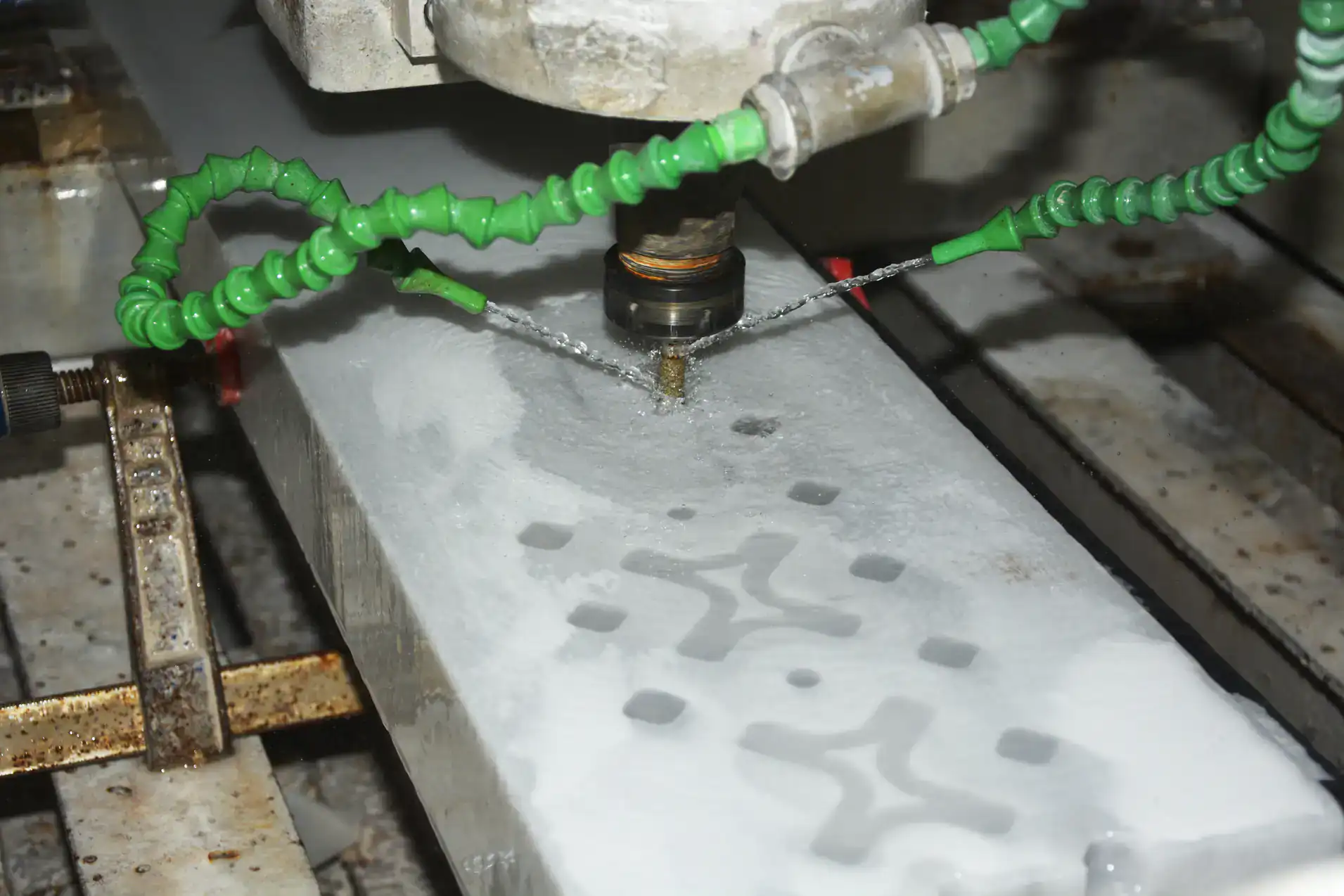
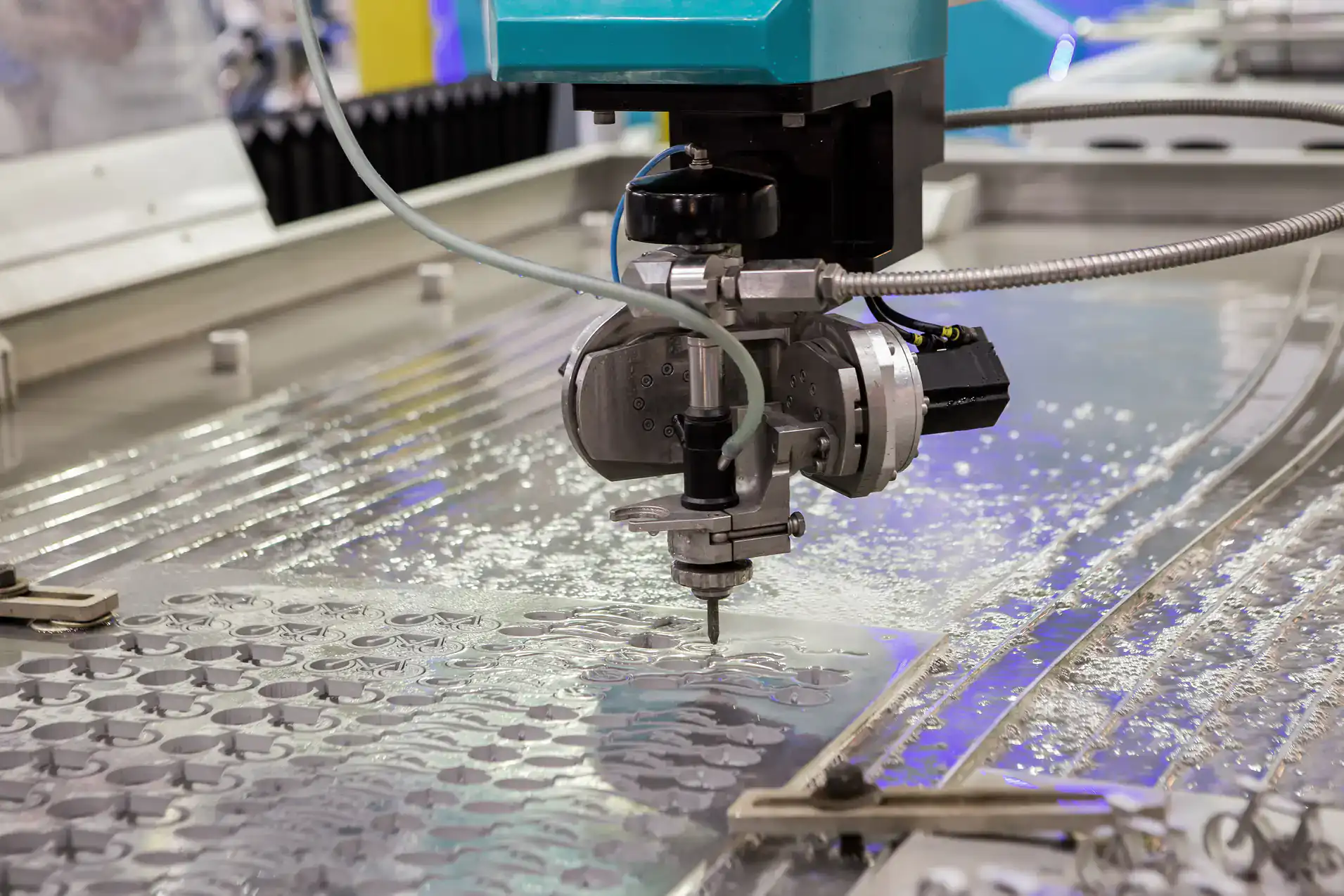
Once the file is approved, it goes directly to the CNC controller on our waterjet system. The machine follows your vectors exactly, using a high-pressure stream mixed with abrasive garnet to cut through marble without generating heat. There’s no blade friction, no thermal expansion, no risk of cracking from stress.
The cutting head moves in precise paths controlled by the computer, maintaining consistent pressure and speed. Complex curves, tight inside corners, intricate inlays—it all gets cut in one setup without repositioning the material or changing tools. When the cut is complete, you get parts with smooth edges that require minimal finishing and dimensions that match your file within five-thousandths of an inch.
Ready to get started?
Custom marble cutting with waterjet technology handles the jobs that traditional fabrication can’t—radius edges for curved countertops, medallion inlays with multiple pieces that need to fit together perfectly, decorative wall panels with repeating patterns, and architectural elements where every piece needs to align across large installations.
The Long Island market, especially around Massapequa Park, NY, has seen a significant uptick in luxury residential projects and commercial renovations that demand statement marble features. Designers are specifying bold veining patterns and complex geometric layouts that require cutting precision you can’t achieve with a bridge saw.
Industrial marble waterjet cutting gives you the capability to execute those designs without the material waste that comes from trial cuts and adjustments. The narrow kerf width—the amount of material removed during cutting—means you maximize yield from expensive slabs. When you’re working with book-matched marble or rare stone, that efficiency translates directly to cost savings. You also get faster turnaround on complex patterns because the CNC system doesn’t need constant operator intervention or tool changes between different cut types.
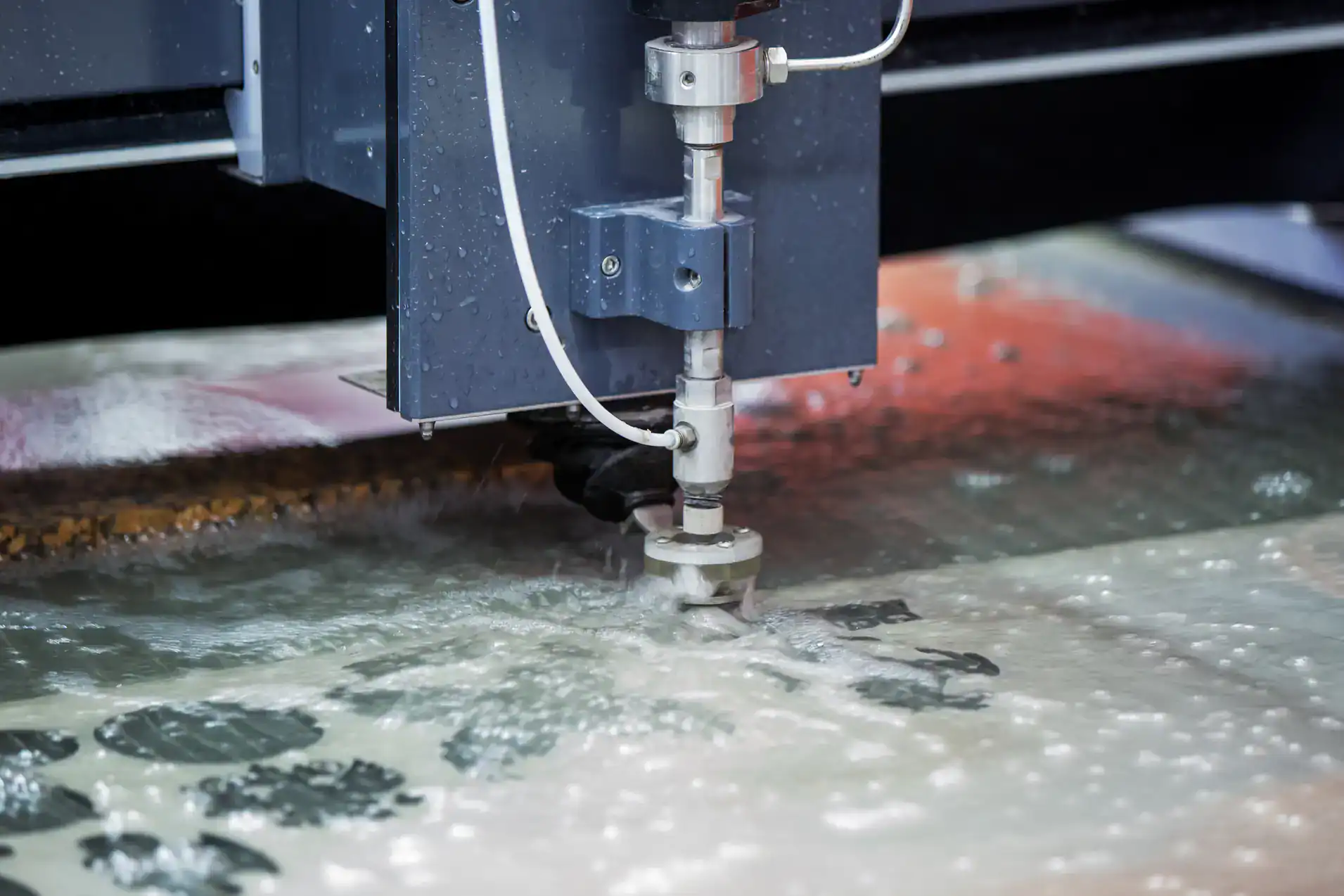
Waterjet cutting maintains tolerances of ±0.005 inches, which is five-thousandths of an inch. To put that in perspective, a sheet of standard printer paper is about four-thousandths thick. That level of precision means parts fit together exactly as designed, with no gaps or misalignments when you’re doing inlay work or multi-piece installations.
Traditional bridge saws and hand-guided tools rely on operator skill and have much wider tolerance ranges—usually closer to ±0.030 inches or more, depending on the material and complexity of the cut. That difference becomes critical when you’re cutting multiple pieces that need to align perfectly, like a geometric backsplash pattern or a radius countertop edge that meets a straight section.
The CNC control on waterjet systems eliminates human error in the cutting path. Once your design file is loaded, the machine follows it exactly, every single time. You get consistent results across multiple pieces, which is essential for large-scale projects where you need dozens or hundreds of identical cuts.
No. Waterjet cutting is a cold-cutting process that doesn’t generate heat, which means there’s no thermal stress on the marble. Traditional cutting methods like saws create friction, and that friction produces heat that can cause microcracks or weaken the stone’s structure, especially along natural veining where the material is already less uniform.
When marble heats up and cools down rapidly during cutting, it expands and contracts. That thermal cycling can create internal stress fractures that aren’t visible immediately but can lead to cracking later, particularly during installation or when the stone is subjected to temperature changes in its final location. Waterjet cutting eliminates that risk entirely.
The high-pressure water stream mixed with abrasive garnet erodes the material rather than cutting it with a blade. There’s no physical force pushing against the stone that could cause it to fracture, and the cutting process doesn’t alter the marble’s natural properties. What you get is a clean cut with smooth edges and no structural compromise to the material.
We work with DXF, DWG, STEP, and IGES files—the standard formats that most CAD and design software can export. If you’re working in AutoCAD, SolidWorks, Rhino, or similar programs, you can send us your design directly without needing to convert it to a different format.
The key is that the file needs to be vector-based, not a raster image like a JPG or PNG. Vector files contain the actual geometric paths that the CNC system follows, with precise coordinates for every line and curve. If you only have a sketch or a photo of what you want, our design team can help convert that into a cuttable file, but it’s faster and more accurate if you can provide a CAD drawing.
Before we cut anything, our team reviews the file to make sure the design is optimized for waterjet cutting. Sometimes designs that look good on screen have issues when translated to actual cutting—like lines that are too close together, corners that are too tight for the cutting head to navigate, or dimensions that don’t account for the kerf width. We catch those problems upfront and work with you to adjust the design before it goes to production.
Waterjet cutting typically reduces material waste by 25-30% compared to traditional cutting methods. The kerf width—the amount of material removed during the cut—is only about 0.040 inches, which is roughly the thickness of a credit card. Traditional saws have much wider kerfs, often 0.125 inches or more, which means more material turns into dust with every cut.
That difference adds up quickly when you’re doing complex layouts or trying to maximize the number of pieces you can get from a single slab. With waterjet cutting, you can nest parts closer together and make more efficient use of the available material. When you’re working with expensive marble, especially rare or book-matched slabs, that efficiency translates directly to cost savings.
The precision of CNC cutting also means fewer mistakes that result in scrapped pieces. Traditional methods require test cuts and adjustments, and every failed attempt wastes material. With waterjet cutting, the first cut is the final cut—no trial and error, no do-overs. You get exactly what you designed, cut correctly the first time, with minimal offcut waste.
Yes. Waterjet systems can cut marble up to six inches thick or more, depending on the specific equipment and material hardness. The cutting process doesn’t change based on thickness—you don’t need different tools or setups. The system simply adjusts the cutting speed to maintain the same precision whether you’re cutting half-inch tile or three-inch countertop slabs.
Complex shapes are where waterjet cutting really outperforms traditional methods. If you can draw it in CAD, we can cut it. Tight inside corners, intricate curves, detailed inlay patterns, cutouts for fixtures—all of it gets handled in a single setup without repositioning the material or switching between different cutting tools. Traditional saws can only make straight cuts or simple curves, and anything more complex requires multiple setups, hand finishing, or specialized tooling.
The CNC control means the cutting head follows your design path exactly, no matter how complicated. A geometric pattern with dozens of angles and curves takes the same level of precision as a simple rectangle. That capability opens up design possibilities that aren’t practical with conventional fabrication methods, especially for architectural projects where you want statement pieces that stand out.
Cutting time depends on the complexity of the design and the thickness of the material, but waterjet cutting is typically 40% faster than traditional methods for complex patterns. A simple rectangular countertop cutout might take 20-30 minutes. An intricate backsplash pattern with multiple pieces and detailed curves could take several hours. Thick slabs cut slower than thin ones because the waterjet stream needs more time to penetrate the material.
The real time savings comes from eliminating secondary operations. Traditional cutting methods often require extensive hand finishing, grinding, and polishing to smooth rough edges and correct imperfections. Waterjet cutting produces edges that are smooth enough to use with minimal finishing, which cuts down on labor time significantly. You’re not spending hours with grinders and sanders trying to fix rough cuts.
Turnaround time from when you submit your file to when your parts are ready typically runs a few days to a week, depending on our production schedule and the scope of your project. Rush jobs can often be accommodated if you’re on a tight timeline. The key factor is file preparation—if your design is ready to cut without modifications, the process moves faster. That’s why our design team reviews every file upfront, so we’re not discovering issues halfway through production that delay your project.
Useful Links
Other Services we provide in Massapequa Park