
Hear from Our Customers
You’re specifying marble for a reason. The veining matters. The pattern alignment matters. The edge quality absolutely matters when you’re installing high-end residential countertops or commercial lobby floors that need to look flawless under scrutiny.
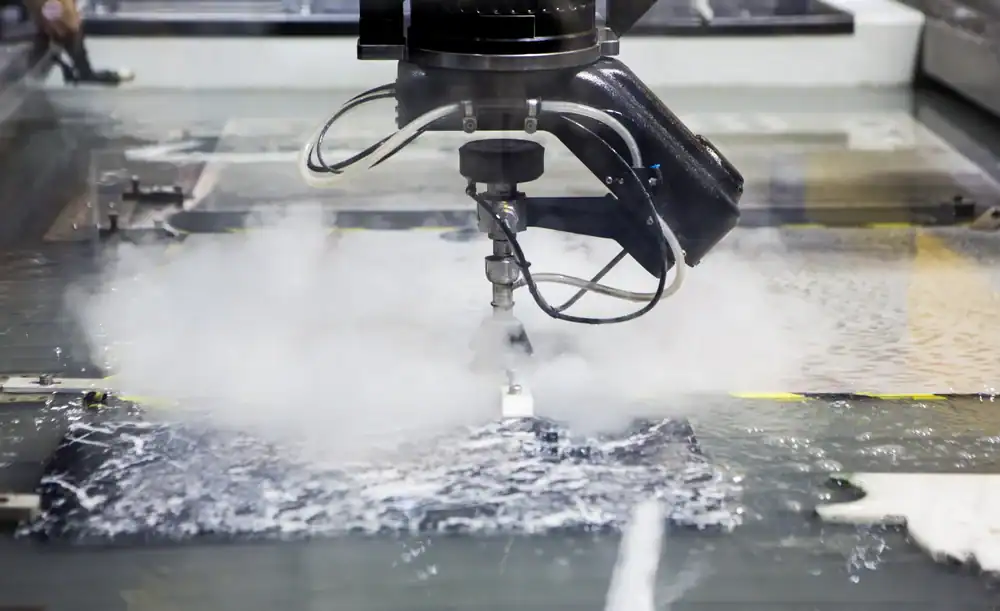
Traditional cutting methods generate heat. That heat creates microfractures you might not see immediately, but your client will notice when the marble chips six months later. Waterjet cutting uses high-pressure water and natural abrasive to cut through marble without generating any heat, which means zero thermal stress and zero compromise to the stone’s structural integrity.
The CNC control gives you repeatable accuracy across multiple pieces. If you’re doing a large installation with geometric patterns or custom inlays, every piece cuts identically. No hand-measuring. No human error. No surprises during installation when pieces don’t line up.
You also get better material utilization. Precision nesting means less waste, which directly impacts your project budget. The cuts are clean enough that you’re spending less time on edge finishing, which speeds up your timeline from fabrication to installation.
We’ve been serving architects, designers, and contractors throughout Port Washington, NY and the surrounding tri-state area with precision cutting services that match the technical demands of high-end projects. We run state-of-the-art OMAX waterjet systems operated by experienced machinists who understand material behavior and project timelines.
Port Washington’s architectural landscape includes everything from historic waterfront properties to modern commercial developments. That diversity means we’ve cut marble for residential kitchen renovations, corporate office lobbies, retail installations, and custom artistic commissions. We’ve worked with brands that can’t afford mistakes, and we’ve delivered on projects where tolerances weren’t negotiable.
We’re not the cheapest option, and that’s intentional. You’re paying for equipment that’s calibrated correctly, operators who know how to program complex cuts, and a process that doesn’t leave you scrambling when pieces arrive damaged or dimensionally incorrect.
You send us your design file—DXF, DWG, or whatever CAD format you’re working in. If you’re still sketching concepts, we can consult on design feasibility and help optimize patterns for cutting efficiency and material usage.
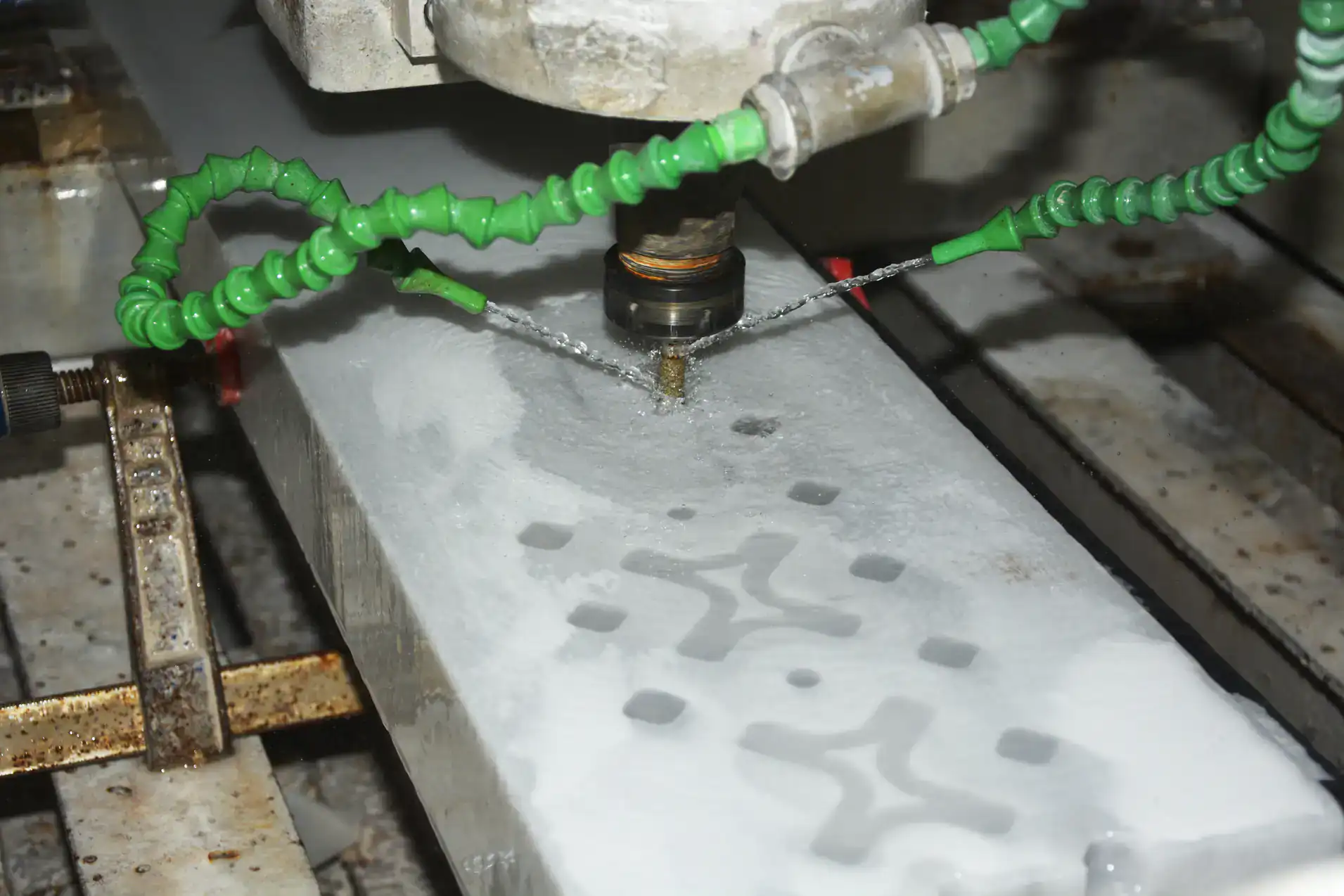
We program the cut path into our CNC system, accounting for material thickness, edge quality requirements, and any specific tolerances your project demands. The waterjet operates at pressures up to 60,000 PSI, mixing water with garnet abrasive to cut through marble cleanly. There’s no blade contact, no vibration, and no heat generation.
For complex projects, we can cut multiple layers simultaneously, which increases production speed without sacrificing consistency. The system monitors cut quality in real-time, adjusting pressure and speed as needed to maintain edge integrity across the entire piece.
Once cutting is complete, pieces come off the table with smooth edges that require minimal finishing. Depending on your specifications, we can deliver pieces ready for installation or coordinate with your fabricator for any additional edge profiling or polishing your project requires.
Ready to get started?
Custom marble waterjet cutting in Port Washington, NY means you’re getting cuts that accommodate straight lines, curves, inside corners, and intricate geometric patterns that would be nearly impossible with traditional methods. We handle everything from simple rectangular cuts for countertops to complex medallions and artistic inlays with multiple interlocking pieces.
The process works for various marble types—Carrara, Calacatta, Emperador, Statuario—without adjusting technique based on hardness or veining patterns. You’re not limited by material characteristics the way you would be with saw cutting or routing.
Port Washington’s proximity to New York City means many of our clients are working on projects with aggressive timelines and high visibility. We’ve cut marble for luxury residential renovations in Sands Point, commercial installations in Great Neck, and custom architectural elements for projects throughout Nassau County. The local market demands quality that holds up under scrutiny, and waterjet cutting delivers that consistency.
You also get environmental advantages. The process uses only water and natural garnet abrasive—no chemicals, no coolants, no toxic runoff. For projects pursuing LEED certification or other sustainability benchmarks, that matters. The water recirculates through filtration systems, and the garnet abrasive is inert and disposable without special handling.
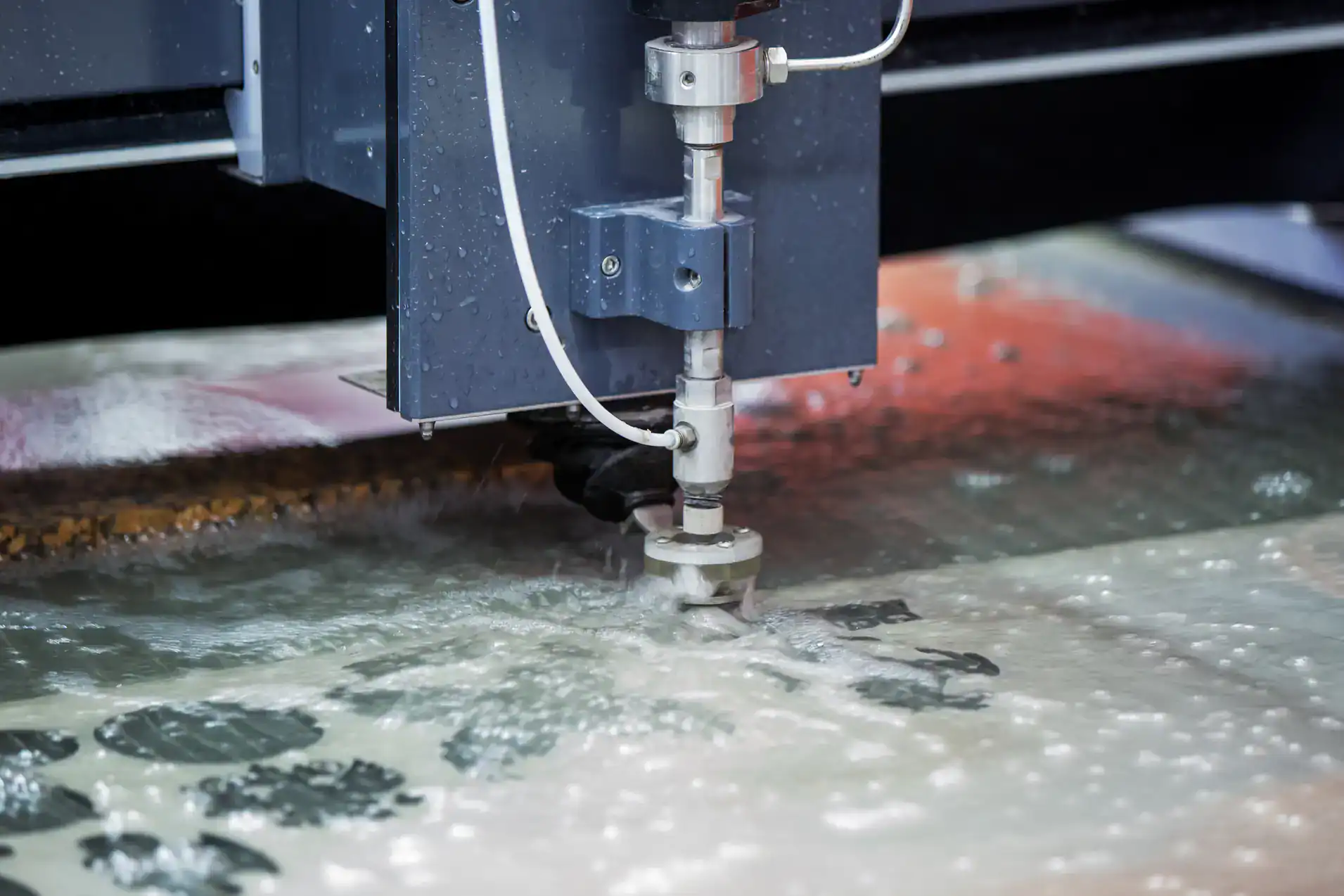
Marble chips and cracks during traditional cutting because of two factors: vibration and heat. Saw blades create both. The blade’s rotation generates vibration that travels through the stone, and friction creates heat that causes thermal expansion. Marble doesn’t handle either well, especially if there are natural fissures or veining patterns that create weak points.
Waterjet cutting eliminates both problems. There’s no physical contact between a blade and the stone, so there’s zero vibration. The water stream is doing the cutting, and water doesn’t generate heat—it actually keeps the material cool throughout the entire process.
The abrasive garnet particles mixed into the water stream do the actual material removal, but they’re hitting the stone at such high velocity and in such small quantities that there’s no impact force large enough to cause structural damage. You get a clean cut edge without the microfractures that lead to chipping later.
This matters most when you’re working with expensive marble or irreplaceable slabs where you can’t afford to lose material to damage. One ruined piece on a traditional saw can cost more than the entire waterjet cutting service.
Turnaround depends on design complexity and project size, but most custom marble waterjet cutting projects in Port Washington, NY are completed within 3-5 business days from file approval to finished pieces ready for pickup or delivery.
Simple cuts—straight lines, basic shapes, standard countertop dimensions—can often be completed in 1-2 days. Complex designs with intricate patterns, multiple interlocking pieces, or tight tolerance requirements take longer because programming and cutting require more precision and machine time.
The biggest variable is usually on your end: how quickly you can finalize the design file and approve the cut plan. Once we have a clean CAD file and confirmed specifications, the actual cutting process moves quickly. Unlike traditional methods that require multiple setups, tool changes, and finishing passes, waterjet cutting completes the entire cut in one operation.
If you’re working against a hard deadline, let us know upfront. We can often accommodate rush projects by adjusting our production schedule, though that may involve expedite fees depending on how much we need to shift other work.
Yes. Our waterjet systems cut marble up to 6 inches thick without any loss in precision or edge quality. Most residential countertops use 2cm or 3cm slabs, which are well within the easy range for waterjet cutting.
Thicker material takes longer to cut because the water stream needs more time to penetrate through the full depth, but the process remains consistent. You’re not dealing with blade depth limitations or multiple passes from different angles. The waterjet goes straight through in one continuous cut.
For thick slabs, edge quality actually improves compared to traditional methods. Saw blades can leave different finish characteristics at different depths as the blade wears or heats up during the cut. Waterjet cutting maintains the same edge quality from the top surface all the way through to the bottom, which means less hand-finishing work after cutting.
If you’re doing waterfall edge countertops or other installations where the cut edge will be visible, waterjet cutting gives you a cleaner starting point for polishing. The edge comes off the machine smooth enough that you’re only doing finish polishing, not trying to remove saw marks or repair chipped corners.
Waterjet cutting holds tolerances down to 0.005 inches, which is tight enough for intricate inlay work where pieces need to fit together with minimal gaps. For reference, that’s about the thickness of two sheets of paper.
This level of precision matters when you’re creating geometric patterns, custom medallions, or artistic designs where visual alignment is critical. If pieces don’t fit together accurately, you see gaps, misalignment, or pattern distortion that ruins the aesthetic you’re trying to achieve.
The CNC control ensures repeatability. If you’re creating a pattern that repeats across a large floor installation or multiple countertop sections, every piece cuts identically. You’re not dealing with accumulated error from hand-measuring or slight variations in saw blade positioning.
For complex inlays with multiple marble types or colors, we can program the entire pattern as one job and cut all pieces in sequence. This ensures that pieces designed to fit together actually do fit together, because they’re all cut using the same reference points and dimensional accuracy. You spend less time on-site trying to make pieces work and more time on actual installation.
Yes, and it’s actually better than traditional cutting methods for marble with challenging characteristics. Heavy veining and natural fissures create weak points in the stone that are prone to cracking when subjected to vibration or uneven pressure from saw blades.
Waterjet cutting doesn’t create those stress points. The water stream applies consistent pressure across the entire cut line without vibration, which means the stone isn’t being stressed in ways that would exploit existing weaknesses. Veining patterns don’t affect cut quality or accuracy.
This gives you more freedom in how you orient the marble. Instead of having to plan cuts around veining to avoid breakage, you can orient the slab based on aesthetic considerations—how you want the veining to flow visually in the finished installation. That’s especially valuable when you’re working with book-matched slabs or trying to achieve specific visual effects with natural patterns.
For marble with visible fissures, we can often cut successfully where traditional methods would fail. The key is that we’re not applying mechanical force that would pry the fissure open. The water stream removes material without creating lateral stress, so even marble with cosmetic fissures can be cut cleanly as long as the stone is structurally sound enough for its intended application.
Waterjet cutting typically costs more per linear foot than traditional saw cutting, but that’s not the full picture. You need to factor in material waste, labor time for edge finishing, and the risk of damaged pieces that need to be recut.
Traditional cutting generates more waste because tolerances aren’t as tight and you often need to leave extra material for hand-finishing. If you’re working with expensive marble, that waste adds up quickly. Waterjet cutting’s precision means you’re using material more efficiently, which can offset the higher cutting cost.
Edge finishing time is significantly reduced. Saw-cut edges need grinding, smoothing, and polishing to remove blade marks and achieve the finish quality you need. Waterjet-cut edges come off the machine smooth enough that you’re only doing final polishing, not corrective work. That’s less labor time and faster project completion.
The biggest cost consideration is risk. If a piece cracks during traditional cutting, you’re paying for replacement material and the time to recut. With waterjet cutting, the failure rate is dramatically lower because there’s no heat or vibration causing damage. For high-value projects where you can’t afford delays or material loss, that reliability is worth the premium.
Useful Links
Other Services we provide in Port Washington