Hear from Our Customers
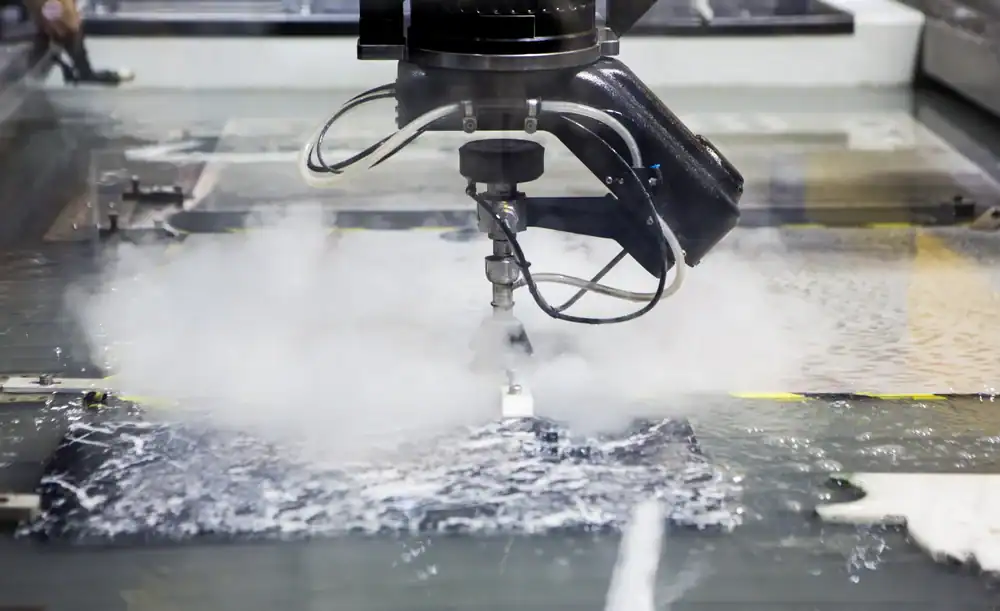
When you’re working with expensive marble slabs, you can’t afford mistakes. Traditional cutting methods generate heat that can crack the stone, create rough edges that need hours of polishing, and waste material you’ve already paid for.
Waterjet cutting changes that. The process uses high-pressure water mixed with fine abrasive to cut through marble without generating any heat. That means no thermal stress, no micro-cracks, and no discoloration along the cut line.
You get edges smooth enough that they often don’t need additional finishing. You get curves, inlays, and complex patterns that would be impossible with a blade. And you get it done faster because there’s no secondary polishing or edge work eating into your timeline.
For architects specifying custom marble installations in Wantagh, NY, or contractors managing high-end residential projects across Long Island, this matters. Your material costs drop because waste drops. Your labor costs drop because finishing work drops. Your client gets exactly what they approved in the design phase.
We serve architects, designers, contractors, and fabricators throughout Wantagh, NY and the surrounding Long Island area. We run CNC-controlled waterjet systems that handle everything from simple countertop cutouts to intricate inlay patterns and custom architectural features.
Long Island’s design community has high standards. The residential market here expects luxury finishes, and commercial projects demand precision that holds up under scrutiny. We’ve built our reputation on delivering both.
When you send us your CAD file or template, you’re working with a team that understands marble’s properties, knows how to optimize cuts for minimal waste, and has the equipment to hold tolerances that matter. We’re not a general fabrication shop that happens to own a waterjet. This is what we do.
You start by sending us your design file or template. If you’re working from a hand drawing or concept sketch, we can convert that into a CAD file that our CNC system can read. We’ll review the design with you to confirm dimensions, discuss any tight tolerances, and flag anything that might affect the cut quality or material usage.
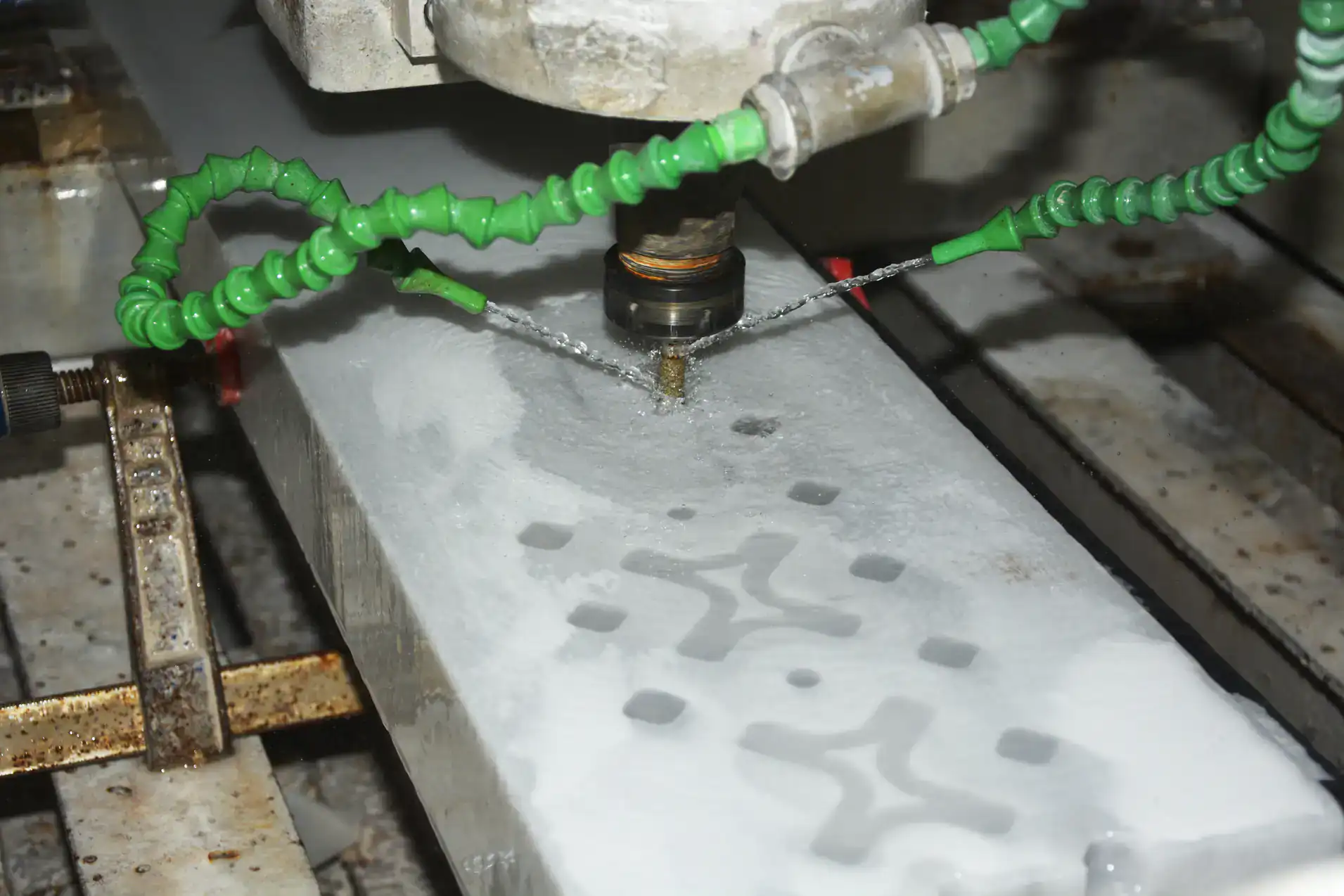
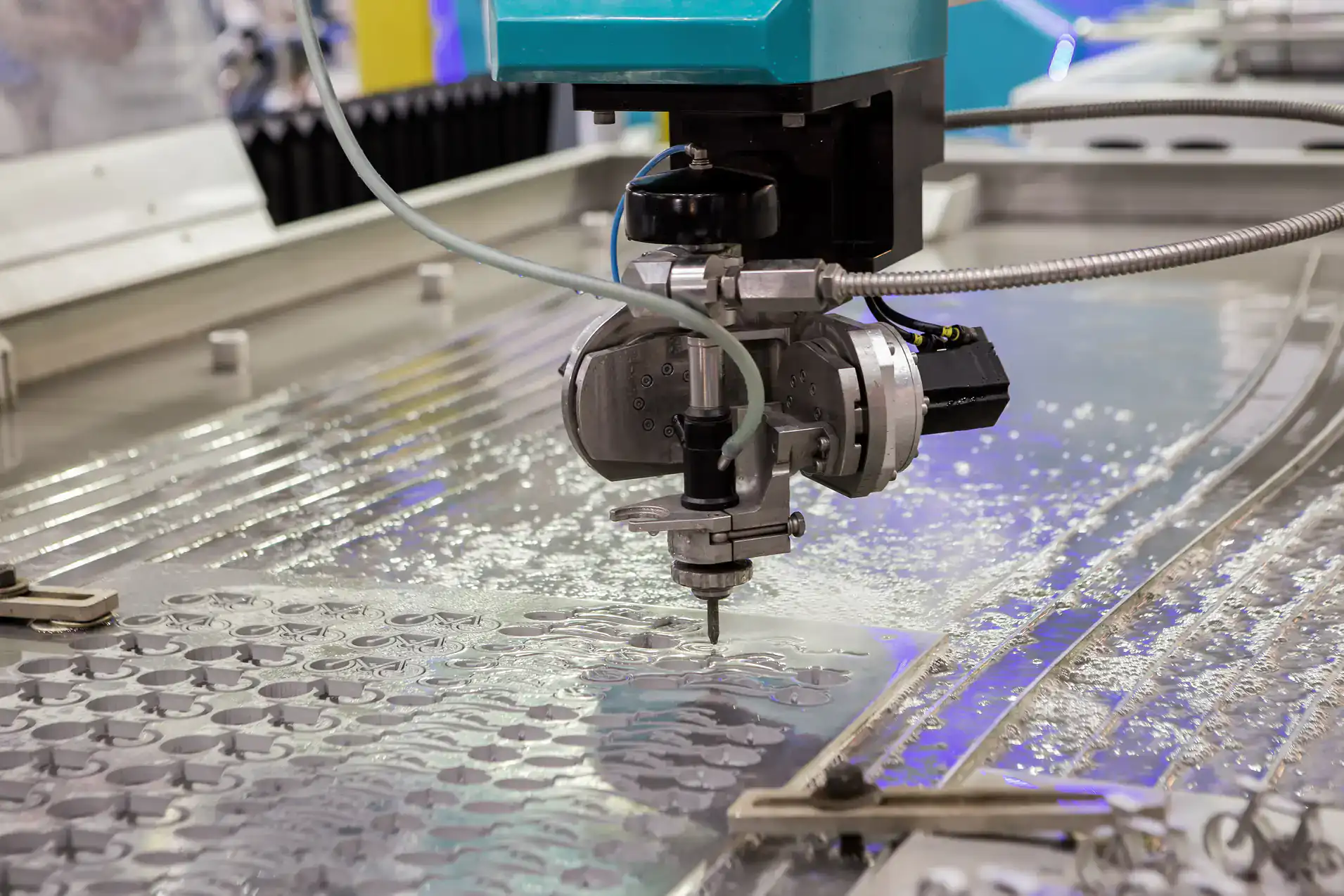
Once the file is programmed, your marble slab goes onto the cutting table. The waterjet head follows the programmed path, cutting through the stone with a stream of water and garnet abrasive. The pressure is high enough to cut through any thickness of marble, but there’s no blade contact and no heat generation.
The cutting speed depends on the thickness of your material and the complexity of the pattern. Simple straight cuts move faster. Intricate curves and detailed inlays take more time because the system slows down to maintain precision through direction changes.
After cutting, most pieces come off the table ready to install. If you need additional edge profiling or surface finishing, that happens next. But in many cases, the waterjet edge is clean enough to use as-is, especially for pieces that will be grouted or joined.
Ready to get started?
You get cuts accurate to within 0.005 inches. That level of precision means your inlays fit without gaps, your mitered edges align perfectly, and your patterns line up across multiple pieces.
You get clean edges that preserve the marble’s natural finish. Because there’s no heat and no mechanical stress from a spinning blade, the stone’s surface stays intact right up to the cut line. You’re not dealing with chips, micro-cracks, or discoloration that need to be ground away.
You get flexibility in design that traditional methods can’t match. Waterjet handles tight inside corners, gradual curves, and intricate patterns without changing tools or setups. If you can draw it in CAD, we can cut it in marble.
For projects in Wantagh, NY and across Nassau County, this matters because the local market expects high-end results. Waterfront properties, luxury renovations, and commercial lobbies all demand marble work that looks flawless. Waterjet cutting delivers that without the compromises you’d face with saw cutting or CNC routing.
You also get better material utilization. We can nest multiple pieces on a single slab, position cuts to avoid natural veining or flaws, and minimize the waste strip between parts. That directly reduces your material cost, which matters when you’re working with premium marble varieties.
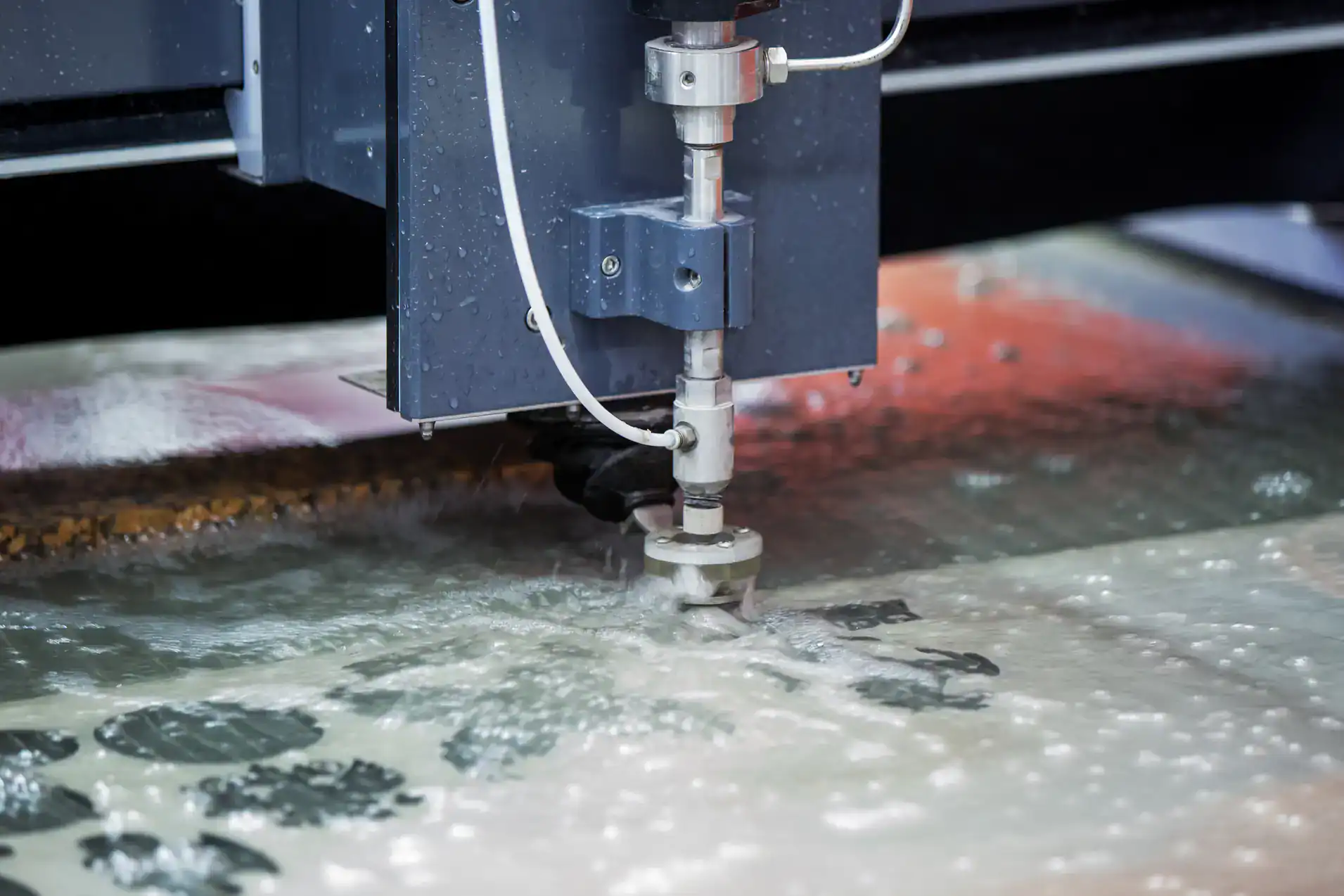
Traditional marble cutting uses diamond blades that generate friction and heat. That heat creates thermal stress in the stone, which can cause micro-cracks, discoloration along the cut line, and sometimes catastrophic cracking in thin or fragile pieces.
Waterjet cutting uses high-pressure water and abrasive with no blade contact. There’s no heat generation, which means no thermal stress and no risk of heat-related damage. The stone’s properties stay unchanged right up to the cut edge.
The edge quality is also different. Blade cutting typically leaves a rough surface that needs grinding and polishing. Waterjet produces a smooth, almost polished edge in a single pass. Depending on your application, you might not need any additional edge finishing.
For complex shapes, traditional methods require multiple setups, tool changes, and often hand-finishing to achieve curves or intricate patterns. Waterjet handles all of that in one continuous cut, following your CAD file exactly. You get faster turnaround and more design flexibility without compromising accuracy.
Waterjet cuts through any thickness of marble without limitation. Whether you’re working with standard 2cm or 3cm slabs, or custom-cut thick blocks for architectural features, the process stays the same. The cutting speed adjusts based on thickness, but the capability doesn’t change.
Complex patterns are where waterjet really separates itself from other methods. The CNC-controlled cutting head follows your programmed path with consistent accuracy, whether that’s a simple rectangle or an intricate medallion design with dozens of curves and inside corners.
You can cut patterns that would be impossible with traditional tools. Tight inside radiuses, gradual curves that change direction smoothly, and detailed inlays all happen in a single setup. There’s no tool changing, no repositioning, and no accumulated error from multiple operations.
For custom marble waterjet cutting in Wantagh, NY, this capability matters because high-end projects often require unique designs. You’re not limited to what’s available in standard templates. If your architect or designer can draw it, we can cut it accurately in marble.
Turnaround depends on the complexity of your cuts and our current production schedule. Simple cuts like countertop edges or basic shapes typically take a few days from file approval to finished pieces. Complex patterns with intricate details take longer because the cutting head moves more slowly through direction changes to maintain precision.
The actual cutting time is often faster than you’d expect. Waterjet processes material roughly 40% quicker than traditional methods for complex patterns because there’s no tool changing, no multiple setups, and no secondary finishing in most cases. What takes hours with blade cutting and hand-finishing might take minutes on the waterjet.
Lead time also depends on whether we’re cutting your material or you’re providing the slabs. If we’re sourcing the marble, add time for material selection and delivery. If you’re supplying the slabs, we can typically start cutting within a few days of receiving them and approving the cut files.
For projects in Wantagh, NY with tight deadlines, talk to us early. We can often accommodate rush jobs if we know about them in advance, and we’ll give you a realistic timeline based on your specific requirements rather than a generic estimate.
Waterjet cutting typically reduces material waste by 15-25% compared to traditional methods. The cutting stream is only about 0.04 inches wide, which means minimal material loss along each cut line. Compare that to a diamond blade that might be 0.125 inches wide or more, and the savings add up quickly on projects with multiple cuts.
We can also nest parts more efficiently. The CNC system lets us position pieces close together, rotate them to fit more on a single slab, and work around natural flaws or veining patterns you want to avoid. That optimization isn’t always possible with manual cutting methods.
For expensive marble varieties, this waste reduction directly impacts your project cost. If you’re working with premium stone at $80-150 per square foot, saving even a few square feet per slab makes a meaningful difference in your material budget.
The precision of waterjet also means fewer rejected pieces. When cuts are accurate the first time, you’re not reordering material to replace parts that didn’t fit correctly. That’s another hidden source of waste that waterjet cutting eliminates through consistent accuracy.
In many applications, waterjet-cut edges are smooth enough to use without additional finishing. The fine abrasive stream produces a surface that’s significantly smoother than blade-cut edges, often with a slightly matte finish that’s acceptable for pieces that will be grouted, joined, or otherwise concealed.
For exposed edges where you want a polished finish to match the marble’s surface, additional edge profiling is straightforward. Because the waterjet edge is already smooth and uniform, the polishing process is faster and requires less material removal than finishing a rough blade-cut edge.
The decision depends on your specific application and aesthetic requirements. Countertop edges that will be visible typically get polished. Inlay pieces that fit into recesses might not need any finishing. Tile edges that will be grouted are usually fine as-cut.
We can discuss edge finishing requirements when we review your project. If you need polished edges, we can handle that after cutting or coordinate with your fabricator. The key advantage is that you’re starting with a much better edge than traditional cutting methods produce, which saves time and labor regardless of the final finish you choose.
We work with standard CAD formats including DXF, DWG, and AI files. These vector-based formats give us the precise dimensions and geometry we need to program the CNC waterjet system accurately. If you’re working with an architect or designer, they can typically export these formats directly from their design software.
If you don’t have CAD files, we can work with accurate templates, detailed drawings with dimensions, or even photos and sketches for simpler projects. We’ll convert those into CAD files for cutting, though there’s more opportunity for interpretation errors, so we’ll review the converted file with you before cutting.
For complex patterns or custom designs, the more detail you can provide upfront, the better. Call out any critical dimensions, specify which edges need to be precise versus which have tolerance, and flag any areas where the marble’s natural veining should be oriented a certain way.
Once we have your file, we’ll review it for any potential issues like corners that are too tight for the cutting stream width, dimensions that don’t match standard material sizes, or features that might be fragile in marble. That review catches problems before cutting starts, which saves time and material.
Useful Links
Other Services we provide in Wantagh