Hear from Our Customers
You need parts that fit. Not almost. Not close enough. Actually fit.
Waterjet cutting metal in Bellmore, NY means your aluminum panels, steel brackets, or titanium components come out with smooth edges and tight tolerances. No burn marks. No warping from heat. No secondary grinding to clean up sloppy cuts.
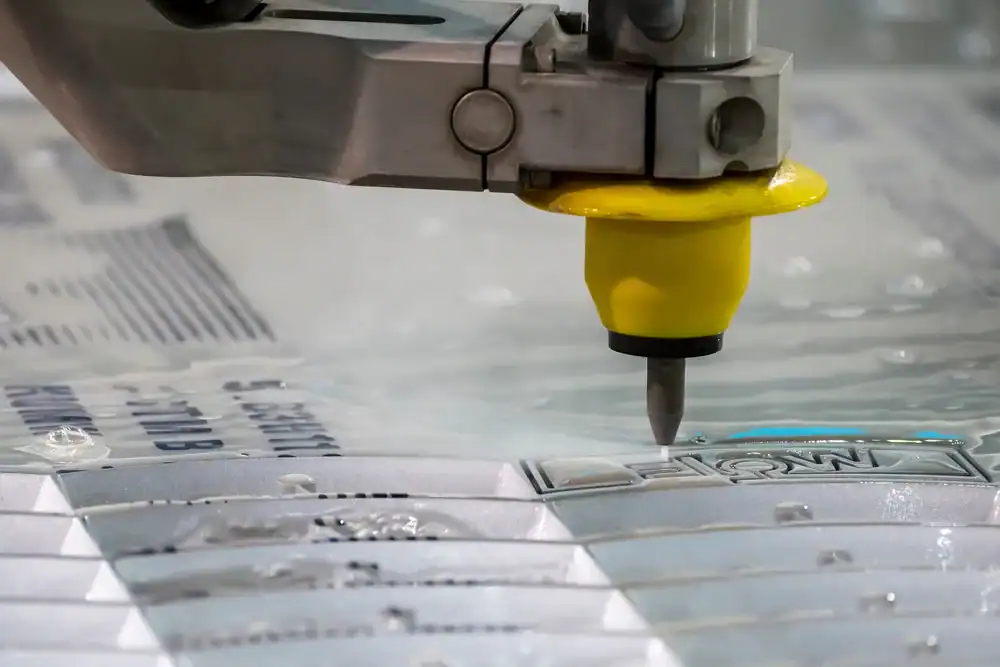
The process uses high-pressure water mixed with abrasive garnet to slice through material without generating heat. That means your metal’s structural integrity stays intact. Hardness doesn’t change. Dimensions hold. Complex geometries with sharp internal corners come out clean.
You send us a DXF or DWG file. Our design team reviews it before we cut anything. If there’s an issue with your design that’ll cause problems during fabrication or assembly, we catch it early. That review step alone saves you from scrapping expensive material or discovering fit issues on the job site.
This is what custom metal waterjet cutting looks like when it’s done right. Parts arrive ready to use, not ready for more work.
Tri-State Waterjet has been serving manufacturers, fabricators, and architects across Nassau and Suffolk counties for over six decades. We’re not new to this.
Our shop in Bellmore handles everything from one-off prototypes to production runs. We’ve cut components for companies like Metfab Metals, American Aluminum Company, and projects for Ralph Lauren and Coach. The work gets done here, locally, with fast turnaround times that matter when you’re on a deadline.
You’re working with people who understand what happens when a part doesn’t fit or a cut comes back rough. We built our process around preventing those problems before they cost you time and money.
You send us your design file. DXF and DWG formats work best, but we can also work with STEP or IGES files and extract the 2D profiles we need.
Our design team reviews your file before it goes to the cutting table. We’re checking for potential issues: tolerances that are too tight for the material thickness, internal radii that won’t work with the cutting stream width, or features that might cause problems during nesting. If we spot something, we’ll call you. Better to fix it now than after we’ve cut your material.
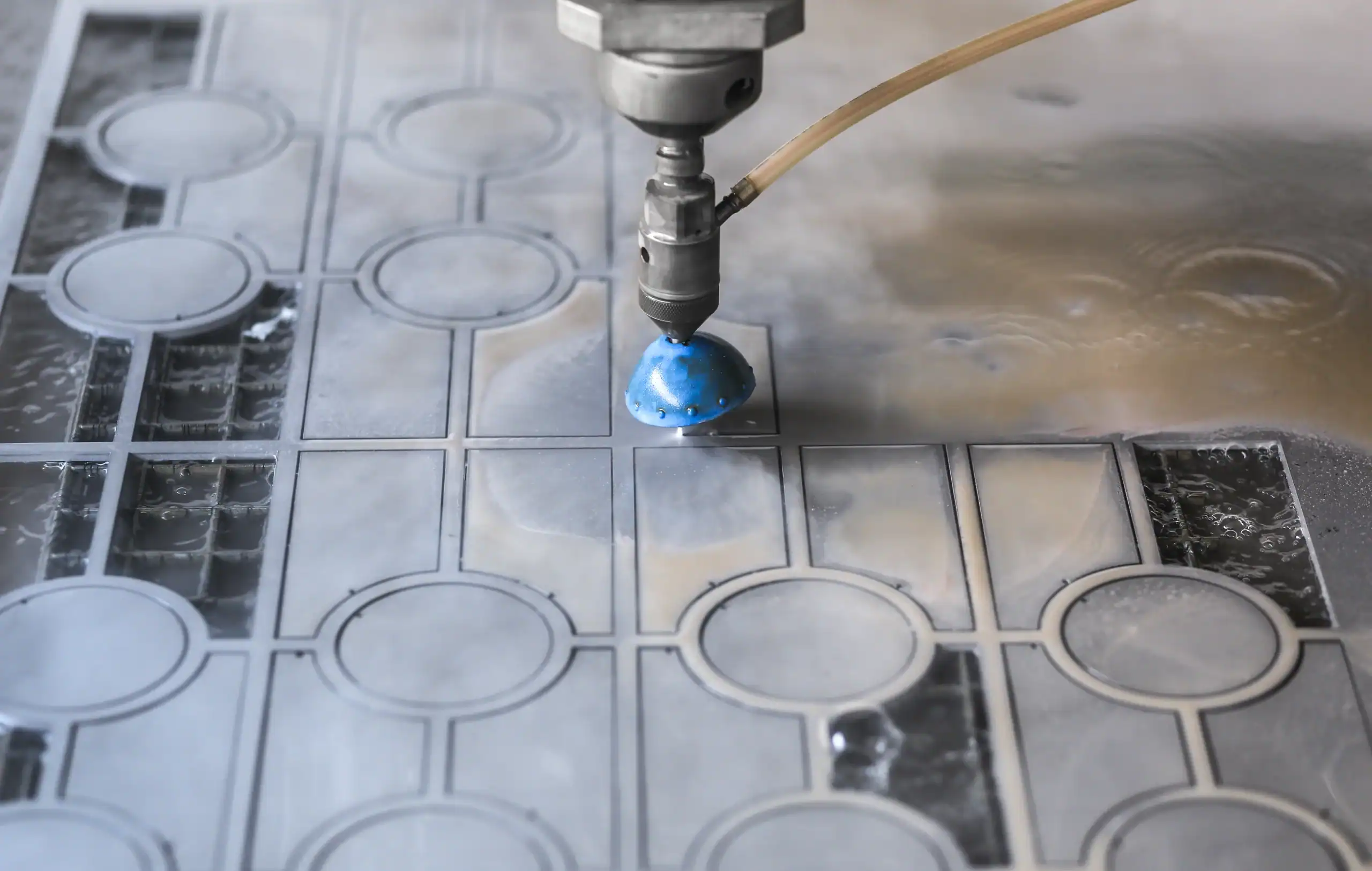
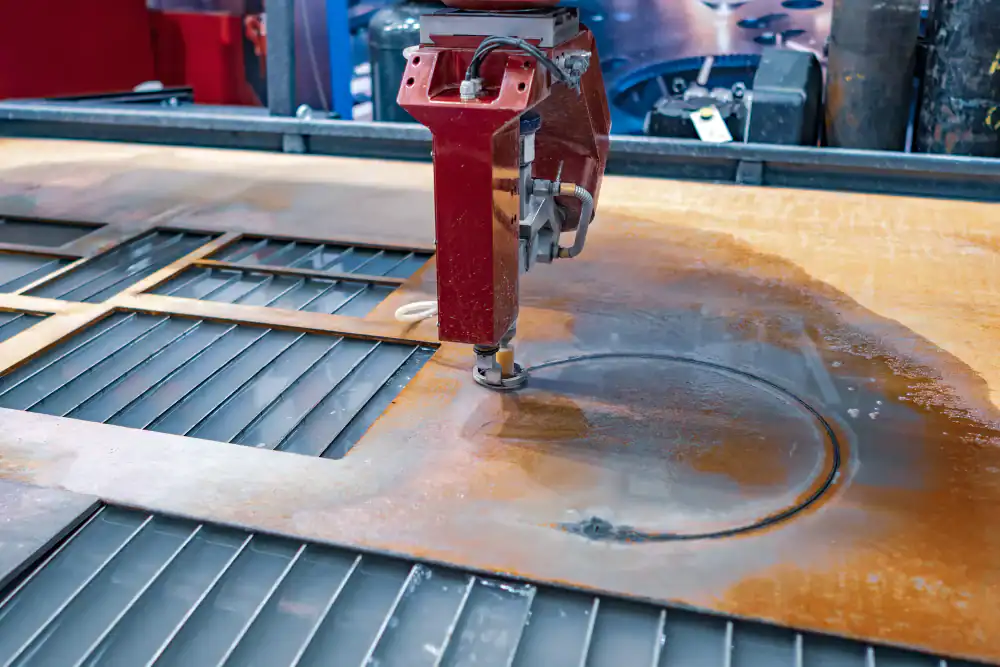
Once the file is approved, we program the CNC waterjet system and load your material. The cutting head moves across the sheet, directing a stream of water and garnet abrasive through the metal at up to 60,000 PSI. The stream is narrow—about the width of a human hair at the orifice—so material waste stays minimal.
Depending on material type and thickness, we adjust cutting speed to maintain the tolerance you need. Slower speeds give you tighter tolerances and smoother edge finish. For most applications, we hold +/- 0.003″ to 0.005″ without issue.
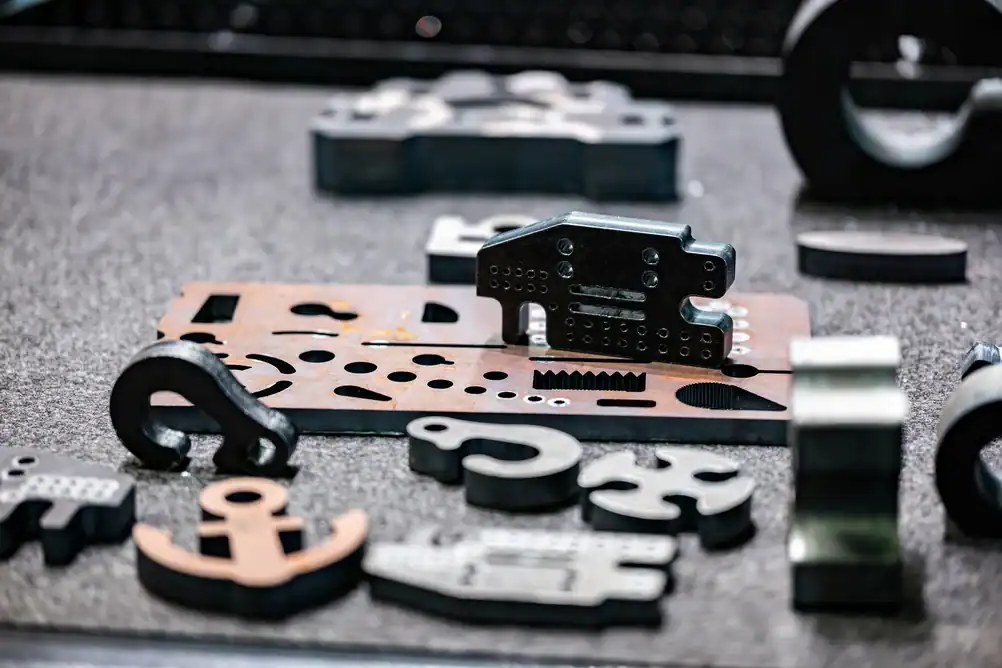
After cutting, parts come off the table with clean edges. Most applications don’t need additional finishing. If your specs require it, we can handle secondary operations, but the waterjet process typically delivers parts that are ready to weld, assemble, or install.
Ready to get started?
We cut aluminum, stainless steel, carbon steel, tool steel, titanium, brass, copper, and exotic alloys. Thickness ranges from thin gauge sheet up to 10 inches depending on material hardness.
Waterjet works especially well when you’re dealing with hardened metals or materials that can’t handle the heat from plasma or laser cutting. No heat-affected zone means no change to the material’s temper or hardness. That matters for tool steel components, aerospace parts, or anything that’s been heat-treated to specific properties.
Complex shapes aren’t a problem. Sharp internal corners, small holes, intricate patterns—the cutting stream follows your design path precisely. You’re not limited by tool access or worried about rough edges that need grinding.
For projects in Bellmore and across Long Island, we offer quick turnaround because we’re local. You’re not shipping material across the country and waiting weeks for parts to come back. We can often turn around simple jobs in days, and we’re available to discuss your project requirements before you commit to an order.
If you’re in manufacturing, construction, or architectural fabrication and you need metal components that meet tight specifications, this is the process that gets you there. No shortcuts. No compromises on accuracy.
Waterjet cuts virtually any metal. Aluminum, stainless steel, carbon steel, tool steel, titanium, brass, copper, Inconel, Hastelloy—if it’s a metal, we can cut it.
The process works especially well on materials that are difficult to machine or sensitive to heat. Hardened tool steels that would destroy conventional cutting tools go through the waterjet stream without issue. Pre-hardened materials maintain their properties because there’s no thermal distortion.
Thickness capacity depends on the material. Softer metals like aluminum can be cut up to 10 inches thick. Harder alloys like titanium or tool steel typically max out around 6 inches, though most applications don’t require anywhere near that thickness. For sheet and plate work—which covers most fabrication projects—we’re cutting anywhere from 1/16″ up to 3″ regularly.
The main limitation isn’t what we can cut, it’s how fast we can cut it while maintaining your required tolerance. Thicker materials and harder alloys take longer because we slow the cutting speed to maintain edge quality and dimensional accuracy.
Waterjet holds tighter tolerances than plasma and matches or exceeds laser cutting for most applications. We consistently hold +/- 0.003″ to 0.005″ on standard jobs. With slower cutting speeds and optimized parameters, we can push tighter when your application demands it.
The advantage over laser comes with thicker materials and reflective metals. Laser cutting loses accuracy as material thickness increases because of heat distortion and beam divergence. Waterjet maintains consistent accuracy through the full thickness of the cut because it’s a mechanical process, not a thermal one.
Compared to plasma, there’s no contest. Plasma cutting generates significant heat, which causes warping and creates a heat-affected zone that changes material properties. Edge quality is rougher, and tolerances are looser—typically +/- 0.030″ at best. Waterjet gives you a clean, square edge with minimal taper.
For parts that need to fit precisely or materials that can’t tolerate heat exposure, waterjet is the clear choice. You’re getting accuracy that’s closer to machining than traditional cutting processes, without the setup time or tooling costs.
Waterjet cutting produces remarkably clean edges with minimal burrs. Most parts come off the table ready to use without secondary deburring or grinding.
You’ll typically see a slight burr on the bottom exit side of the cut, but it’s minor—usually just a light touch with a file or deburring tool removes it if your application requires a completely smooth edge. The top surface and cut face are smooth and square.
This is completely different from plasma cutting, which leaves heavy dross and slag that requires significant grinding. It’s also cleaner than laser cutting on thicker materials, where you often get burrs and oxidation on the cut edge that need to be cleaned up.
The edge finish quality depends partly on cutting speed. Faster cuts leave a slightly rougher surface with more visible striation marks. Slower cuts produce a smoother finish. For most fabrication and manufacturing applications, the standard edge finish is acceptable as-is. If you need a polished or completely smooth edge for aesthetic reasons, that’s a secondary operation, but it’s rarely necessary for functional parts.
Turnaround time depends on job complexity, material thickness, and our current queue. Simple jobs with standard materials often turn around in 3-5 business days. More complex projects or jobs requiring special materials might take 1-2 weeks.
Actual cutting time varies widely. Thin aluminum with simple geometry cuts quickly—we might run through a full sheet in an hour. Thick stainless steel with intricate patterns takes longer because we slow the cutting speed to maintain edge quality and accuracy.
The design review process happens within 24 hours of receiving your file. If we spot issues that need discussion, we’ll contact you immediately so you’re not waiting to find out there’s a problem. Once the file is approved and we schedule your job, cutting happens efficiently.
Being local to Bellmore means you’re not dealing with cross-country shipping delays. Parts stay in the region, and if you need something rushed, we can often accommodate tight deadlines when our schedule allows. The key is getting us your files early and being available for quick communication if questions come up during review.
DXF and DWG files work best for waterjet cutting. These are standard CAD formats that contain the 2D geometry we need to program the cutting paths.
If you’re working in 3D CAD software like SolidWorks or Inventor, you can export your part as a DXF or DWG by creating a flat pattern or saving a 2D drawing view. Make sure the file is at 1:1 scale and includes only the geometry you want cut—no dimension lines, text, or reference geometry.
We can also work with STEP or IGES files. These are 3D formats, but we can import them and extract the 2D profiles we need for cutting. This adds a bit of time to the setup process, but it works when that’s what you have available.
PDF files are problematic. They’re images, not true geometry, so we’d need to manually redraw your part. If PDF is all you have, we can work with it, but expect longer lead times and potential accuracy issues if dimensions aren’t clearly specified.
The cleaner your file, the faster we move from quote to cut. Remove any duplicate lines, ensure curves are smooth, and make sure all geometry is closed where you want a complete cut. Our design team will catch issues during review, but starting with a clean file saves everyone time.
Waterjet makes sense when you need precision without heat distortion, when you’re cutting materials that are difficult to machine, or when edge quality matters for your final application.
The cold-cutting process means your material’s properties don’t change. Heat-treated parts stay heat-treated. Hardened tool steel stays hard. Pre-finished materials don’t get burn marks or discoloration. This matters for aerospace components, medical device parts, or any application where material certification and traceability are important.
You also get versatility that other processes can’t match. One setup cuts aluminum, then stainless, then titanium without changing tools or worrying about reflectivity issues that plague laser cutting. Thick materials cut with the same accuracy as thin sheet. Complex geometries with tight internal radii come out clean without multiple setups or special tooling.
The trade-off is speed. Waterjet is slower than laser or plasma for simple shapes in thin material. But when you factor in the time saved by not having to grind, deburr, or rework parts that came out warped or burned, waterjet often wins on total cycle time.
For projects in Bellmore, NY where you need metal components that fit right and perform as designed, waterjet cutting delivers results that other processes struggle to match. No heat. No stress. Just accurate parts ready to use.
Useful Links
Other Services we provide in Bellmore