Hear from Our Customers
You’re not looking for another vendor who promises precision and delivers parts that still need work. You need metal cut correctly so you can move forward with your project.
Waterjet cutting metal in Manorville, NY means no heat-affected zones that warp your material. No rough edges that need grinding down. No secondary operations eating into your timeline and budget.
The abrasive waterjet stream cuts through aluminum, stainless steel, titanium, and hardened metals without changing their properties. You get clean edges, accurate dimensions, and parts that match your specs. Whether you’re running a single prototype or a full production batch, the process stays consistent because there’s no tool wear to account for.
Your fabrication schedule depends on parts arriving when promised and fitting correctly when they get there. That’s what happens when the cutting method doesn’t compromise the material.
We serve the Long Island manufacturing community with precision waterjet cutting for metal fabrication projects. We’re based in the tri-state area and understand the demands of local shops, contractors, and designers who need accurate cuts without the wait.
Manorville’s manufacturing sector has grown alongside the area’s skilled workforce—35.70% of adults here hold bachelor’s or advanced degrees, and the region employs more people in technical fields than 95% of places nationwide. You’re working in a market that values precision, and you need a cutting service that matches that standard.
We handle custom metal waterjet cutting for architectural elements, industrial components, and specialty parts. Our process accommodates your material specifications and project timelines without the complications that come with thermal cutting methods.
You send us your design file—DXF, DWG, or whatever format your CAD software exports. We review it for any potential issues with kerf width, nesting efficiency, or material utilization. If something looks off, we’ll tell you before we start cutting.
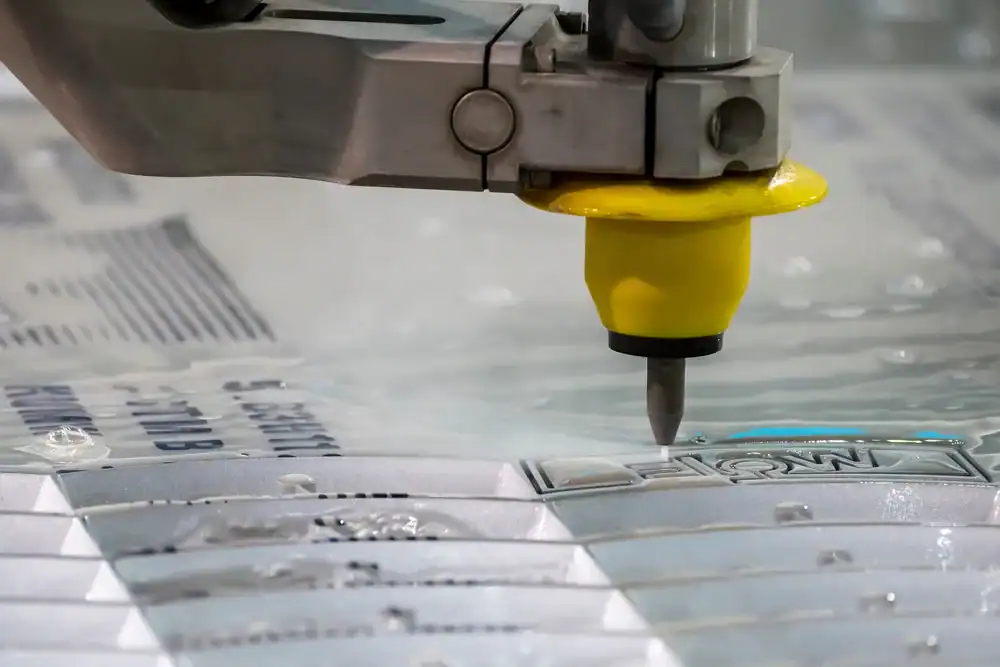
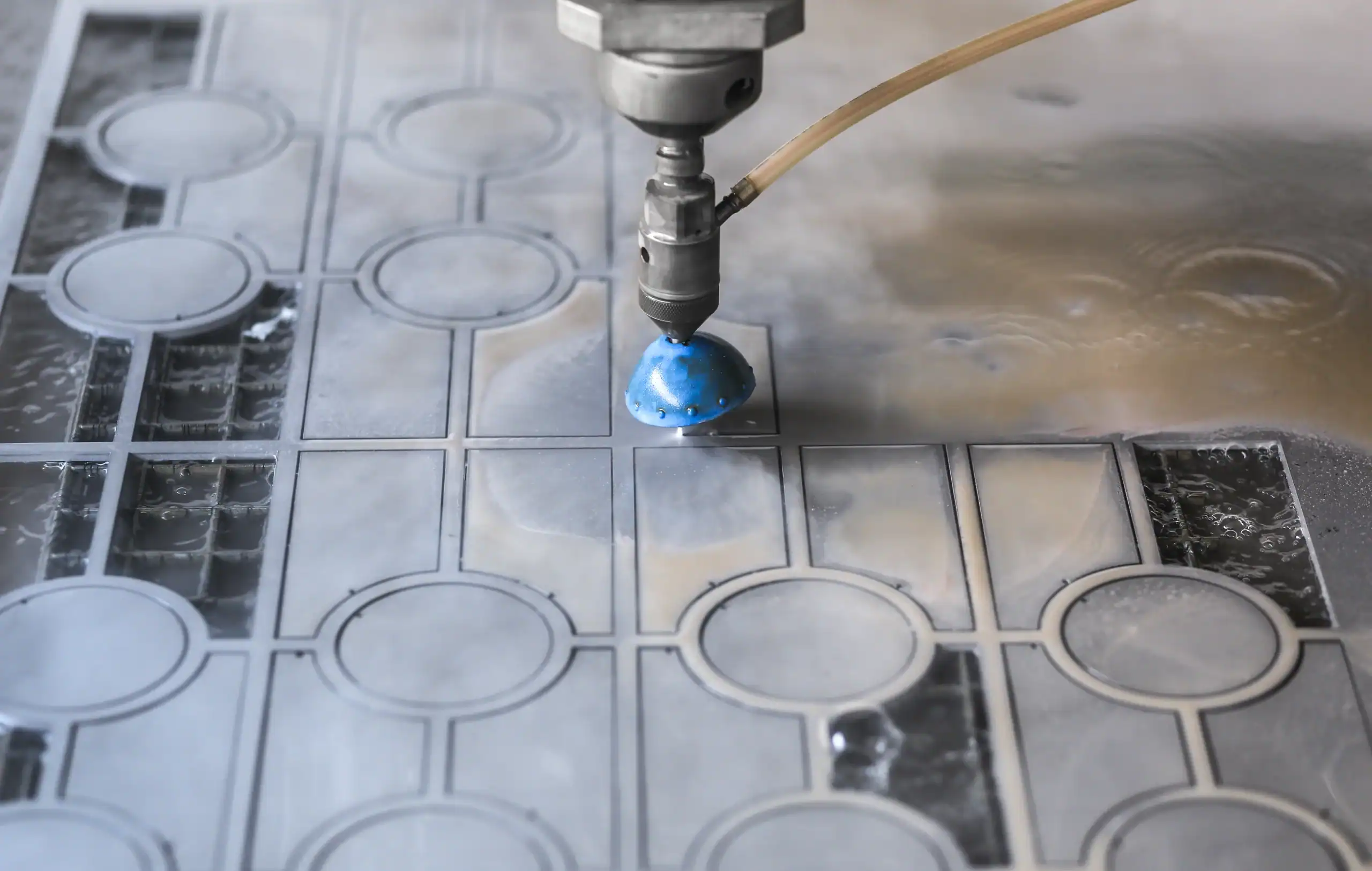
Once the file is programmed into our CNC system, we load your metal onto the cutting bed and secure it to prevent any shifting during the process. The high-pressure waterjet stream—mixed with abrasive garnet particles—cuts along the programmed path at speeds up to 60,000 PSI.
The cutting head moves in precise X-Y coordinates, following your design exactly. There’s no heat buildup, so the metal doesn’t warp or develop a heat-affected zone. The stream cuts all the way through without leaving burrs or requiring secondary deburring in most cases.
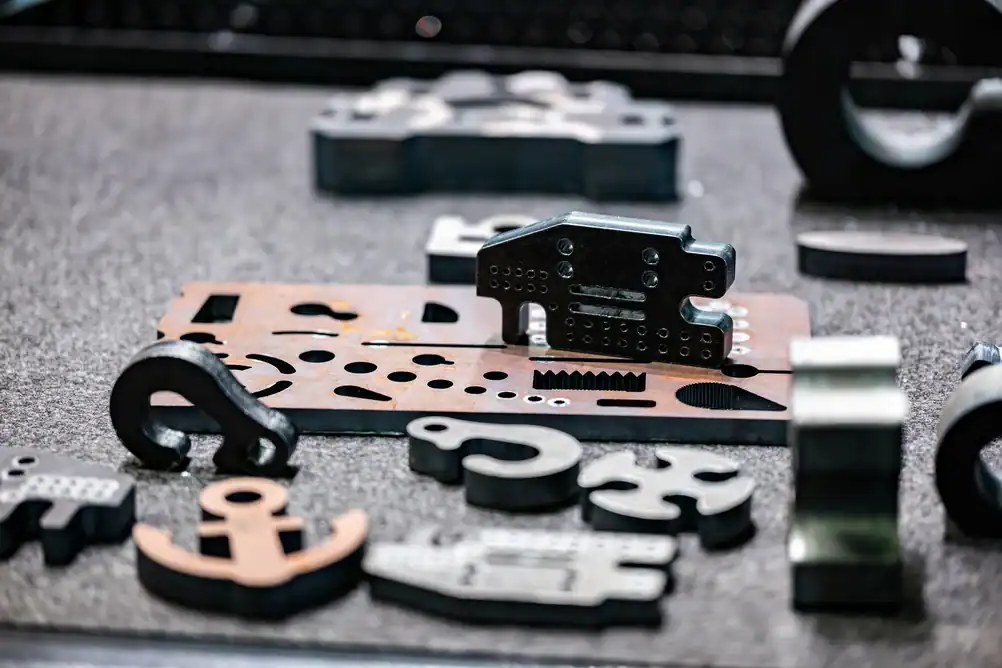
After cutting, we inspect dimensions to verify they match your specifications. Then your parts are cleaned, packaged, and ready for pickup or delivery. The entire process typically runs faster than conventional methods because there’s no tool changing, no heat cooldown time, and minimal setup between cuts.
Ready to get started?
Precision metal cutting in Manorville, NY means working with a process that handles complexity without compromising accuracy. You can cut intricate patterns, tight inside corners, and complex geometries that would be difficult or impossible with plasma, laser, or mechanical cutting.
The waterjet metal cutting process accommodates material thicknesses from thin gauge sheet metal up to several inches of plate steel. You’re not limited by material hardness—the same setup cuts soft aluminum and hardened tool steel without adjustment. That versatility matters when you’re working with mixed materials or testing different alloys for a project.
Local manufacturers benefit from reduced material waste because the narrow kerf width (typically 0.030 to 0.040 inches) maximizes the number of parts you can nest on a single sheet. Advanced nesting software arranges your parts efficiently, and you’re not paying for material that becomes scrap.
Manorville’s median household income of $135,695 reflects a community that invests in quality work. Your customers expect precision, and waterjet cutting metal delivers tolerances that meet those expectations. The process produces consistent results across production runs, so part number fifty matches part number one.
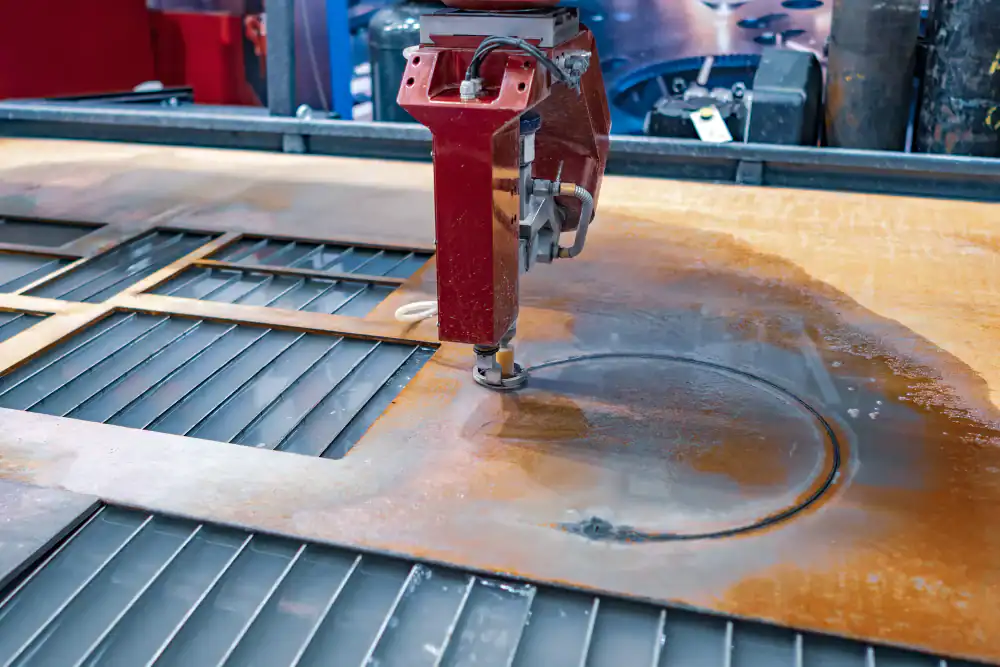
Abrasive waterjet cutting handles virtually any metal you’re working with. Aluminum, stainless steel, carbon steel, titanium, copper, brass, and hardened tool steels all cut cleanly without heat damage.
The process works because the cutting stream doesn’t rely on melting or burning through the material. Instead, the high-pressure water mixed with abrasive garnet particles erodes the metal along the cut path. That means metals that would warp under thermal cutting methods stay flat and true to dimension.
Exotic alloys and specialty metals also cut successfully. If you’re working with Inconel, Hastelloy, or other difficult-to-machine materials for aerospace or industrial applications, waterjet cutting provides a reliable method that doesn’t work-harden the edges or create metallurgical changes. The cold-cutting process preserves the material properties your application requires.
Standard waterjet cutting achieves tolerances of ±0.005 inches consistently. With dynamic waterjet systems that compensate for stream lag, you can hit ±0.003 inches on critical dimensions.
The accuracy comes from computer-controlled motion systems that position the cutting head precisely along your programmed path. There’s no tool deflection like you’d see with mechanical cutting, and no heat distortion like thermal processes create. The metal stays dimensionally stable throughout the cut.
For parts requiring even tighter tolerances, secondary operations like precision grinding can bring dimensions down further. But most fabrication projects find that waterjet-cut parts fit their assemblies correctly without additional machining. The consistent edge quality and perpendicular cut angles mean your parts mate properly and fasteners align as designed.
Most waterjet cuts on metal produce minimal to no burrs on the top edge. The bottom edge may have slight burr formation depending on material type and thickness, but it’s typically much less than plasma or laser cutting creates.
The exit side of the cut sometimes shows a small amount of dross or slight roughness in the last few thousandths of an inch of material thickness. For many applications, this is acceptable as-is. If your parts require completely smooth edges on both sides, a quick pass with a deburring tool or light sanding removes it in seconds.
Compared to other cutting methods, waterjet significantly reduces finishing time. You’re not dealing with heat-affected zones that need grinding back, slag that needs chipping off, or hardened edges that resist deburring tools. The clean cut quality means your parts move directly to assembly or coating in most cases.
Turnaround depends on material availability, current queue, and cut complexity. Simple parts from stock material often complete within 2-3 business days. More complex projects or specialty materials may take a week.
The actual cutting time is usually faster than you’d expect. CNC waterjet systems cut continuously without tool changes or cooldown periods. A sheet of parts that might take hours on a traditional mill or require multiple setups can often cut in a fraction of the time.
Rush service is available when your project timeline demands it. If you’re facing a deadline and need parts quickly, communicate that upfront. We can often accommodate urgent requests by adjusting the production schedule. Having your design files ready and material specifications confirmed helps speed the process from quote to finished parts.
Waterjet cutting typically costs more per hour of machine time than plasma, but the total cost per part often comes out competitive or lower when you factor in the complete picture.
You’re not paying for secondary finishing operations to remove heat-affected zones or clean up rough edges. There’s no consumable cost for gases like plasma or laser cutting requires. The abrasive garnet used in the process costs less than you might think, and the water is filtered and recirculated.
For short runs, prototypes, and complex parts, waterjet often delivers better value because there’s minimal setup time and no expensive tooling to create. You can cut one part or one hundred with the same programming, and changes to your design don’t require new fixtures or dies. When you calculate the true cost including quality, accuracy, and reduced finishing time, waterjet cutting metal in Manorville, NY makes financial sense for many applications.
Waterjet systems cut metal plate up to 6 inches thick in many cases, though cutting speed decreases as thickness increases. Most fabrication work falls in the range of 1/8 inch to 2 inches, where waterjet excels at both speed and edge quality.
Thin materials down to 0.010 inches also cut successfully without the warping problems that thermal methods create. The lack of heat input means thin gauge metals stay flat and don’t develop waves or distortion along the cut edge.
Material thickness affects cutting speed and cost, but not capability. A 2-inch steel plate takes longer to cut than 1/4-inch aluminum, but the process handles both with the same level of precision. If your project mixes different thicknesses or materials, waterjet accommodates that variety without requiring different equipment or setups between cuts.
Useful Links
Other Services we provide in Manorville