
Hear from Our Customers
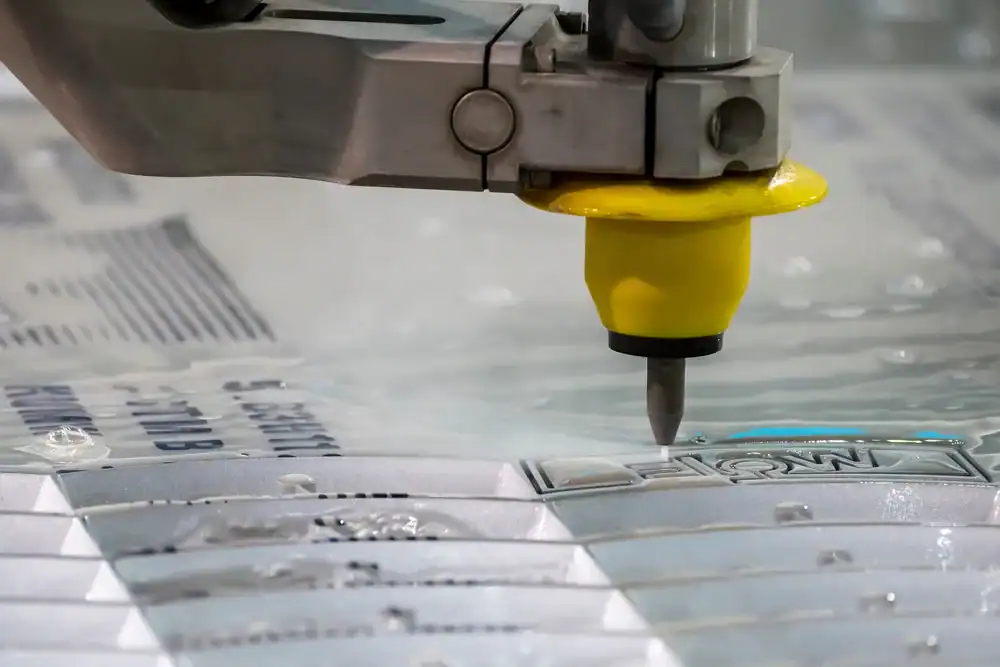
You need metal components that meet spec without the hassle of rework or secondary operations. Waterjet cutting metal delivers that because there’s no heat involved—which means no warped edges, no hardened zones, and no compromised material properties.
The process uses high-pressure water mixed with abrasive garnet to cut through stainless steel, aluminum, copper, brass, titanium, and high-strength alloys. Thickness ranges from 0.5 mm sheet up to 50 mm plate. The kerf width on thin materials is only 0.7 to 1.0 mm, so you get tight nesting and minimal waste.
What you end up with are clean edges ready for welding or assembly. No deburring. No grinding. No fixing mistakes caused by thermal distortion. CNC metal waterjet cutting in Miller Place, NY means your parts arrive ready to use, whether you’re running a prototype or a production batch.
We serve manufacturers, contractors, architects, and fabricators across Miller Place and the surrounding Tri-State area. We handle everything from one-off custom pieces to repeat production runs, working directly from your CAD files or helping you refine designs for manufacturability.
Miller Place is seeing significant construction and industrial activity—Trader Joe’s is actively under construction, and the broader Central New York region is experiencing a manufacturing resurgence with projects like Micron Technology’s semiconductor megafabs near Syracuse. That growth means more demand for precision-cut metal components, and local access matters when timelines are tight.
You get the advantage of working with a shop that understands the local market, can turn jobs around quickly, and doesn’t add unnecessary lead time or shipping costs to your project.
First, you send over your design—CAD file, drawing, or even a sketch if you’re still working through the concept. If needed, we provide support on material selection and design optimization to make sure the part cuts efficiently and meets your functional requirements.
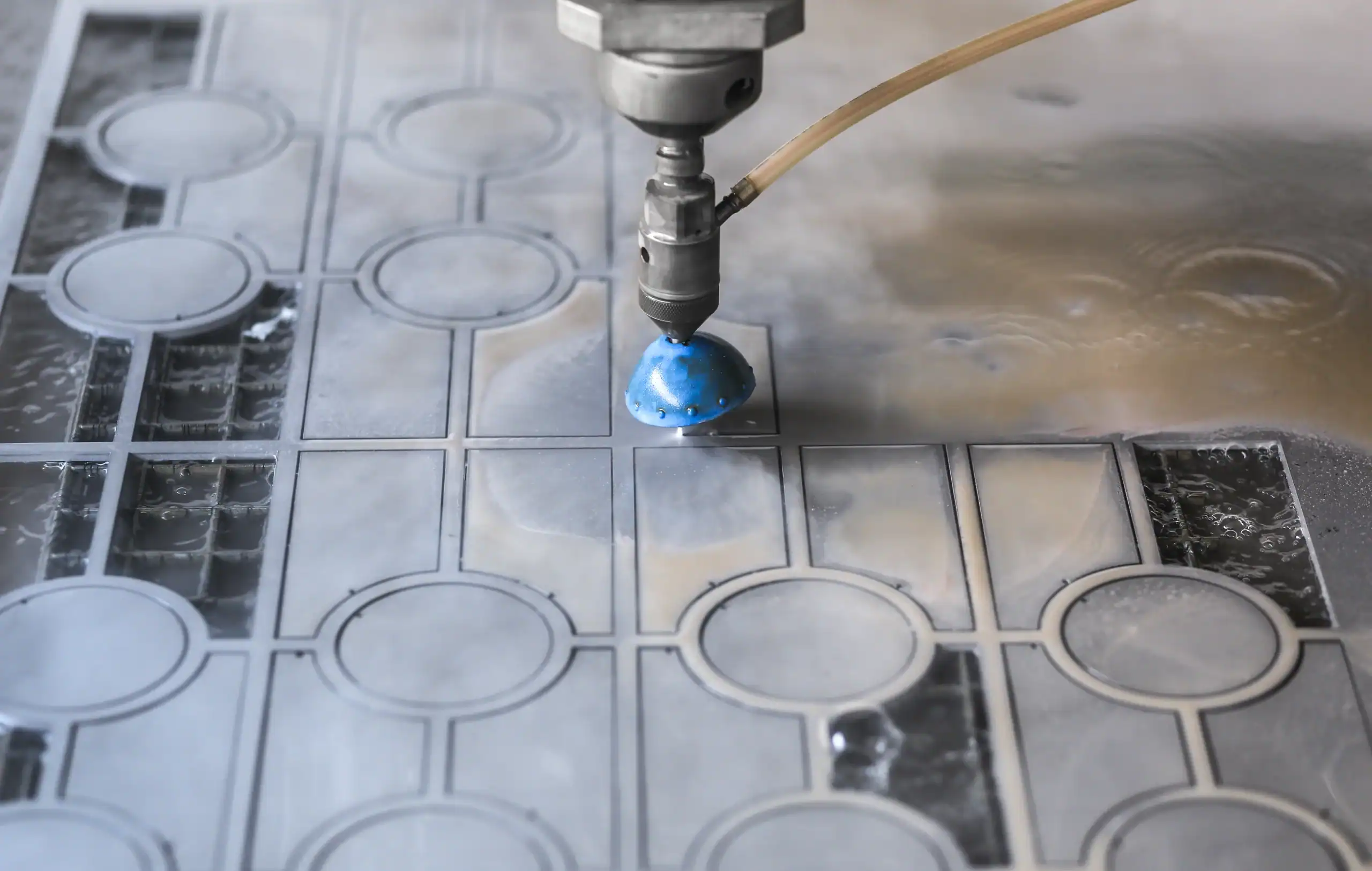
Next, the file gets programmed into our CNC system. The waterjet cutting head follows the toolpath with positional accuracy of ±0.1 mm. Dynamic head compensation eliminates taper, so even thick plate comes out square. For intricate shapes or tight tolerances, the system handles it without tool changes or repositioning.
During the cut, high-pressure water (up to 60,000 psi) mixed with abrasive garnet erodes the material. Because it’s a cold process, there’s no heat-affected zone, no melting, and no oxidation. Materials that are difficult for lasers—like reflective metals or very thick plate—cut cleanly without issue.
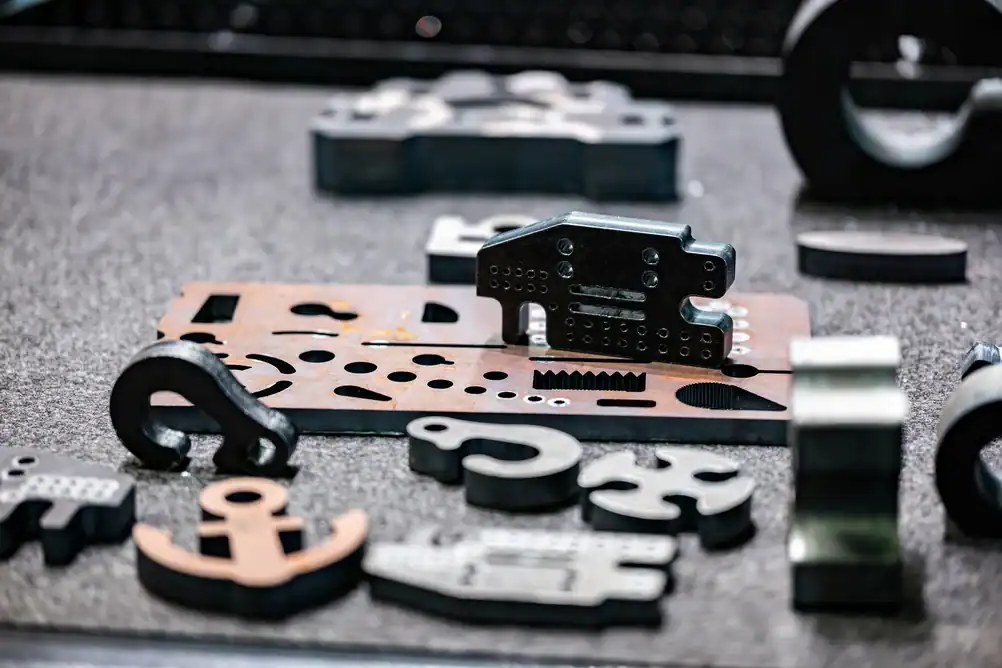
Once the cut is complete, parts are inspected and cleaned. In most cases, edges are smooth enough to go straight into your next operation. No secondary machining. No finishing delays. You get what you ordered, on spec, ready to install or assemble.
Ready to get started?
Every job starts with material consultation. Stainless steel, aluminum, titanium, copper, brass, tool steel—whatever the application calls for. Our thickness capacity goes up to 50 mm, and the process works across the full range without losing accuracy or edge quality.
You also get design support if your part needs tweaking for better manufacturability or cost efficiency. Small adjustments to geometry or nesting layout can reduce material waste and cut time, which directly impacts your bottom line. That feedback happens before the job runs, not after.
Miller Place and Long Island manufacturers benefit from fast local turnaround. Prototypes can often be completed within days, and production runs are scheduled based on your delivery requirements. For marine fabricators working on corrosion-resistant hardware, HVAC contractors needing custom mounting plates, or aerospace suppliers requiring tight-tolerance brackets, the combination of speed and precision matters.
We also handle complex geometries that would require multiple setups or tool changes on traditional equipment. Intricate cutouts, interior details, decorative panels—waterjet handles it in a single operation. That reduces touch time, eliminates alignment errors, and gets your parts to you faster.
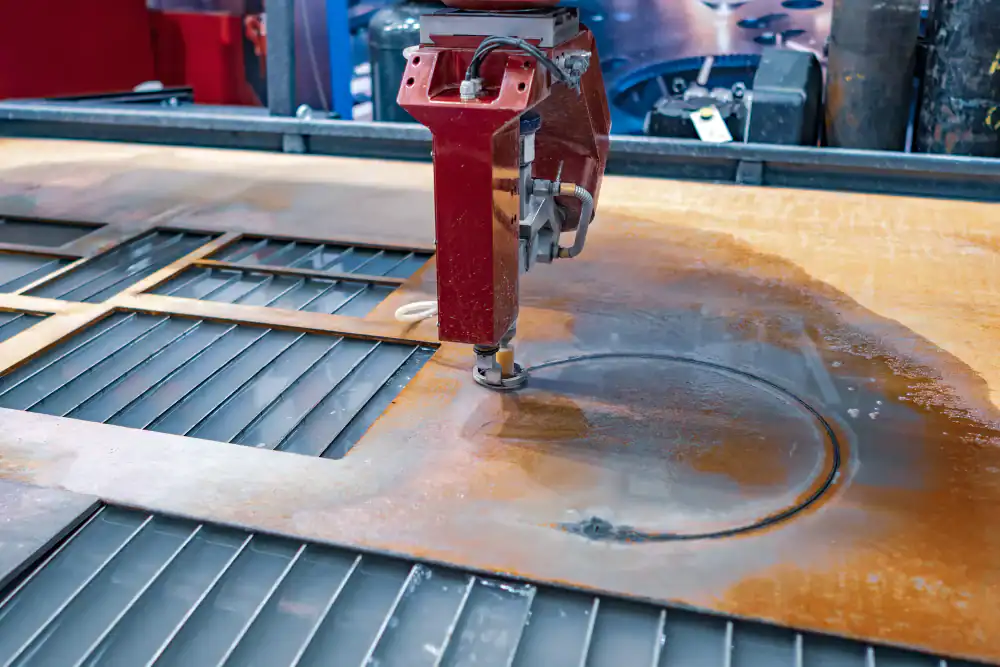
Waterjet cuts virtually any metal without limitation. Stainless steel is one of the most common materials, handled in thicknesses from 0.5 mm up to 50 mm with a clean, satin finish. Aluminum cuts without melting or burr formation, which is a significant advantage over thermal processes that can leave rough edges.
Copper and brass—both highly reflective—cut cleanly without the issues lasers face with reflective surfaces. Titanium, often used in medical and aerospace applications, maintains its material properties because there’s no heat-affected zone. High-strength steels and tool steels also cut without losing temper or hardness.
The process works equally well on exotic alloys and specialty materials. If you’re unsure whether your material is a good fit, a quick conversation about thickness, grade, and application will clarify whether waterjet is the right method.
Positional accuracy typically lands within ±0.1 mm, and with dynamic head compensation, taper is virtually eliminated. For parts requiring tolerances down to ±0.005 inches, waterjet delivers consistent results across the entire cut.
Thin materials—0.5 mm to 3 mm—produce a kerf width of only 0.7 to 1.0 mm, which allows for tight nesting and intricate detail work. Thicker plate up to 50 mm cuts square and clean, with edges ready for welding or forming without additional machining.
Because the process is CNC-controlled, repeatability is high. If you’re running a batch of identical parts, each one will match the programmed dimensions. That consistency matters for assembly, fitment, and quality control, especially in industries like aerospace or medical device manufacturing where specs are non-negotiable.
Waterjet is a cold-cutting process, which means there’s no heat-affected zone. Laser and plasma both generate extreme temperatures that can warp thin materials, harden edges, or alter the microstructure of the metal. For applications where material properties are critical—structural components, aerospace parts, or anything that’s been heat-treated—waterjet preserves those properties.
Waterjet also handles reflective materials like copper, brass, and polished aluminum without issue. Lasers struggle with reflective surfaces and can produce inconsistent cuts or require multiple passes. Waterjet cuts through in a single operation.
Thickness capacity is another factor. While fiber lasers excel on thin sheet, waterjet handles thick plate up to 50 mm without losing cut quality. Plasma can cut thick material but leaves a rougher edge that often requires secondary finishing. Waterjet edges are smooth enough to weld or assemble immediately, eliminating that extra step.
Turnaround depends on material availability, job complexity, and current shop schedule, but prototypes and small custom runs often complete within a few days. Production batches are scheduled based on your delivery requirements, with lead times communicated upfront so there are no surprises.
Local access in Miller Place, NY means faster coordination compared to outsourcing to distant shops. You can drop off material, review parts in person, or adjust specs without the delays that come with shipping and remote communication.
For urgent jobs—retrofit parts, replacement components, or time-sensitive project work—expedited scheduling is available when our capacity allows. The key is clear communication about your timeline and any constraints on your end, so the job can be planned accordingly.
In most cases, no. Waterjet produces a clean edge with minimal burr, especially on materials like stainless steel and aluminum. The edge quality is smooth enough for welding, powder coating, or direct assembly without additional machining.
Thermal cutting methods—laser, plasma, oxy-fuel—leave heat-affected zones that often require grinding or deburring to remove hardened material or oxidation. That adds time and labor cost to every part. Waterjet eliminates that step because there’s no heat involved.
For applications where edge finish is critical—decorative panels, visible components, or parts that require specific surface roughness—waterjet delivers out of the machine. You’re not paying for secondary operations or waiting for additional processing before your parts are ready to use.
Yes. Our CNC system makes it easy to program one-off prototypes or scale up to production quantities without retooling. For prototypes, you get the advantage of cutting complex geometries without investing in custom dies or tooling, which keeps costs down and speeds up iteration.
For production runs, the process is consistent and repeatable. Each part matches the programmed dimensions, and because there’s no tool wear or thermal drift, quality stays stable across the entire batch. That’s important for industries like aerospace, medical, and automotive where traceability and consistency are required.
Material nesting is optimized during programming to reduce waste and cut time, which improves cost efficiency on larger orders. Whether you’re ordering five parts or five hundred, the same precision and edge quality apply.
Useful Links
Other Services we provide in Miller Place