Hear from Our Customers
You’re not looking for someone to just cut metal. You need parts that meet spec without secondary operations eating into your timeline or budget.
Waterjet cutting metal in North Hempstead gives you that. We’re talking +/- 0.003″ to 0.005″ tolerances on complex geometries, with edges clean enough to skip deburring in most cases. No heat means your material properties stay intact—hardened steel stays hardened, tempered aluminum doesn’t lose its temper.
When you’re working with expensive alloys or tight production schedules, waste isn’t just material cost. It’s time, it’s rework, it’s missed deadlines. Our CNC metal waterjet cutting process minimizes kerf width and maximizes nesting efficiency, so more of what you pay for ends up in finished parts instead of the scrap bin.
You get parts ready for assembly or finish work without the distortion, micro-cracking, or edge hardening that comes with thermal cutting methods.
We serve the North Hempstead manufacturing community with precision waterjet metal cutting from our West Islip facility. We work with local contractors, fabricators, and engineers who need reliable turnaround without sacrificing accuracy.
North Hempstead’s industrial base—from aerospace components to architectural metalwork—demands precision that holds up under inspection. We’ve built our process around that standard. You send us a CAD file or a sketch, we program the cut, and you get parts that match your specs.
We’re not the cheapest option, and that’s intentional. You’re paying for equipment that holds tolerance, operators who understand material behavior, and a process that doesn’t create problems downstream.
You start by sending us your design—CAD files work best, but we can work from PDFs, sketches, or even samples if that’s what you have. We’ll review it for manufacturability and flag anything that might cause issues before we start cutting.
Once the file is dialed in, we program the toolpath. Our CNC metal waterjet cutting systems calculate speed, abrasive flow, and pressure based on your material type and thickness. The software handles taper compensation automatically, so you get square edges without manual adjustments.
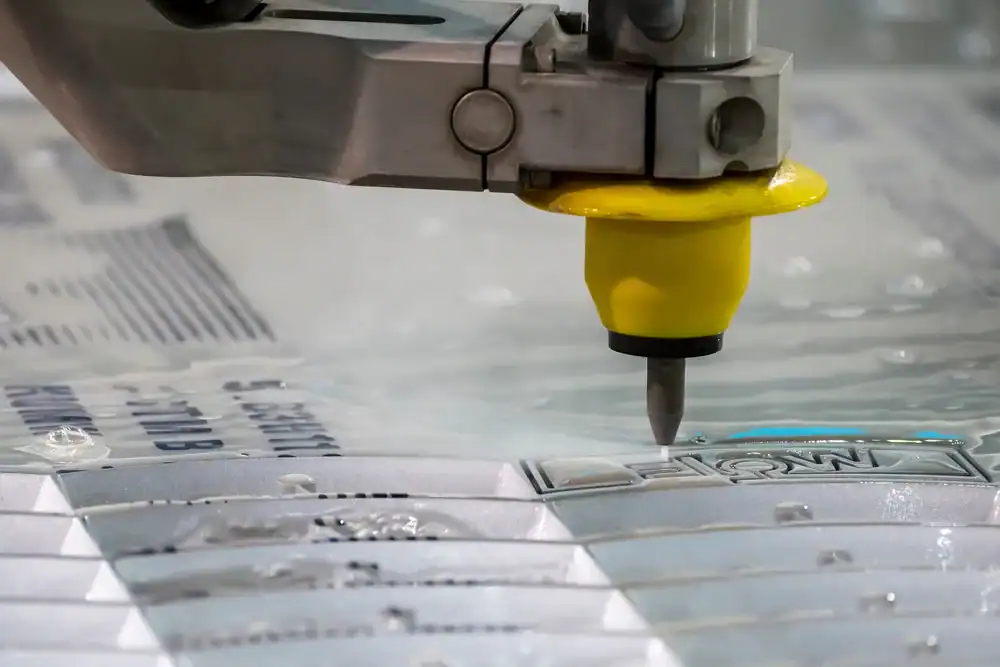
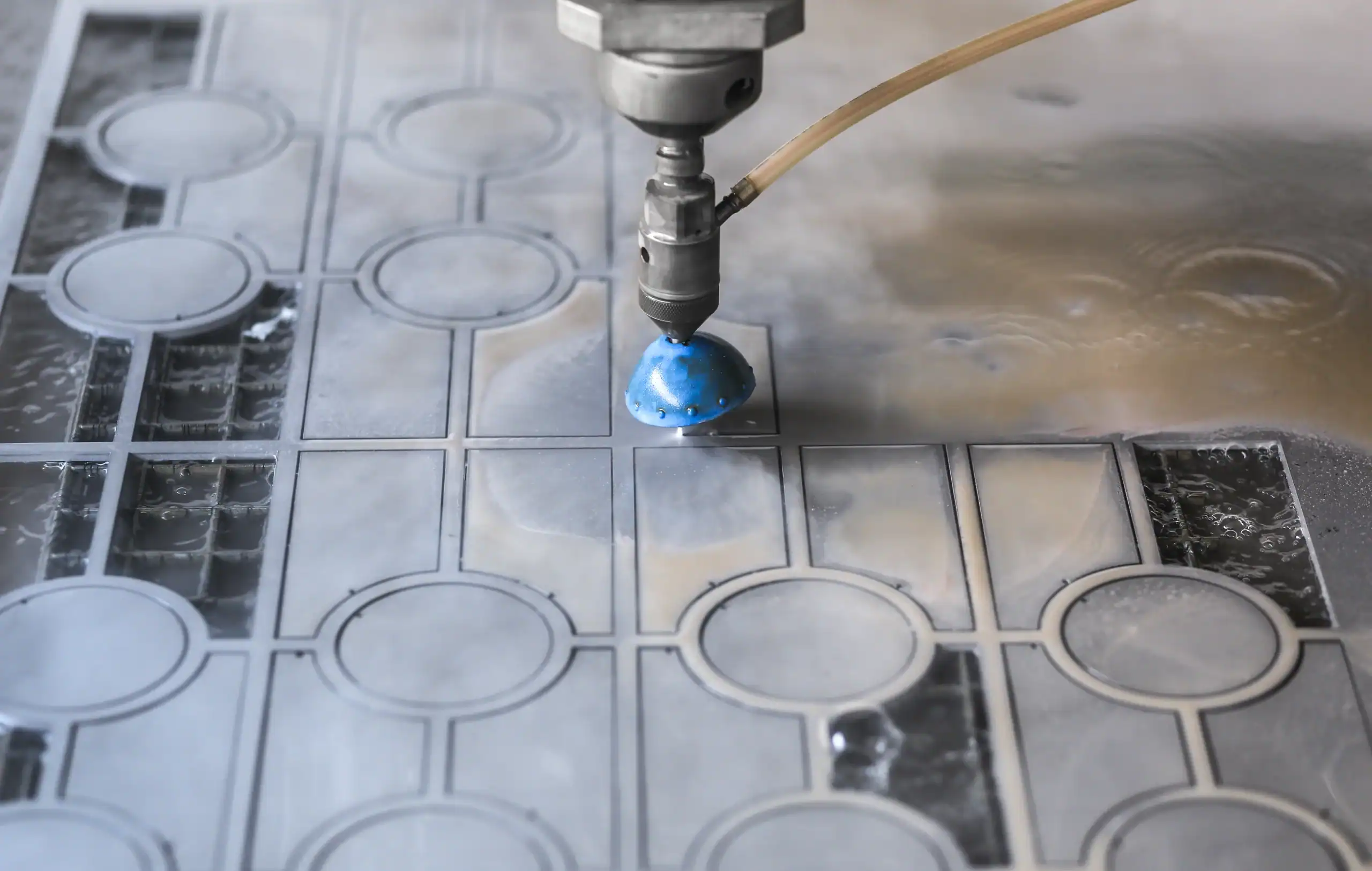
The actual cutting happens with a high-pressure stream of water mixed with garnet abrasive. It cuts through steel, aluminum, stainless, titanium, copper—basically any metal up to 10 inches thick. No preheating, no cooldown, no thermal stress.
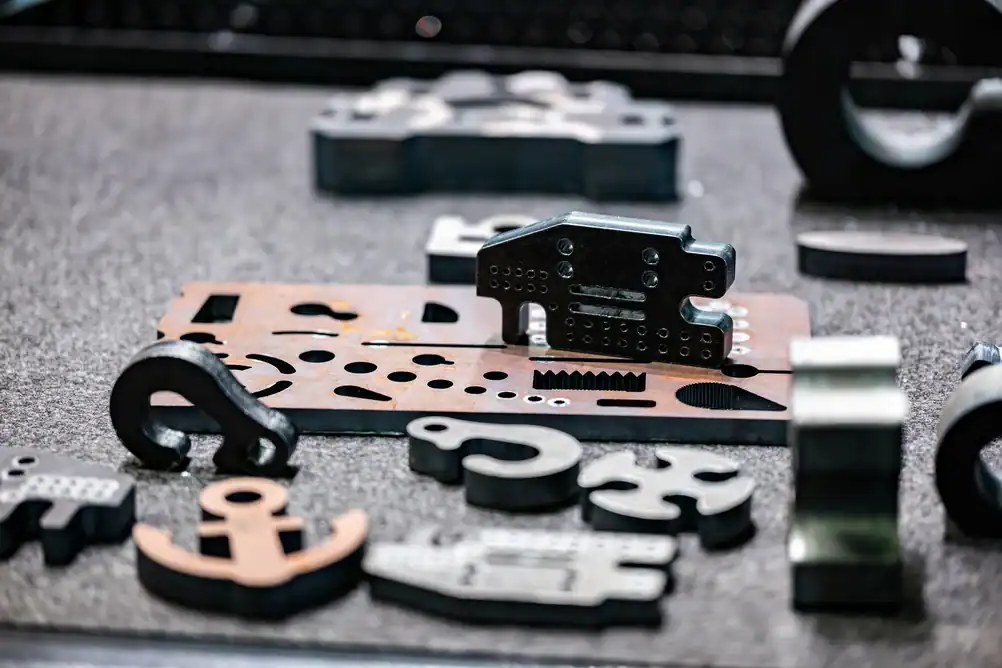
After cutting, parts come off the table ready for use or ready for secondary operations like tapping, welding, or finishing. Most edges are clean enough that you can skip grinding or filing unless your application has unusually tight cosmetic requirements.
Ready to get started?
Every custom metal waterjet cutting job includes material consultation upfront. If you’re not sure whether your specified material will behave the way you need it to, we’ll tell you before we cut. That saves you from expensive surprises later.
You get CNC-programmed cuts with repeatability across production runs. One piece or a thousand, the dimensions stay consistent. We handle prototyping, short runs, and full production with the same equipment and process, so there’s no quality drop when you scale up.
North Hempstead manufacturers often need fast turnaround on replacement parts or custom components that don’t exist in any catalog. Waterjet cutting metal doesn’t require custom tooling or dies, so we can go from design to finished part faster than stamping, punching, or traditional machining for complex shapes.
We cut a range of metals common in local manufacturing: mild steel, stainless steel in multiple grades, aluminum alloys, tool steels, hardened materials, and exotic metals like Inconel or titanium when your application demands it. Thickness ranges from thin gauge sheet up to several inches, depending on material hardness and your tolerance requirements.
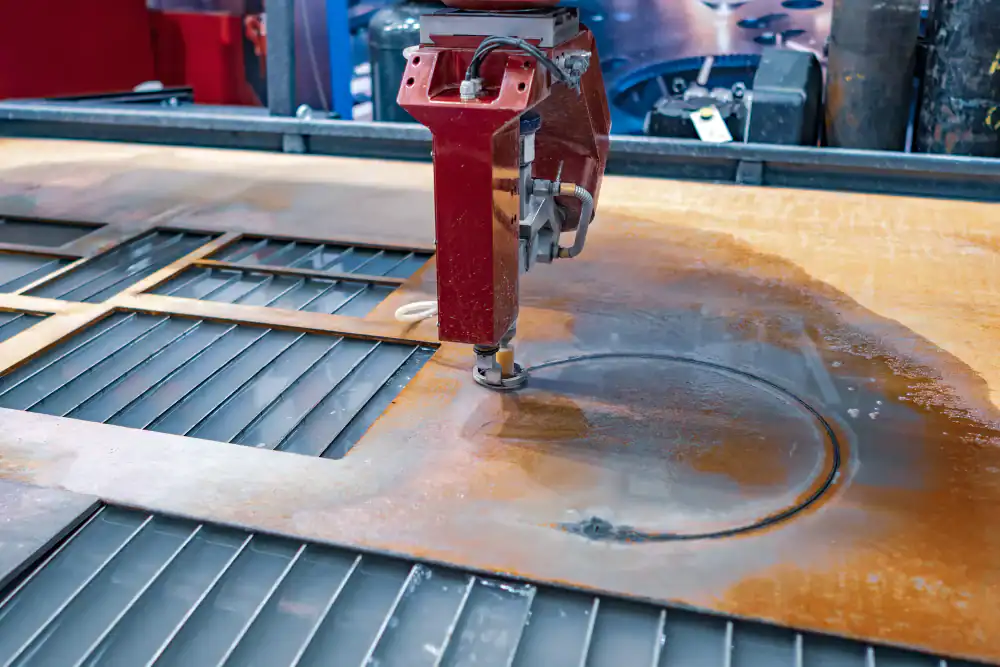
We cut virtually any metal you’re likely to spec. That includes mild steel, stainless steel (304, 316, 17-4, and other grades), aluminum alloys, tool steels, hardened steel, copper, brass, bronze, titanium, and high-temp alloys like Inconel.
Thickness capacity depends on the material. Softer metals like aluminum can be cut up to 10 inches thick without much trouble. Harder materials like tool steel or Inconel cut cleanly up to about 6 inches, though speed slows down as thickness and hardness increase.
If you’re working with something unusual—say, a laminated material or a metal-composite sandwich—send us the specs and we’ll tell you whether waterjet is the right process. Some materials cut beautifully, others need special handling, and a few are better suited to different methods entirely.
The biggest difference is heat. Laser and plasma both use thermal energy to melt through metal, which creates a heat-affected zone along the cut edge. That zone can change material properties—hardness, temper, grain structure—and it often causes warping on thin materials or tight geometries.
Waterjet cutting metal is a cold process. No heat means no distortion, no hardening, no annealing, and no micro-cracking. Your material behaves the same after cutting as it did before. That matters when you’re working with pre-hardened tool steel, tempered aluminum, or anything that’s been heat-treated to specific properties.
Laser is faster on thin materials and gives you a narrower kerf, so it’s a good choice for high-volume production of simple shapes in sheet metal. Plasma is cheaper per cut but rougher on edge quality. Waterjet sits in the middle—not the fastest, not the cheapest, but the most versatile when you need tight tolerances, thick materials, or complex shapes without thermal damage.
Standard tolerance on our CNC metal waterjet cutting systems is +/- 0.005 inches. If you need tighter than that, we can hold +/- 0.003 inches by slowing down the cut speed and optimizing the toolpath for your specific geometry.
Tolerance depends partly on material thickness and hardness. Thinner materials and softer metals generally hold tighter tolerances because there’s less deflection in the cutting stream. Thicker or harder materials may see slightly wider variation, though we’re still well within standard machining tolerances.
Taper is another factor. Waterjet streams naturally taper slightly as they pass through material—the top edge is marginally wider than the bottom edge. Our equipment compensates for this by tilting the nozzle at a calculated angle, moving the taper to the scrap side of the cut. That gives you square edges on the part you’re keeping, which is critical for parts that need to mate with other components or fit into assemblies without gaps.
Yes, but there are some geometry limits to understand. The waterjet stream has a physical diameter—usually around 0.03 to 0.04 inches depending on orifice and nozzle size. That means the tightest inside corner radius we can cut is roughly half that diameter, so about 0.015 to 0.020 inches.
If your design calls for truly sharp inside corners (zero radius), waterjet won’t get you there. You’d need EDM or a secondary operation. But for most applications, a small corner radius is acceptable and often preferable from a stress concentration standpoint anyway.
Complex curves, intricate cutouts, nested parts, and multi-axis shapes are all fair game. Since the process is CNC-controlled and programmed directly from CAD files, we can cut geometries that would be difficult or impossible with punch presses, saws, or manual methods. That’s especially useful for prototyping or low-volume custom parts where building dedicated tooling doesn’t make sense.
Turnaround depends on material thickness, complexity, and current queue, but most jobs ship within a few days to a week. Simple parts in common materials can often be turned same-day or next-day if you’re in a bind.
Cutting speed varies by material. Thin aluminum might cut at several inches per minute, while thick stainless steel slows down to a fraction of that. Complex parts with lots of detail take longer than simple rectangles, and harder materials take longer than softer ones.
Programming time is usually minimal—our software imports your CAD file and generates the toolpath automatically. The bigger time factor is often material sourcing if you need us to supply it. If you’re providing your own material, we can usually start cutting as soon as the file is approved and the material arrives.
For production runs, we can give you a more precise timeline once we see the part and know the quantity. Prototypes and one-offs typically move faster because we can slot them into the schedule between larger jobs.
We can do either. If you have material on hand or a specific supplier you prefer, you can send it to us and we’ll cut from your stock. That’s common when you’re working with specialty alloys, certified material, or leftovers from another job.
If you need us to source the material, we work with local and regional metal suppliers who stock most common grades and thicknesses. We’ll quote material cost along with cutting cost so you know the full price upfront. Sourcing through us can sometimes save you time and shipping costs, especially for smaller quantities where minimum orders from a supplier don’t make sense.
Either way, we’ll verify material type and thickness before cutting. If there’s a discrepancy between what you specified and what we received, we’ll flag it before we start. That prevents scrapped parts and wasted time on both ends.
Useful Links
Other Services we provide in North Hempstead