Hear from Our Customers
When your project timeline doesn’t allow for do-overs, you need cuts that match your specs exactly. CNC metal waterjet cutting in Sayville, NY gives you that precision without the thermal distortion that comes with plasma or laser cutting.
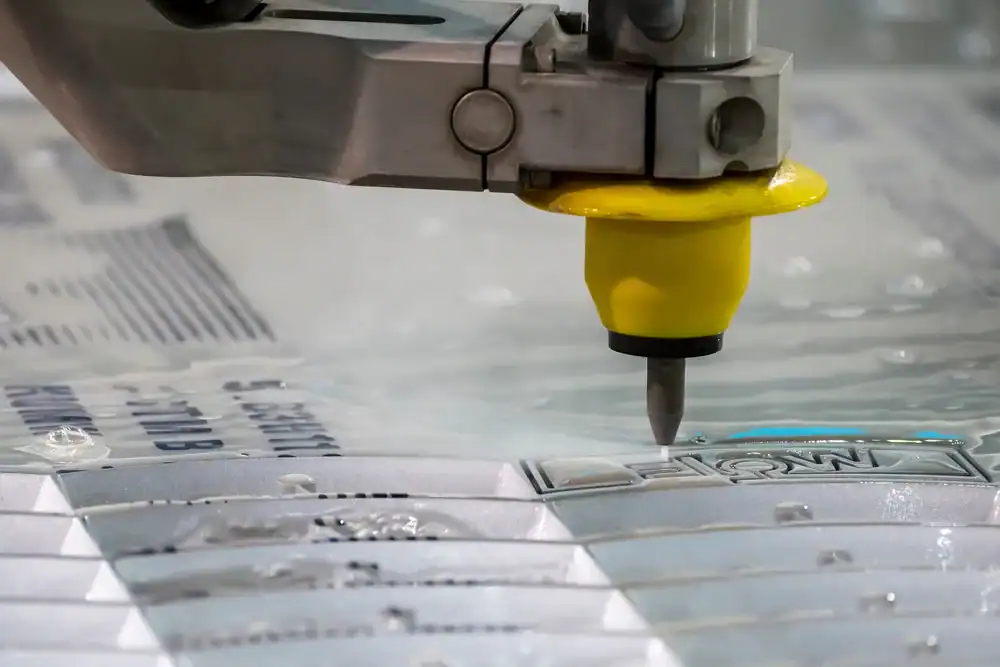
You’re working with materials that cost real money—steel, aluminum, titanium, brass. The last thing you need is scrap from heat warping or rough edges that require secondary finishing. Waterjet cutting metal uses ultra-high-pressure water mixed with abrasive garnet to slice through materials up to 8 inches thick, leaving you with finished edges and minimal kerf width.
The result? Parts that fit correctly the first time. Less material waste means lower costs per part. No heat-affected zones mean your metal properties stay intact. And because the process is CNC-controlled, you get the same accurate results whether you’re cutting one prototype or a full production run.
We serve manufacturers, fabricators, and builders across Sayville, NY and the surrounding Long Island area. We’ve built our reputation on delivering precision metal waterjet cutting services that meet tight deadlines without sacrificing quality.
You’re dealing with the same challenges every metal shop on Long Island faces—rising material costs, supply chain delays, and the constant pressure to deliver faster without cutting corners. We get it because we work in the same market you do.
Our facility uses advanced CAD/CAM integration to turn your designs into production-ready cuts. Whether you’re a marine fabricator in Sayville working with saltwater-resistant alloys or an automotive shop prototyping custom brackets, you need a cutting partner who understands both the technical requirements and the local business reality.
You start by sending us your design files—CAD drawings, DXF files, or even detailed sketches if that’s what you’re working from. We review your specifications to confirm material type, thickness, and tolerance requirements. If something looks off or could be optimized for the waterjet process, we’ll flag it before we start cutting.
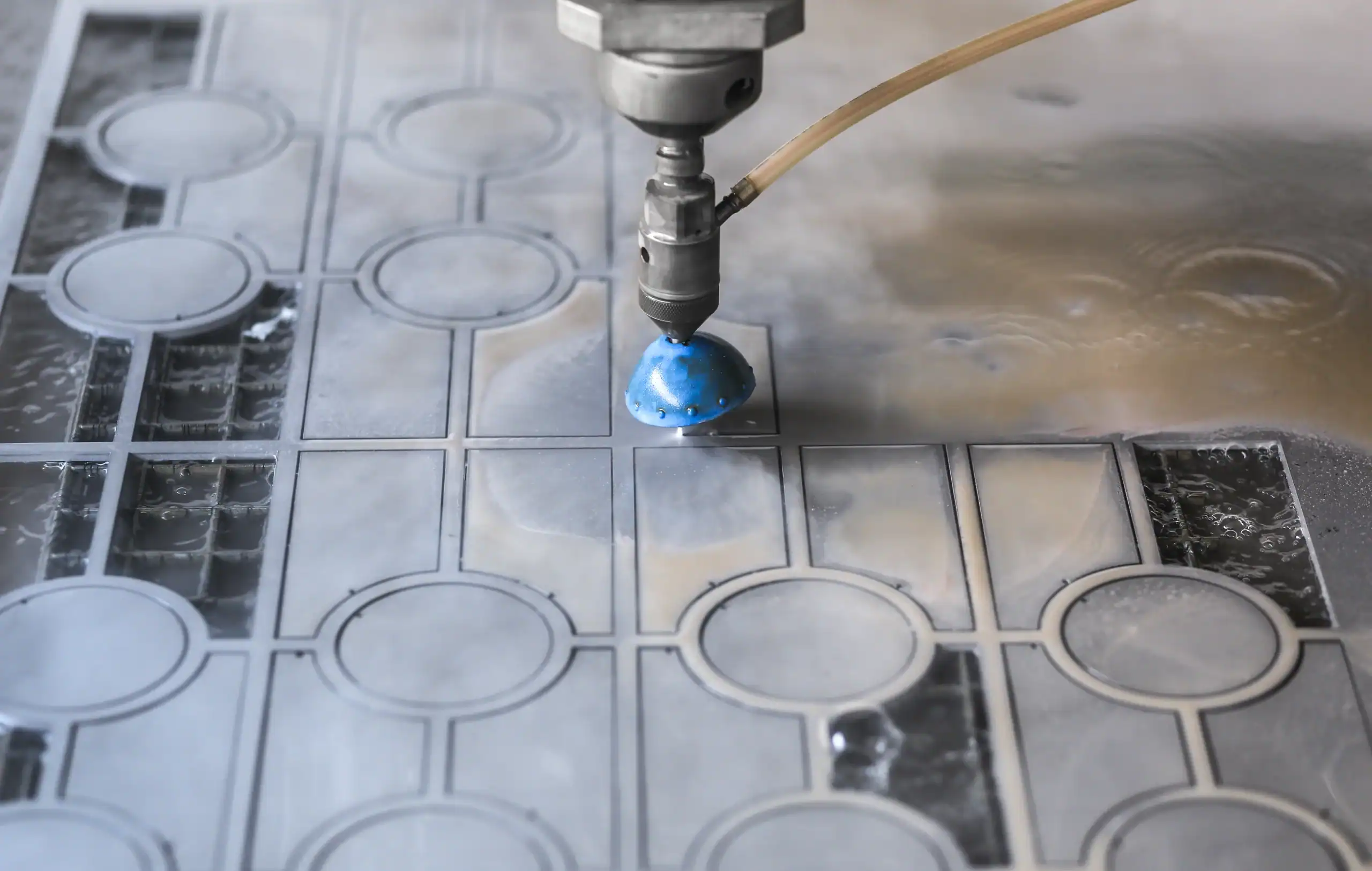
Once the design is confirmed, we convert your files into G-code that controls our CNC waterjet system. The machine uses a high-pressure pump to force water through a tiny orifice, mixing it with abrasive garnet particles. This stream cuts through your metal in a single pass at speeds up to four times faster than conventional cutting methods.
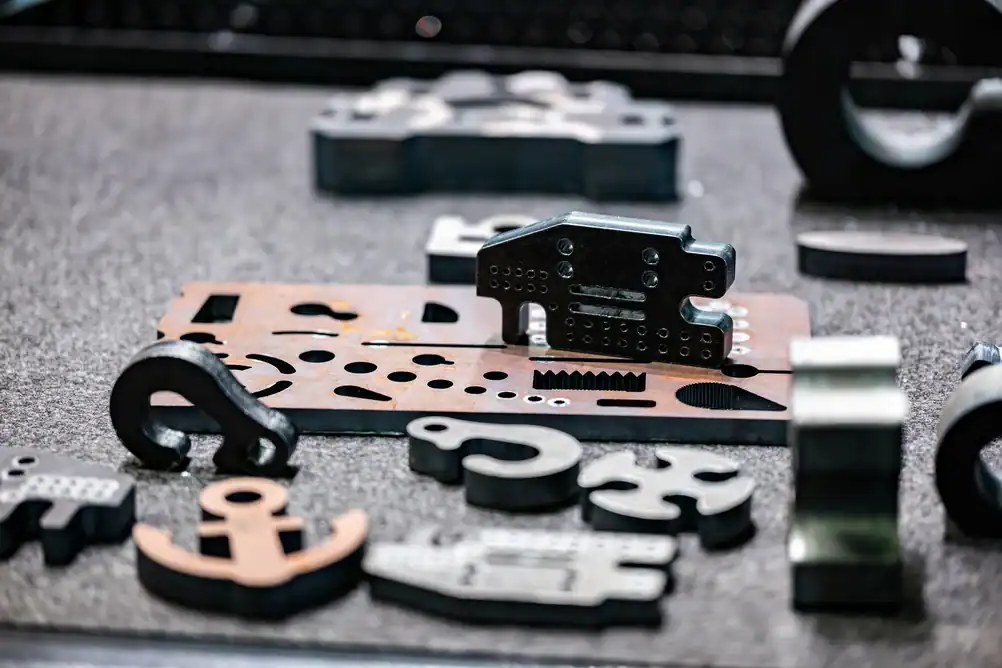
During the cut, there’s no heat generation, which means no warped edges, no hardened zones, and no material property changes. The CNC system follows your exact specifications with repeatability that holds tolerances within 0.005 inches. After cutting, most parts come off the table ready to use—no grinding, no deburring, no secondary operations eating into your timeline.
You get finished parts that match your design, delivered on schedule, with the material efficiency that keeps your project costs predictable.
Ready to get started?
When you work with our waterjet metal cutting shop in Sayville, NY, you’re getting more than just a cutting service. You’re getting CAD support that catches design issues before they become expensive mistakes. You’re getting material expertise that helps you choose the right alloy for your application without over-engineering the solution.
The Long Island manufacturing landscape has shifted. With skilled fabricators aging out and material costs climbing 30-40% over the past few years, you can’t afford inefficiency. Our abrasive waterjet cutting process produces minimal waste—often less than 1/16 inch kerf width—which matters when you’re cutting expensive materials like titanium or tool steel.
We handle everything from one-off prototypes for R&D facilities to production runs for aerospace and marine applications. The same process that cuts intricate decorative panels for architectural firms also produces structural brackets for automotive builds. Steel, aluminum, brass, copper—if it’s metal and you need it cut precisely, the waterjet handles it without tool changes or setup delays.
You also get local proximity, which matters more than you might think. When a project changes mid-stream or you need to verify a dimension in person, you’re 20 minutes away, not dealing with a shop three states over. That responsiveness has kept Long Island manufacturers competitive even as larger operations moved offshore.
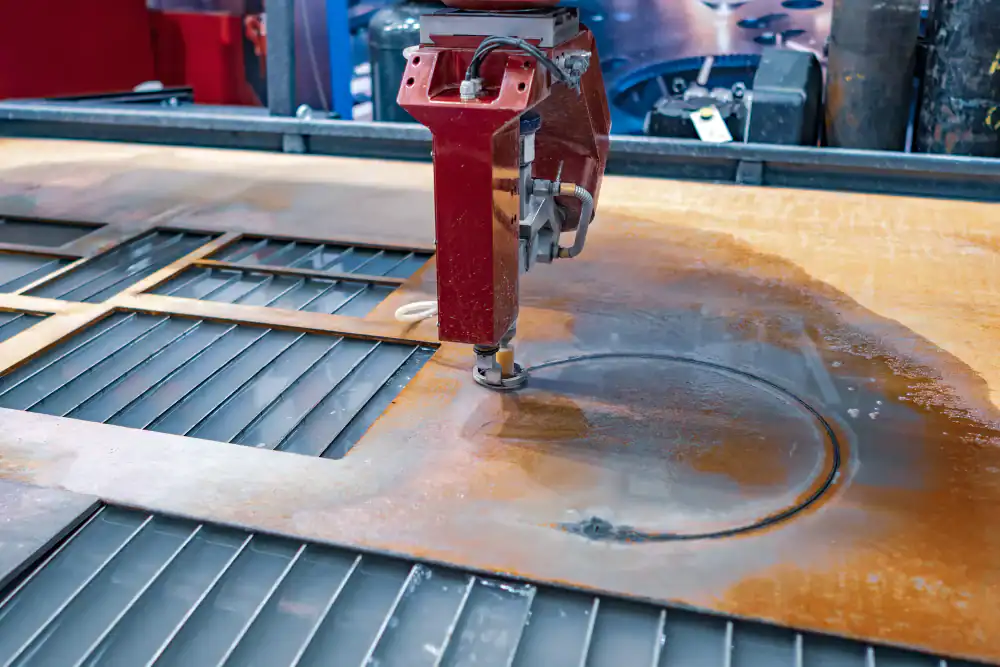
We cut virtually any metal you’re working with—aluminum, steel (including stainless and tool steel), titanium, brass, copper, and exotic alloys. The waterjet process doesn’t rely on heat, so it works on materials that would warp or harden with plasma or laser cutting.
Thickness capacity goes up to 8 inches, though most production work falls in the 1/4-inch to 2-inch range. Thinner materials cut faster, but the process handles thick plate without the edge quality degradation you’d see with other methods.
If you’re working with a specialty alloy or aren’t sure whether waterjet is the right process for your material, send us the specs. We’ll tell you straight whether it’s a good fit or if another cutting method makes more sense for your application.
The biggest difference is heat. Laser and plasma both use thermal energy to melt through metal, which creates a heat-affected zone that can warp thin materials or change the metal’s properties. Waterjet cutting metal uses mechanical force—high-pressure water and abrasive—so there’s zero thermal distortion.
That matters most when you’re working with tight tolerances or materials that can’t handle heat exposure. Waterjet also cuts thicker materials more effectively than laser. While laser excels at thin sheet metal, waterjet maintains edge quality through 8-inch plate.
The tradeoff is speed on very thin materials. For 16-gauge sheet metal in high-volume production, laser might be faster. But for anything over 1/4 inch, or when edge quality and dimensional accuracy matter more than raw speed, waterjet typically delivers better cost-per-part results. You’re also not limited by material reflectivity the way you are with laser—aluminum and copper cut just as easily as steel.
Most jobs run 3-5 business days from approved design files to finished parts. Rush service is available when your timeline demands it, though that depends on current shop capacity and the complexity of your cuts.
Simple 2D profiles in common materials cut faster than complex 3D shapes or very thick plate. If you’re running a prototype that needs to be in your hands by end of week, that’s usually manageable. Production runs get scheduled based on volume and material availability.
The best approach is to send your files as early in your project timeline as possible. We’ll give you a realistic completion date based on what’s actually happening in the shop, not an optimistic estimate that falls apart when your deadline hits. If supply chain issues are affecting your material availability, let us know—we can sometimes source common alloys faster than individual shops can.
Usually not. Waterjet cutting produces a finished edge that’s ready to weld, assemble, or use as-is in most applications. You’re not dealing with the slag cleanup required after plasma cutting or the heat scale from torch cutting.
The edge quality depends partly on cutting speed and material thickness. Thicker materials or faster cutting speeds might show slight striations on the bottom edge, but for most structural and functional applications, no secondary finishing is needed. If your application requires a completely smooth edge—like a decorative architectural panel—we can adjust cutting parameters to minimize striations, though that increases cutting time and cost.
For parts that need specific edge treatments like chamfers or radii, those would need to be added after cutting. But the raw waterjet edge is clean enough that you’re not adding grinding or deburring steps just to make the part usable. That time savings adds up quickly when you’re running production quantities.
Yes. CNC metal waterjet cutting in Sayville, NY holds tolerances within ±0.005 inches on most materials, which covers the majority of manufacturing applications. The CNC control allows for complex 2D profiles—curves, angles, interior cutouts, whatever your design requires—without tool changes or multiple setups.
The cutting stream is narrow (typically 0.030-0.040 inches), which means you can nest parts efficiently and cut fine details that would be difficult with wider-kerf processes. Sharp internal corners get a small radius equal to the stream width, but for most designs that’s not a limitation.
If your tolerances are tighter than ±0.005 inches, that’s worth discussing upfront. Some applications can achieve ±0.003 inches with optimized parameters and material selection, but that’s not a standard capability across all materials and thicknesses. For precision work, we’ll verify that waterjet is the right process before you commit to it. Sometimes a combination of waterjet cutting followed by minimal CNC machining gives you the best balance of cost and accuracy.
Pricing depends on material type, thickness, cutting time, and complexity. Thicker materials take longer to cut, which increases cost. Complex shapes with lots of direction changes take longer than simple rectangles. Harder materials require slower cutting speeds.
As a rough baseline, you’re typically looking at $1-3 per linear inch of cutting for common materials like aluminum and steel in standard thicknesses. That’s competitive with other precision cutting methods when you factor in the finished edge quality and lack of secondary operations.
The real cost advantage shows up in material efficiency. Because waterjet has such a narrow kerf and doesn’t require large lead-ins or heat-affected safety zones, you can nest parts tighter and get more pieces from each sheet. On expensive materials, that waste reduction often offsets the per-inch cutting cost. For an accurate quote on your specific project, send us your design files and material specs—we’ll give you a firm number based on actual cutting time, not a ballpark estimate that changes when you’re ready to order.
Useful Links
Other Services we provide in Sayville