Hear from Our Customers
Your parts come out dimensionally accurate to 0.001 inches. No warping from heat. No hardened edges that need grinding down. No secondary finishing eating into your timeline.
The cut surface is smooth enough to weld or assemble immediately. You’re not dealing with slag, burn marks, or stress fractures that show up later during load testing or quality control.
If you’re running aerospace components, automotive prototypes, or architectural metalwork, you already know that heat changes material properties. Waterjet cutting metal in Mastic, NY eliminates that variable entirely. The stream is cold, the kerf is narrow, and your material stays structurally sound from edge to edge.
You can stack materials to increase throughput. You can cut complex geometries without multiple setups. And you’re not limited by conductivity or thickness the way you are with plasma or laser.
We’ve been serving manufacturers, fabricators, and contractors across Long Island, NY with precision waterjet cutting services that don’t compromise material integrity. We work with aerospace suppliers, automotive shops, and custom fabricators who need accuracy without the guesswork.
Mastic sits in the heart of Suffolk County’s manufacturing corridor. You’re surrounded by shops that rely on precision cutting to stay competitive. We’ve worked with enough of them to know what matters: tight tolerances, fast turnaround, and parts that don’t need rework.
Our CNC metal waterjet cutting systems handle everything from single prototypes to production runs. You send the CAD file, we program the machine, and your parts come out right the first time.
You provide the CAD file or technical drawing with your specs. We review it for material type, thickness, tolerances, and any edge requirements you need to hit.
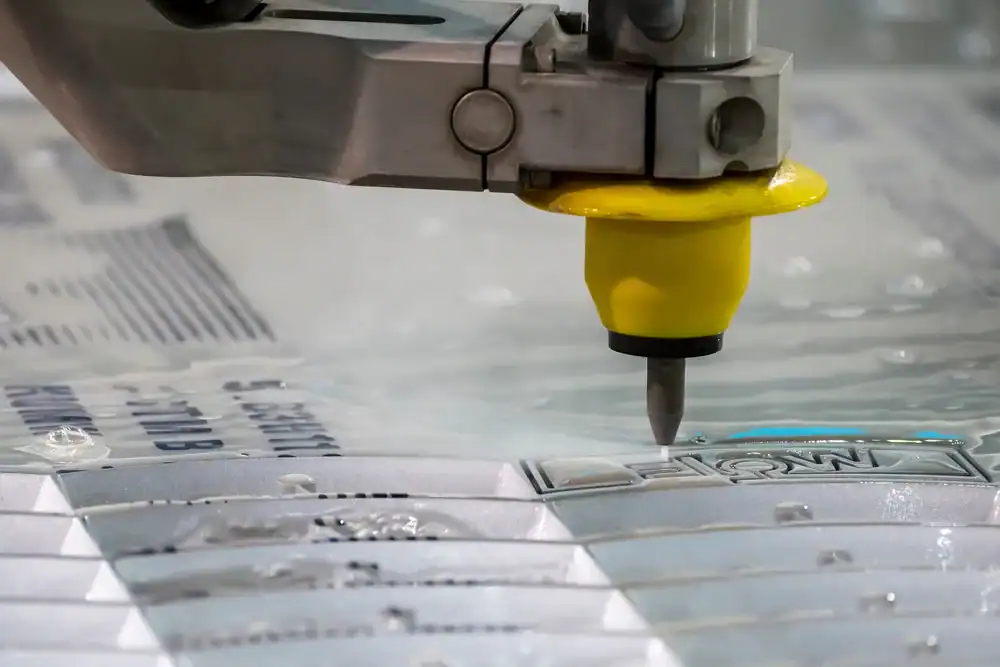
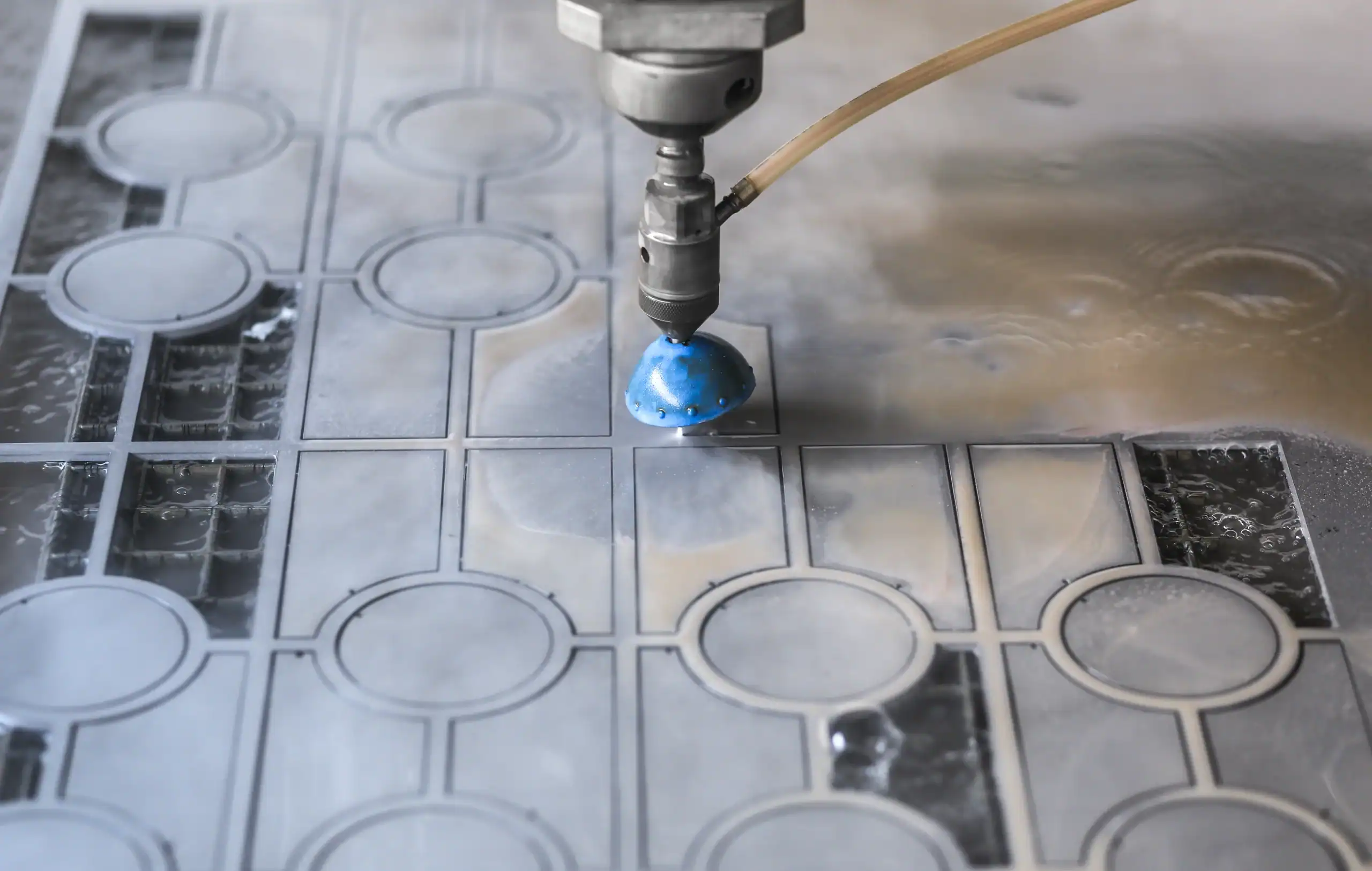
Once the file is programmed into the CNC system, we load your material onto the cutting bed. The waterjet stream—pressurized to around 60,000 PSI and mixed with abrasive garnet—follows the programmed path with pinpoint accuracy. There’s no heat, no blade wear, and no tool changes between complex curves and straight cuts.
The process is fast. Setup time is minimal because there’s no fixturing or clamping like you’d need with milling. The stream does the work, and the material stays cool throughout.
After cutting, parts are removed and inspected. Most jobs don’t need deburring or additional finishing. The edge quality is clean enough for welding, powder coating, or immediate assembly. If you’re running a batch, we can stack sheets to cut multiple layers at once and keep your per-piece cost down.
Ready to get started?
You get full CNC programming based on your file. We handle material consultation if you’re not sure whether your alloy or thickness is suited for waterjet. We cut steel, stainless, aluminum, titanium, copper, brass—basically any metal you’re working with.
Edge quality comes standard. You’re not paying extra for a smooth finish or tight tolerance. That’s built into the process. If you need parts nested to minimize scrap, we optimize the layout before cutting.
Mastic’s industrial landscape includes a lot of job shops and contract manufacturers who need flexible cutting capacity without the overhead of owning a waterjet system. That’s where custom metal waterjet cutting makes sense. You get access to the technology when you need it, and you’re only paying for the cuts you actually use.
Turnaround depends on complexity and volume, but most jobs move faster than you’d expect. There’s no heat cycle to manage, no cooldown period, and no tool wear slowing things down halfway through a run.
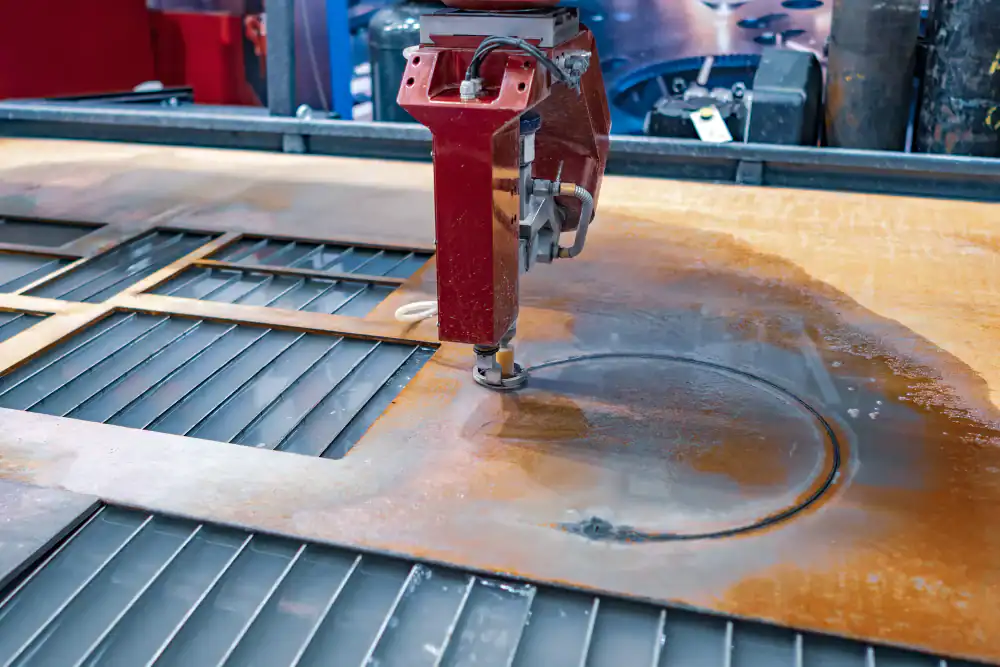
We cut steel, stainless steel, aluminum, titanium, copper, brass, and most aerospace alloys. The process works on both ferrous and non-ferrous metals without changing the setup.
Thickness isn’t a limiting factor the way it is with laser or plasma. We’ve cut steel plate up to 18 inches thick. Thinner gauge sheet metal cuts just as cleanly, and you’re not dealing with edge taper or heat distortion on either end of the spectrum.
If you’re working with exotic alloys or materials that are sensitive to heat—like certain aerospace grades—waterjet is usually the only method that won’t compromise the material’s properties. No heat-affected zone means no microstructural changes, no hardening, and no risk of introducing stress fractures that show up during inspection.
Waterjet holds tolerances down to 0.001 inches on most jobs. That’s tighter than plasma and comparable to laser, but without the heat-related issues that can throw off dimensions on thicker materials.
Laser cutting generates a heat-affected zone that can warp thin materials or change the temper on certain alloys. Plasma is even worse for precision work—it’s fast and cheap, but you’re looking at wider kerfs and rougher edges that need secondary finishing.
Waterjet gives you a narrow kerf, minimal material waste, and edge quality that’s smooth enough to skip the grinder in most cases. If you’re cutting parts that need to fit together with tight clearances, waterjet is the more reliable process. You’re not chasing dimensions or compensating for thermal expansion during the cut.
Yes. The stream diameter is small enough to navigate intricate geometries, tight radii, and detailed patterns without changing tools or repositioning the material.
CNC programming lets us follow any path your CAD file specifies. Sharp inside corners, curved edges, cutouts, slots—it all gets cut in a single pass. You’re not limited by tool access or clearance issues the way you would be with a milling machine.
If your design has a lot of small features or closely spaced holes, waterjet handles that without walking or deflecting. The abrasive stream stays focused and consistent throughout the cut. That’s especially useful for parts that need multiple features in a single setup, because you’re not adding time or cost for tool changes or secondary operations.
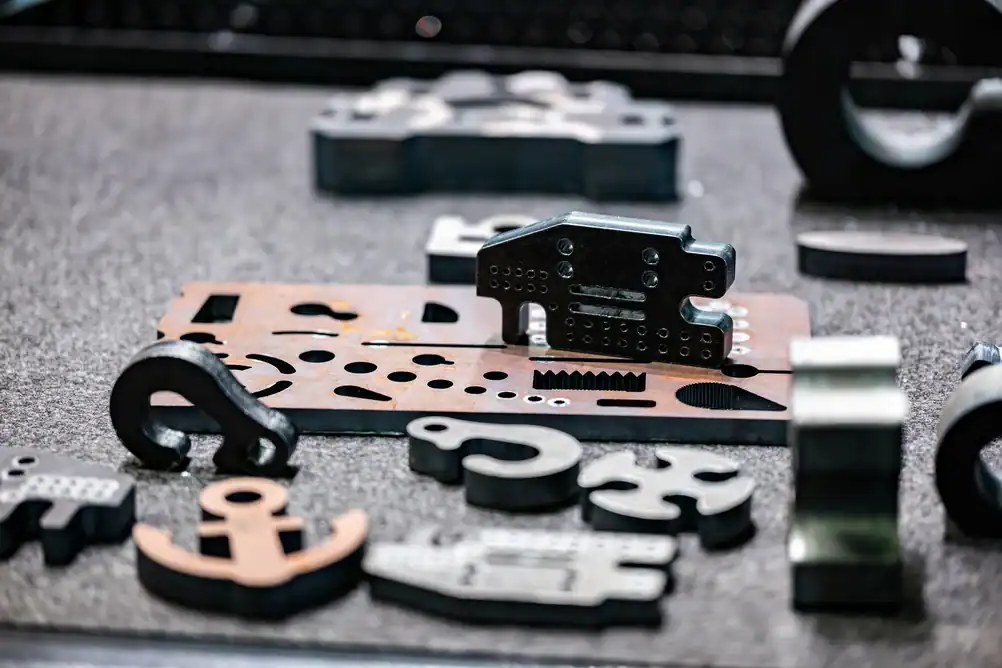
Most parts come off the table ready to use. The edge is smooth, and there’s no slag or burr like you’d get from plasma or oxy-fuel cutting.
Because there’s no heat, you’re not dealing with hardened edges or oxidation. The cut surface is clean enough for welding, powder coating, or anodizing without additional prep. If you’re assembling parts immediately after cutting, you can skip the deburring step entirely in most cases.
Thicker materials might show a slight texture variation between the top and bottom edge, but it’s minimal and doesn’t affect fit or function. If your application requires a perfectly uniform edge finish, we can adjust feed rates or make a finish pass. But for the majority of jobs—especially structural or mechanical components—the standard edge quality is more than sufficient.
Waterjet is efficient for both prototypes and production. We can stack materials to cut multiple layers at once, which increases throughput without sacrificing accuracy.
Setup time is faster than traditional machining because there’s no fixturing, clamping, or tool selection. Once the CNC program is loaded, the machine runs continuously. You’re not stopping mid-job to swap bits or adjust feeds and speeds.
For repeat orders, we save your program and material specs. That means faster turnaround on subsequent runs and consistent results across batches. If you’re scaling up from a prototype to a full production order, the process stays the same. You’re not re-engineering the cut or adjusting for different equipment.
Waterjet doesn’t introduce heat, so your material properties stay intact. That matters if you’re working with aerospace alloys, hardened steel, or anything that’s been heat-treated to specific tolerances.
Laser and plasma both create a heat-affected zone. That can cause warping, change the grain structure, or introduce residual stress that leads to cracking down the line. If your parts are going into structural applications or need to pass stringent quality inspections, heat damage isn’t something you can afford to ignore.
Waterjet also cuts thicker materials than laser can handle and does it more accurately than plasma. You get better edge quality, tighter tolerances, and fewer secondary operations. If you’re comparing cost per part, waterjet often comes out ahead once you factor in the time and labor saved on finishing work.
Useful Links
Other Services we provide in Mastic