Not sure if waterjet cutting fits your project? This guide breaks down when waterjet beats laser and plasma—covering materials, thickness, tolerances, and real costs.

You’ve got a design file, a material spec, and a deadline. Now you need to figure out how to actually cut the thing. Laser? Plasma? Waterjet? Each shop you call gives you a different answer, and you’re left wondering which method won’t waste your material or blow your budget.
Here’s what matters: the cutting method you choose affects whether your parts fit together, whether your expensive materials get ruined by heat, and whether you’re paying for secondary finishing you didn’t budget for. This isn’t about technology for technology’s sake. It’s about getting parts that work the first time.
Let’s walk through when waterjet cutting makes sense for your project—and when it doesn’t.
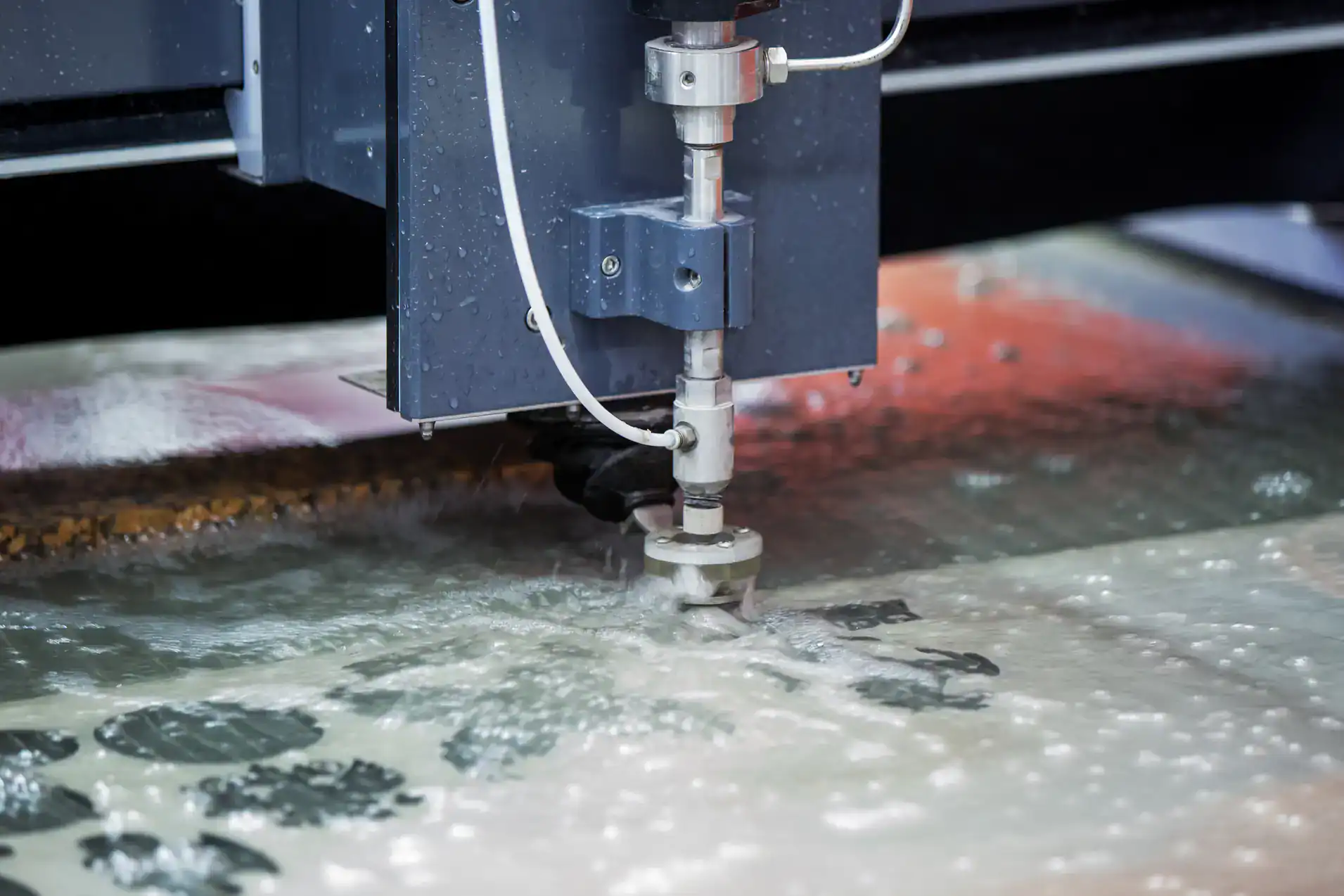
Waterjet cutting uses high-pressure water—often 50,000 to 90,000 PSI—mixed with abrasive particles to cut through materials. The water accelerates the abrasive to supersonic speeds, and that stream erodes material in a controlled, precise path programmed from your CAD file.
The key difference from laser or plasma: no heat. The water acts as a coolant, so you’re not melting, burning, or vaporizing anything. You’re mechanically wearing through the material, similar to how a bandsaw works, except the “blade” is a thin stream of water and garnet moving faster than sound.
That cold cutting process is why precision waterjet cutting works on materials that would crack, warp, or burn under thermal methods. It’s also why the edges come out smooth and why you’re not dealing with heat-affected zones that change material properties.
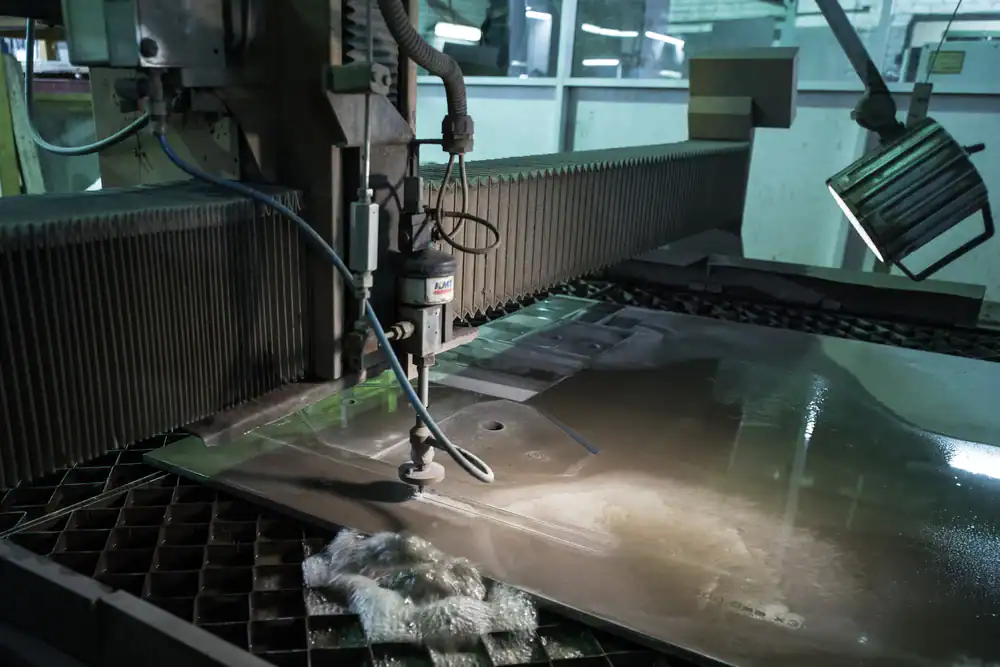
You send over your CAD file—DXF, DWG, or STEP format. We review it to catch any issues that would cause problems during cutting. Things like tolerances that are too tight for the material thickness, or geometry that would create weak points.
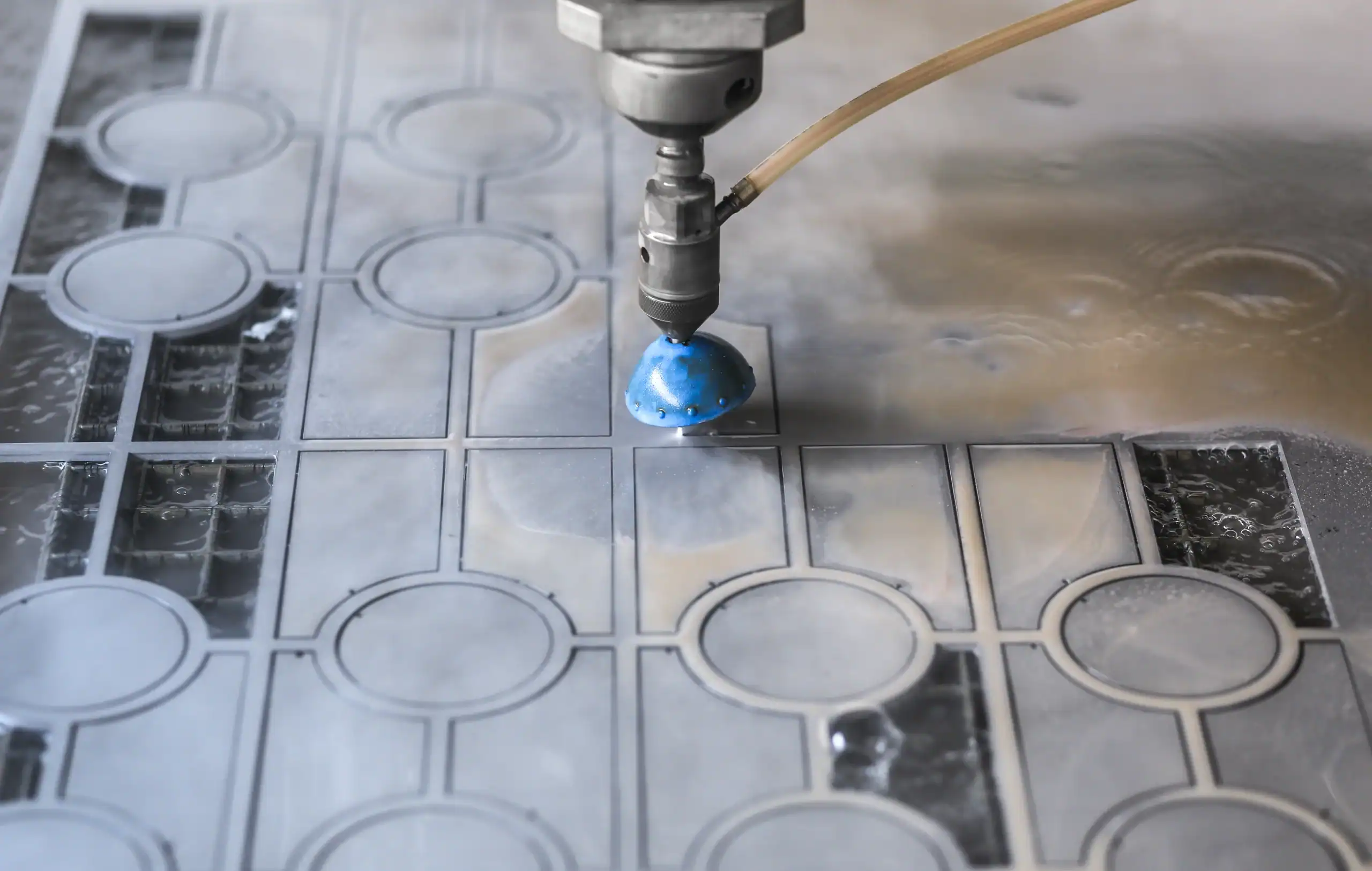
Once the file is approved, it goes into the CNC controller. The waterjet system positions the cutting head, pierces the material at a designated starting point, and follows the programmed path. The cutting head moves in any direction with precision down to thousandths of an inch.
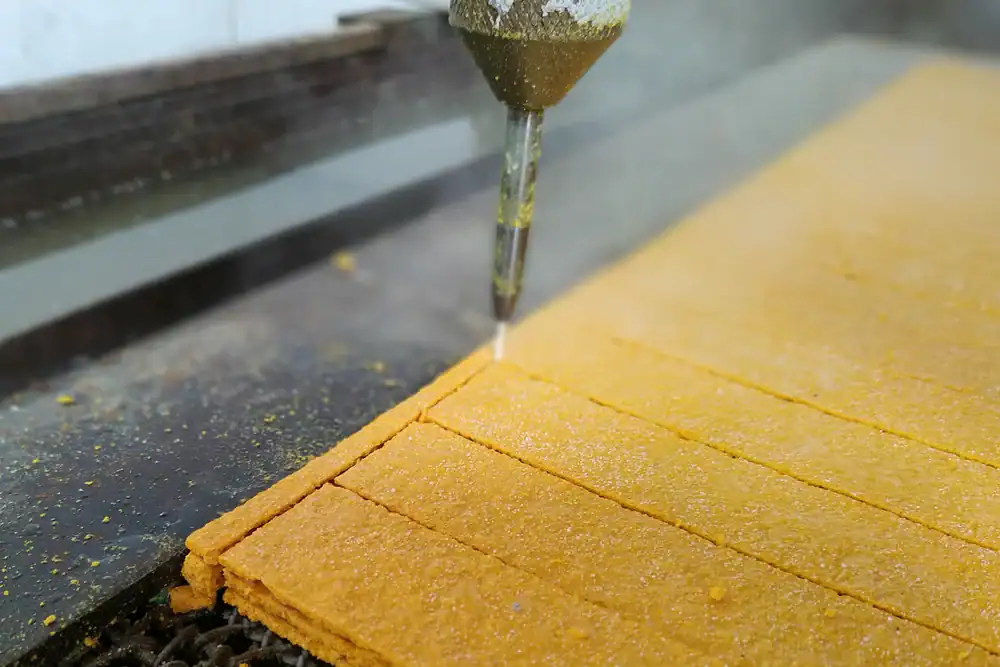
For soft materials like foam, rubber, or gaskets, pure water is enough. For harder materials—metals, stone, glass, composites—the system adds garnet abrasive into the water stream through a venturi vacuum. The abrasive is what actually does the cutting on tough materials.
The mixing happens inside the cutting head. High-pressure water passes through a jewel orifice (usually sapphire or diamond) that focuses it into a coherent jet. That jet then pulls abrasive into the stream, and the mixture passes through a ceramic mixing tube that aligns everything into a cutting stream.
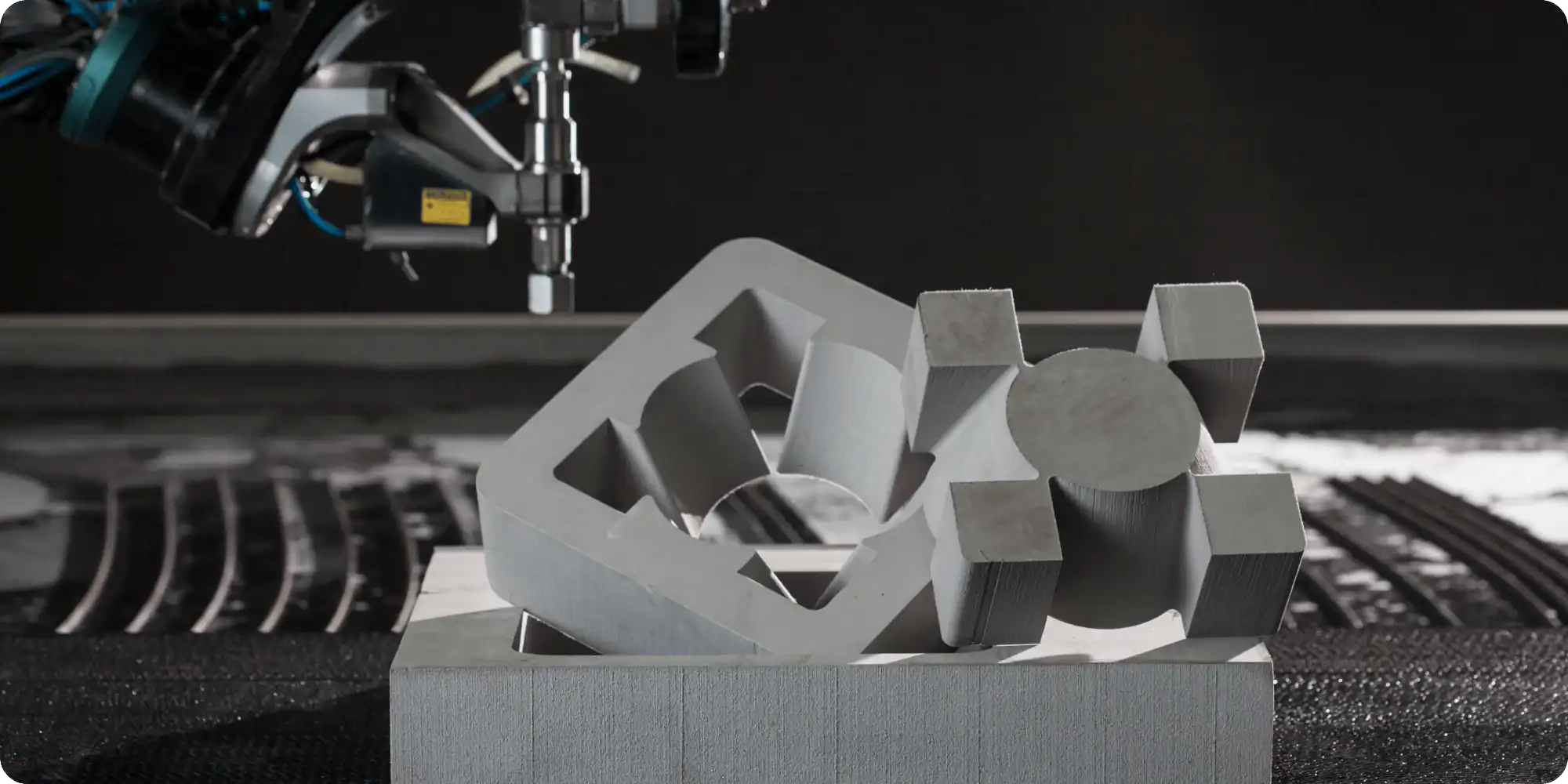
The part gets cut in a single setup. No tool changes between materials. No repositioning for complex shapes. Internal cutouts, sharp corners, gradual curves—all done in one pass. The water-filled tank below catches the spent jet and dissipates its energy.
After cutting, most parts come off the table ready to use. The edge quality is smooth enough that secondary finishing is often unnecessary, especially for structural or mechanical applications. If you need a specific edge finish—like polished glass or deburred metal for safety—that’s a separate step, but it’s not required just to clean up rough cuts.
Custom waterjet cutting handles virtually anything except tempered glass and diamond. Metals up to 6 inches thick or more. Stone, marble, granite. Glass, ceramics, tile. Composites, carbon fiber, fiberglass. Plastics, acrylics, polycarbonate. Rubber, foam, wood. Even food products in processing applications.
That versatility matters when your project uses multiple materials that need to fit together. One cutting process handles all of them with the same precision. You’re not coordinating between different vendors or dealing with tolerance stack-up from different methods.
Laser cutting works well on metals like stainless steel, mild steel, and aluminum—but only up to about 1 inch thick for most systems. Beyond that, the heat buildup causes problems. Reflective metals like copper and brass are difficult because the laser beam reflects instead of cutting. Thermally sensitive materials can melt, discolor, or warp. Non-metals like stone or thick glass don’t work at all.
Plasma cutting only works on electrically conductive metals: steel, stainless steel, aluminum, copper, brass. That’s it. No stone, no glass, no composites, no plastics. It’s fast and cost-effective for thick steel plates, but the material range is narrow.
If your project involves heat-sensitive materials, waterjet is often the only option. Thin aluminum that would warp under laser heat. Composites that would delaminate. Hardened tool steel where you can’t afford a heat-affected zone that changes hardness. Materials where thermal stress creates micro-cracks that show up later as failures.
The cold cutting process also means you can stack different materials and cut them together. Multi-layer assemblies. Dissimilar materials that need to align perfectly. Prototype variations where you’re testing different material combinations. Waterjet handles that without the limitations thermal methods face.
Thickness is another major factor. Metal waterjet cutting excels at thick materials—anywhere from a fraction of an inch up to 6 inches or more, depending on the material. Laser cutting typically maxes out around 1 inch, and quality degrades as you approach that limit. Plasma can cut thick steel, but the edge quality suffers and the kerf (cut width) gets wider, wasting more material.
Want live answers?
Connect with a Tri-State Waterjet expert for fast, friendly support.
Waterjet isn’t always the right answer. It’s slower than laser cutting and more expensive per hour to operate than plasma. But there are specific situations where it’s the only method that delivers what you need—or the most cost-effective option when you factor in the full project cost.
If your material can’t handle heat, waterjet is usually your only choice. If you need tight tolerances on thick material, waterjet delivers where other methods struggle. If you’re working with expensive alloys and can’t afford waste, the narrow kerf and precision nesting make waterjet more economical despite higher operating costs.
Let’s look at the specific scenarios where waterjet cutting is the right call.

Thick materials are where waterjet shines. Anything over 1 inch thick in metal, and laser cutting starts to struggle. The heat buildup causes warping, the cut quality degrades, and you often need secondary finishing to clean up the edges. Plasma can cut thick steel, but you’re dealing with a wide kerf, rough edges, and significant heat-affected zones.
Waterjet cuts 2-inch, 4-inch, even 6-inch thick materials with consistent edge quality. The precision doesn’t degrade with thickness the way it does with thermal methods. You’re not fighting heat distortion or dealing with material properties that changed because of thermal stress.
Heat-sensitive applications are another clear win for waterjet. Aerospace parts where micro-cracks from thermal stress aren’t acceptable. Medical devices where material properties must remain unchanged. Defense applications with strict quality requirements. Composites and carbon fiber that would delaminate under heat. Thin metals that warp when you apply a thermal cutting method.
Multi-material projects benefit from waterjet’s versatility. Architectural installations using metal, stone, and glass that all need to fit together. Custom assemblies combining aluminum brackets with acrylic panels. Prototype development where you’re testing different material combinations. One cutting process handles everything with consistent tolerances, so parts actually fit together without shimming or rework.
Complex geometries with tight tolerances are where CNC waterjet cutting delivers. Intricate patterns in architectural metalwork. Beveled edges and weld prep surfaces that would require multiple setups on other machines. Internal cutouts with sharp corners. Parts with features that need to mate precisely with other components.
Expensive materials justify waterjet’s higher operating cost through reduced waste. Titanium, Inconel, specialty alloys—when the material costs hundreds of dollars per pound, the narrow kerf and precision nesting save more money than you spend on cutting time. A laser kerf might be 0.3-0.5mm, plasma 2-3mm, but waterjet is typically 0.8-1.2mm. That difference adds up fast on expensive stock.
Projects requiring no secondary finishing benefit from waterjet’s edge quality. The smooth, burr-free edges often go straight to welding or assembly. You’re not paying for grinding, deburring, or polishing that eats into your timeline and budget. For production runs, eliminating secondary operations can make waterjet more cost-effective than faster cutting methods that require cleanup.
Material combinations that other methods can’t handle are where waterjet becomes the only option. Reflective metals like copper that cause problems for lasers. Stone and glass that thermal methods can’t cut without shattering. Layered materials where heat would cause delamination. Foam and rubber that would melt under thermal cutting. For glass waterjet cutting or marble waterjet cutting projects, thermal methods aren’t viable options.
Waterjet cutting typically costs $15-30 per hour to operate, compared to $13-20 for laser and $10-15 for plasma. That’s the operating cost. But project cost is different from hourly operating cost, and that’s what actually matters for your budget.
Factor in the full cost: material waste, secondary finishing, rework from parts that don’t fit, delays from coordinating multiple vendors, and scrapped parts from heat damage. Waterjet often comes out ahead even with higher hourly rates.
Material waste is where the math changes. If you’re cutting expensive alloys, the narrow kerf and efficient nesting can save 10-15% of your material cost. On a project using $5,000 worth of titanium, that’s $500-750 in material savings. The cutting cost difference might be $100-200. You’re ahead by several hundred dollars.
Secondary finishing is another hidden cost. Laser and plasma often leave burrs, dross, or rough edges that need grinding or tumbling. Those secondary operations cost labor time and may require sending parts to another vendor. Waterjet edges typically don’t need finishing for structural or mechanical applications. You’re saving both time and money by eliminating that step.
Rework costs add up fast. When parts don’t fit because of heat distortion or dimensional inaccuracy, you’re paying to recut them. Plus the cost of the scrapped parts and material. Plus the delay to your project timeline. Waterjet’s precision and lack of heat distortion reduce rework risk significantly.
Speed matters, but not always the way you think. Laser cutting is faster per inch than waterjet—sometimes 10-70 times faster on thin materials. But if that laser-cut part needs deburring, or if the heat caused warping that requires correction, your total time from file to finished part might actually be longer.
For thick materials, the speed difference narrows. Laser cutting 2-inch steel is slow and produces poor edge quality. Waterjet cutting the same material might take longer, but the edge comes out ready to use. When you factor in the full process, waterjet can be faster from start to finish.
Project complexity also affects the cost calculation. If your design requires multiple materials, waterjet handles all of them without setup changes. Coordinating between a laser shop for metals, a stone cutter for marble, and a glass shop for specialty glass adds overhead, delays, and quality risk. One vendor doing everything with consistent tolerances simplifies your project management and reduces total cost.
Tolerance requirements matter. If your parts need to fit within ±0.001-0.003 inches, precision waterjet cutting delivers that consistently. Plasma cutting can’t hit those tolerances. Laser cutting can on thin materials but struggles on thick ones. If tight tolerances are non-negotiable, paying for waterjet cutting eliminates the risk of parts that don’t meet spec.
The right cutting method depends on your specific materials, thickness, tolerances, and timeline. Waterjet cutting makes sense when you need heat-free cutting, when you’re working with thick or sensitive materials, when tight tolerances matter, or when you’re using multiple materials that need to fit together.
It’s not always the cheapest option per hour, but it’s often the most cost-effective when you factor in material waste, secondary finishing, and rework. For projects involving architectural metalwork, precision manufacturing, marine components, or custom fabrication, waterjet cutting delivers results that thermal methods can’t match.
If you’re evaluating cutting methods for an upcoming project, we can review your specifications and provide guidance on whether a waterjet is the right fit—or if another method makes more sense for your application.
Summary:
Share: