Wondering how thick waterjet cutting can go? From 12-inch steel to delicate glass, learn what's possible with precision waterjet cutting and why thickness isn't your only concern.
You’re looking at a project that needs precision cuts in material that’s either too thick, too expensive, or too delicate for traditional methods. Maybe you’ve already been told it can’t be done. Or maybe you’re just trying to figure out if waterjet cutting is the right call before you commit to a process that could waste time and material.
The thickness question comes up constantly. But it’s not the only thing that matters. What really determines whether precision waterjet cutting works for your project is the combination of material type, required tolerances, edge quality, and whether you can afford heat damage. Let’s walk through what you actually need to know.
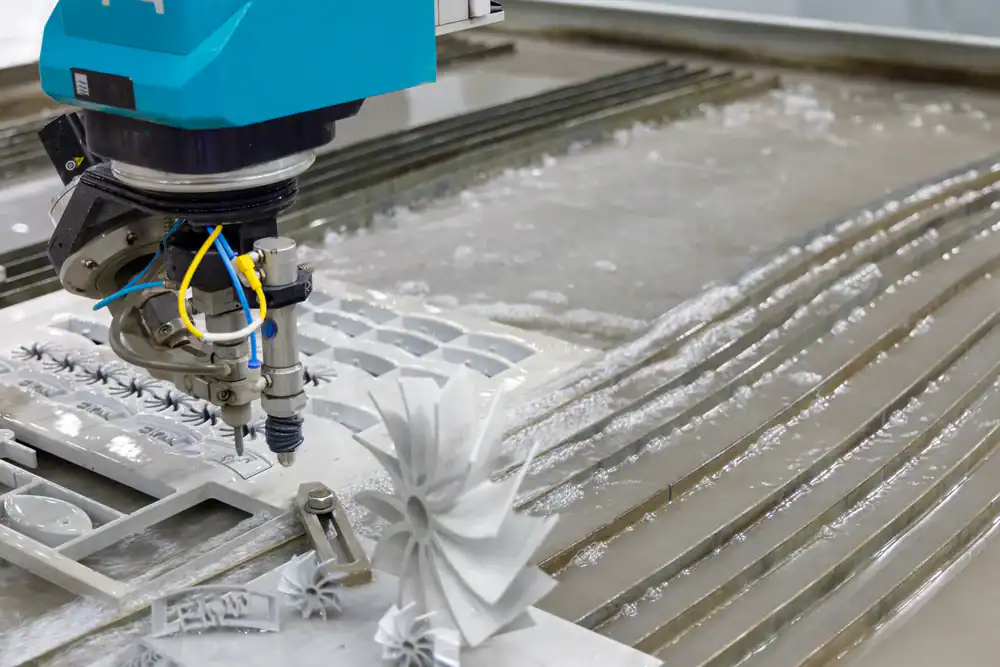
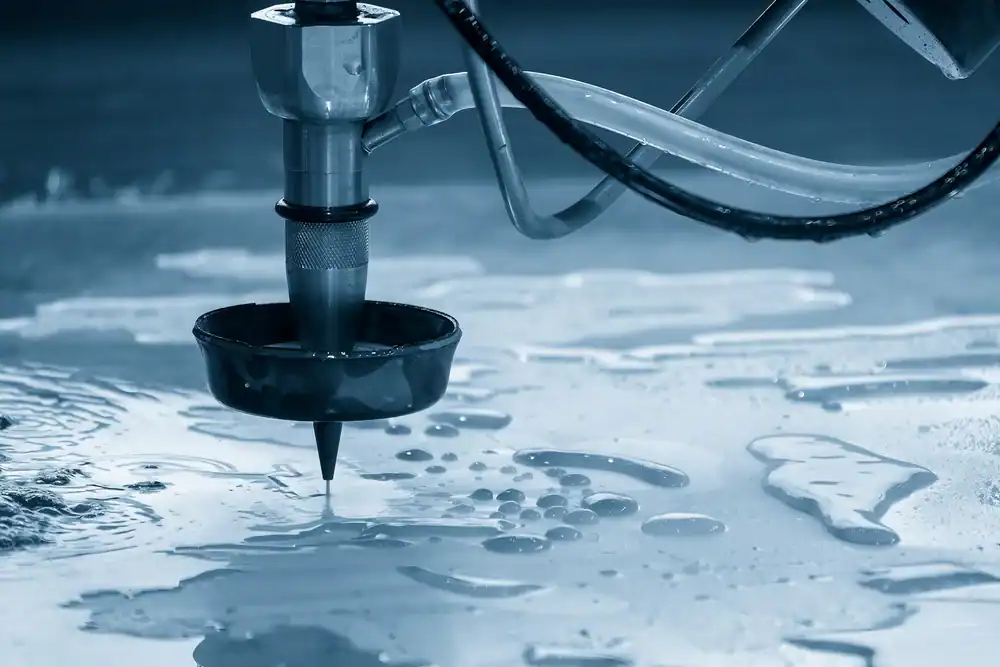
Precision waterjet cutting uses high-pressure water—often exceeding 60,000 psi—mixed with abrasive garnet particles to cut through materials. The stream moves at speeds approaching Mach 3, eroding material with mechanical force rather than heat.
For harder materials like metal, stone, and glass, the abrasive does the heavy lifting. For softer materials like foam or rubber, pure water is sometimes enough. The process is CNC-controlled, meaning your CAD file translates directly into cutting paths with tolerances as tight as ±0.001 inches.
What makes this a cold cutting process is that the water doesn’t generate enough heat to alter your material’s properties. There’s no heat-affected zone, no warping, no hardened edges. The material you start with is the material you end with—just in the shape you specified.

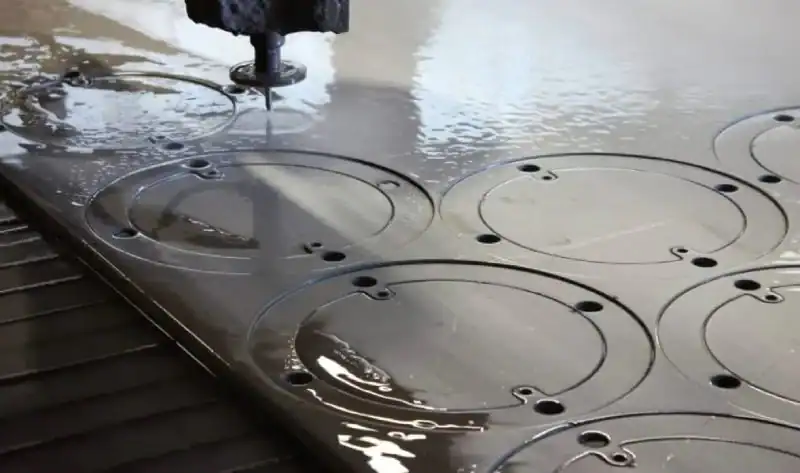
Metal waterjet cutting thickness depends on the specific alloy and your tolerance requirements. Mild steel cuts reliably up to 8 inches with standard equipment, though the practical limit for maintaining tight tolerances sits closer to 6 inches. Stainless steel maxes out around 6 inches while keeping edge squareness acceptable.
Aluminum is softer and cuts faster. You can push to 8-10 inches depending on the grade. Titanium, being dense and expensive, typically stays in the 6-8 inch range—not because the waterjet can’t penetrate deeper, but because cutting speed slows dramatically and cost per part climbs.
Here’s what changes as thickness increases. The waterjet stream has to penetrate deeper, which means slower traverse speeds to maintain cut quality. Thicker materials also introduce more pronounced taper—the cut is slightly wider at the top than the bottom—unless you’re using 5-axis equipment with taper compensation. For most structural and mechanical applications, this taper is negligible. For precision assemblies, it matters.
The other factor is kerf quality. On thinner materials, you get smooth, nearly polished edges that often require no secondary finishing. As you approach maximum thickness, the bottom edge can show more striations. It’s still cleaner than plasma or saw cutting, but it’s not identical top to bottom. If both sides of your cut need to be used without scrap, you’ll want to discuss that upfront.
What you won’t get with metal waterjet cutting is heat distortion. Laser and plasma both create heat-affected zones that can warp thin stock or harden edges on thicker plate. Waterjet eliminates that completely. Your material properties stay consistent all the way through.
Glass waterjet cutting and marble waterjet cutting behave differently than metal under the stream. Architectural glass typically cuts up to 4 inches thick without issue. That covers most commercial and residential applications—panels, custom shapes, decorative elements. The process doesn’t create thermal stress, so you avoid the micro-fractures that can form with other cutting methods.
Tempered glass is the exception. It can’t be cut with waterjet—or any method, really—without shattering. The tempering process creates internal stresses that are released catastrophically when you try to cut through. If your project requires tempered glass, it needs to be cut and shaped before tempering.
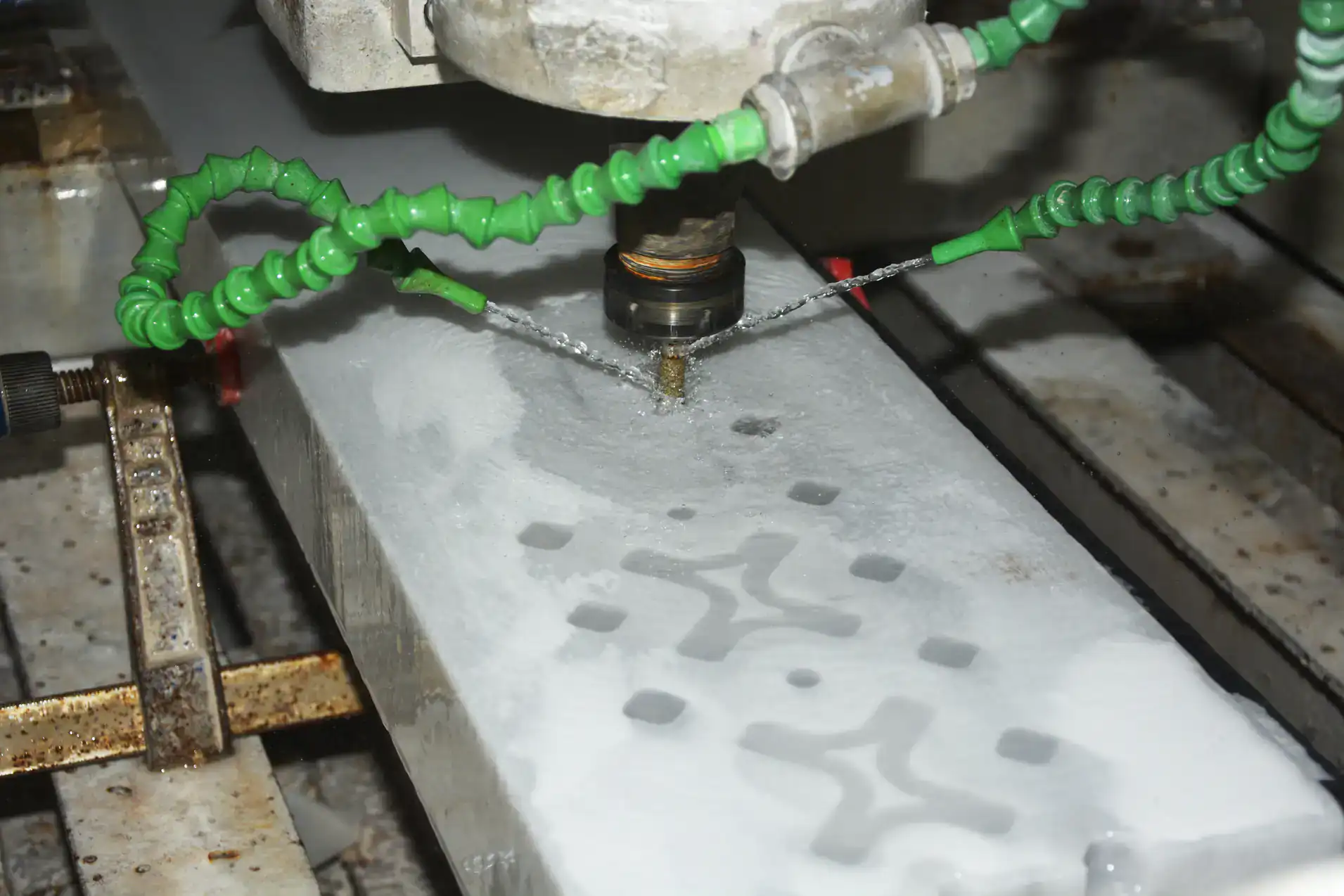
Stone is where custom waterjet cutting really shines. Marble, granite, and similar materials cut cleanly up to 12 inches thick. The abrasive stream erodes through the stone without creating the chipping or cracking you’d see with saw blades. Thicker slabs take longer to cut because the stream has to penetrate deeper, but the precision holds.
For marble specifically, you’re looking at the ability to create intricate inlays, tight inside corners, and complex patterns that traditional stone cutting can’t touch. A 3/4-inch slab cuts faster than a 2-inch piece, but both come out with the same edge quality and dimensional accuracy. That’s critical when you’re doing luxury installations where tolerances are measured in thousandths and pieces need to fit together seamlessly on the first try.
The real advantage with stone and glass is that edges come off the machine ready to use. You’re not scheduling additional grinding or polishing unless your design specifically calls for it. That saves time and keeps your project moving—especially important for Long Island contractors managing tight renovation and construction schedules.
One thing to watch with very thick stone—anything over 8 inches—is lead time. Cutting speed slows as thickness increases, and if we’re in a busy season, that affects how quickly your job can start. Spring through fall tends to be peak construction season on Long Island, which means longer queues. If you have a hard deadline, communicate that early so expectations stay realistic.
Want live answers?
Connect with a Tri-State Waterjet expert for fast, friendly support.
Tolerance is where precision waterjet cutting separates itself from rougher methods like plasma. Standard tolerances range from ±0.001 inches to ±0.005 inches depending on material, thickness, and cutting speed. For most structural, mechanical, and architectural applications, ±0.005 inches is more than adequate.
If you need tighter tolerances—±0.002 inches or better—it’s achievable, but it requires slower cutting speeds, premium equipment calibration, and sometimes test cuts to dial in parameters. Not every shop can guarantee that level of precision consistently. The ones that can typically work with aerospace, medical, or high-end manufacturing clients where dimensional accuracy isn’t negotiable.
Thicker materials present more tolerance challenges. A 1-inch plate holds tighter tolerances more easily than a 6-inch plate because there’s less opportunity for the stream to deflect or taper. That doesn’t mean thick materials can’t be cut precisely—it just means the process requires more attention to parameters like abrasive flow, nozzle condition, and traverse speed.

Several factors determine whether your parts come out within spec. Machine rigidity matters—if the gantry or table flexes under cutting forces, precision suffers. Quality waterjet systems use reinforced frames and precision linear guides to minimize deflection.
Nozzle wear is another variable. The orifice and focusing tube erode over time from the abrasive stream. A worn nozzle produces a less focused jet, which means wider kerf and reduced accuracy. Shops that maintain tight tolerances replace nozzles proactively rather than running them until they fail.
Water pressure consistency plays a role too. If the pump can’t maintain stable pressure throughout the cut, you’ll see variations in edge quality and dimensional accuracy. Direct-drive and intensifier pumps each have advantages, but both need to deliver consistent pressure to produce consistent results.
Material properties also matter. Harder materials resist cutting more than softer ones, which affects how fast you can traverse without sacrificing quality. Cutting too fast leaves uncut material at the bottom. Cutting too slow wastes time and money. Finding the right balance requires experience with the specific material you’re working with.
Operator skill ties it all together. An experienced operator knows how to adjust for material thickness, optimize abrasive flow, compensate for nozzle wear, and catch problems before they ruin expensive stock. The machine does the cutting, but the operator makes the decisions that determine whether your parts meet spec.
For projects where tolerances are critical, ask about the shop’s calibration process, how often they replace consumables, and whether they do test cuts before running production. Shops that take precision seriously will have answers ready. Shops that don’t will give you vague assurances that everything will be fine.
Laser cutting excels on thin materials—typically under 1 inch for steel. It’s fast, precise, and produces excellent edge quality on materials in its sweet spot. But lasers can’t handle thick plates, struggles with reflective metals like copper and aluminum, and creates heat-affected zones that can warp or harden material.
Plasma cutting handles thicker materials than laser—usually up to 2 inches—and cuts conductive metals quickly at lower cost. But plasma produces rough edges that often need secondary finishing, creates large heat-affected zones, and lacks the precision needed for tight-tolerance work. It’s a production tool, not a precision tool.
Waterjet sits in a different category. It cuts thicker than laser, more precisely than plasma, and works on virtually any material without heat damage. The tradeoff is speed. Waterjet is slower than both laser and plasma on materials they can handle. But when you factor in the lack of secondary finishing, the ability to cut heat-sensitive materials, and the precision you get out of the gate, the speed difference often becomes irrelevant.
For thick metals—anything over 2 inches—waterjet is often the only viable option that maintains edge quality and dimensional accuracy. Plasma can cut thicker, but the edge finish and precision suffer. Lasers can’t cut that thick at all. If your project involves 4-inch steel plate, 6-inch aluminum, or 8-inch stone, waterjet isn’t just an option—it’s usually the only practical choice.
The other consideration is material versatility. If you’re cutting multiple materials—say, stainless steel brackets and marble inlays for the same architectural project—waterjet handles both without changing equipment or setup. Lasers and plasma can’t touch stone. That flexibility matters when you’re managing complex projects with mixed materials, especially for Long Island’s diverse manufacturing base that spans aerospace, marine fabrication, and architectural work.
Cost per part depends on your specific application. Plasma is cheapest for thick conductive metals where precision isn’t critical. Laser is most cost-effective for thin materials with complex geometries. Waterjet makes sense when you need precision on thick materials, can’t tolerate heat damage, or are working with non-metals that other methods can’t handle.
Thickness capability matters, but it’s not the whole story. What really determines whether precision waterjet cutting works for your project is if you need clean edges without heat damage, tight tolerances on thick or difficult materials, and the flexibility to cut complex shapes that traditional methods can’t handle.
If you’re working with expensive materials where waste isn’t an option, or if your project demands precision that plasma can’t deliver and thickness that laser can’t handle, waterjet cutting is worth the conversation. The process eliminates the most common failure points—heat distortion, rough edges, cracked stone, warped metal—that cost time and money to fix.
For projects on Long Island, we handle the custom work and specialized fabrication that requires both precision and material knowledge. If your project fits that description, reach out and talk through what you’re trying to accomplish.
Summary:
Article details:
Share: