When tight tolerances and complex materials are on the line, precision waterjet cutting delivers where other methods fall short — here's why Long Island manufacturers keep coming back to it.
If you’ve ever gotten parts back warped, discolored, or just slightly off — you already know what’s at stake when the cutting method doesn’t match the job. For manufacturers, fabricators, architects, and marine builders across Long Island, that kind of rework isn’t just frustrating. It’s expensive, and it throws off every deadline downstream.
We solve that problem at the source with precision waterjet cutting. No heat. No distortion. Tolerances that actually hold. And a process flexible enough to handle the full range of materials that Long Island’s industries demand. Here’s a closer look at how it works, and why it’s become our go-to for complex industrial components across this region.
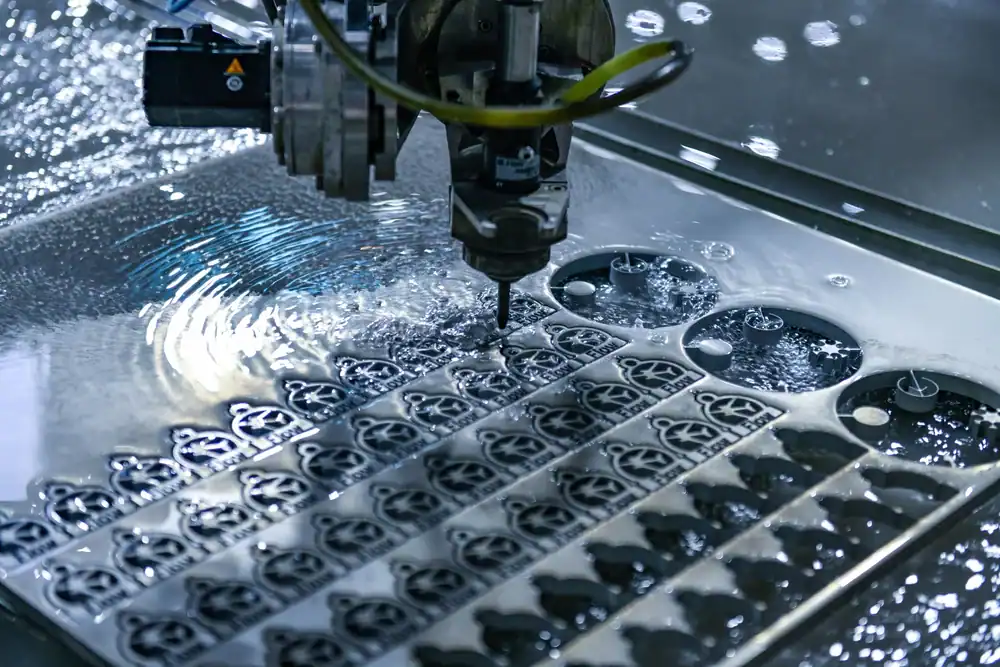
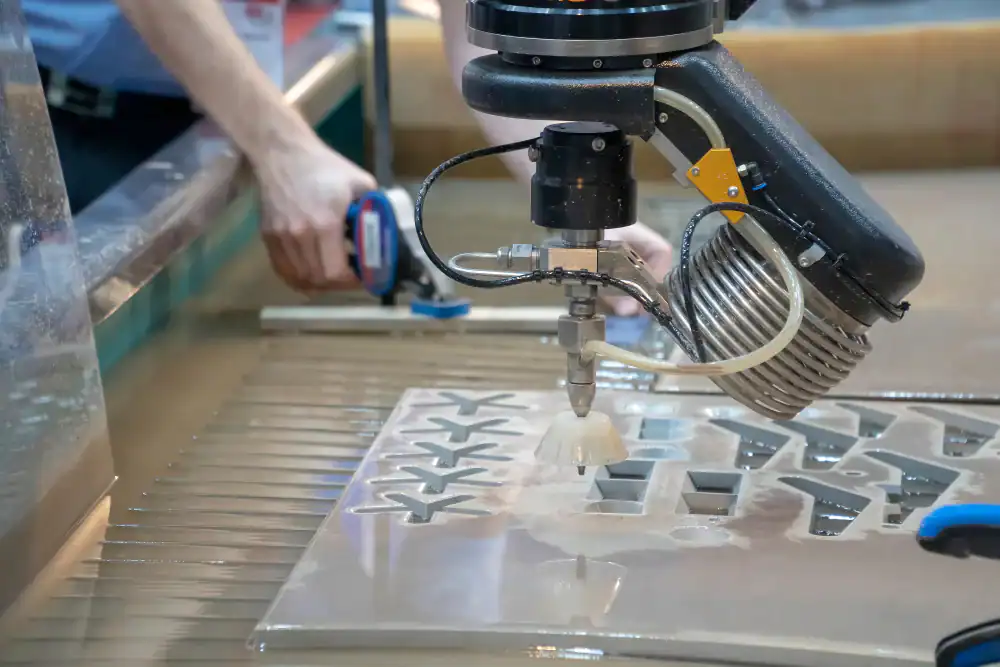
At its core, waterjet cutting uses a highly pressurized stream of water — often mixed with a fine abrasive material called garnet — to cut through virtually any material with exceptional accuracy. Our CNC-controlled systems drive the cutting path directly from your CAD file. There’s no manual guesswork involved, and there’s no heat generated during the cut.
That last point matters more than it might seem. Because there’s no thermal energy entering the material, the part comes off the cutting bed exactly as designed — same dimensions, same material properties, same structural integrity. What you drew is what you get.

This is one of the most common questions buyers ask before committing to a cutting method, and it’s the right question to ask. Tolerances determine whether your part fits the first time or ends up as scrap.
Our CNC waterjet systems hold tolerances within ±0.005 inches as a standard operating parameter. For more demanding applications, we can achieve tolerances as tight as ±0.001 inches using advanced cutting technology. To put that in perspective, plasma cutting typically lands around ±0.030 inches — roughly six times less precise. When you’re working on aerospace brackets, marine hardware, or architectural components where fit and finish are non-negotiable, that gap is significant.
The precision comes from a combination of factors: the quality of the equipment, how the file is set up before the cut begins, and how well the machine maintains its calibration over time. We run the Flow Mach 500, a professional-grade industrial waterjet system used by aerospace manufacturers and precision fabricators worldwide. It’s not entry-level equipment, and that shows in the output.
Before any material hits the cutting bed, we review every submitted file — whether it’s a DXF, DWG, or STEP — using AI-assisted CAD tools to catch dimension errors, outdated revisions, or formatting issues that would otherwise result in a scrapped part. That review step alone has saved our customers significant time and material cost. A lot of shops skip it. We don’t, because getting it right the first time is the whole point.
For buyers who have been burned before — received parts that were technically “cut to spec” but didn’t fit because the spec had an error no one caught — this process is a meaningful change. You’re not just paying for a cut. You’re paying for a result that matches your design.
The term “cold cutting” refers to the fact that waterjet cutting introduces zero heat into the material. There’s no flame, no plasma arc, no laser beam — just a high-pressure stream of water and abrasive doing the work mechanically. For most materials, that’s a nice feature. For some materials, it’s the only acceptable option.
When heat enters a metal during cutting, it creates what’s called a heat-affected zone — a region of the material where the crystalline structure has been altered by thermal stress. In practical terms, this can mean warping, discoloration, surface hardening, or a change in the material’s mechanical properties. For aerospace-grade alloys, marine stainless steel, or titanium, those changes aren’t cosmetic. They can affect how the part performs under load, how it welds, and whether it passes inspection.
Plasma cutting leaves a nitride layer along the cut edge that has to be ground away before welding. Laser cutting can introduce thermal stress in heat-sensitive alloys that shows up as dimensional drift — parts that measure correctly right after cutting but shift slightly as the residual stress releases. We eliminate both problems because there’s no heat to manage in the first place.
Carbon fiber reinforced polymer is a good example of where this really matters. CFRP is widely used in aerospace, marine, and high-performance automotive applications, but it’s notoriously difficult to cut cleanly. Heat from laser or high-speed mechanical cutting burns the resin matrix, releases hazardous dust, and can cause delamination at the cut edge — compromising the structural integrity of the part. Our waterjet process cuts CFRP cleanly, without burning the resin, without delamination, and without the air quality concerns that come with dry mechanical cutting.
The same principle applies to laminated composites, thick rubber, specialty plastics, and reflective metals like copper and brass that scatter laser beams unpredictably. One process, handled correctly, covers a material range that would otherwise require multiple cutting methods and multiple vendors.
Want live answers?
Connect with a Tri-State Waterjet expert for fast, friendly support.
Long Island’s industrial economy has a specific character — shaped by aerospace heritage, a working coastline, a dense concentration of manufacturers in places like the Hauppauge Industrial Park, and an architectural market driven by some of the most demanding residential and commercial projects in the Northeast. We’ve built our business around the industries that make Long Island’s manufacturing sector work.
The companies that rely most heavily on tight-tolerance, complex component cutting are exactly the ones that have been operating here for decades. Understanding that context shapes how we approach every job that comes through our shop.

Long Island has a deep aerospace legacy. Grumman Aircraft — later Northrop Grumman — built the Apollo Lunar Module and the F-14 Tomcat right here in Bethpage. That history didn’t just produce famous aircraft. It built a regional manufacturing culture with aerospace-grade precision expectations baked into it. Suppliers, fabricators, and machine shops across Nassau and Suffolk Counties have been operating to tight tolerances for generations.
That culture is still alive in the facilities along the Route 110 corridor through Farmingdale and Melville, in the defense-adjacent manufacturers spread across Nassau County, and in the hundreds of precision parts suppliers that feed into larger aerospace and defense programs. These buyers don’t have room for parts that are close enough. They need parts that are exactly right.
Waterjet cutting fits this environment well because we hold the tolerances aerospace work requires — ±0.001 to ±0.005 inches — without introducing the heat distortion that would compromise the alloys these applications demand. Titanium, Inconel, hardened tool steel, and aerospace-grade aluminum all cut cleanly through our waterjet process in ways that plasma or laser simply can’t replicate without significant post-processing.
For prototype work, where a single part needs to match a drawing exactly before a production run is approved, the precision and repeatability of CNC waterjet cutting means first-article results you can actually trust. And for production runs, the same accuracy that worked on part one holds on part one hundred.
Long Island has 1,180 miles of coastline. That geography supports a serious marine fabrication industry — marinas, boatyards, marine fabricators, and custom boat builders operating along the South Shore, the North Shore, and out toward the East End. Most of the component work for the boating season gets ordered in late winter and early spring, which means turnaround time and accuracy both matter enormously.
Marine-grade components — hull hardware, custom brackets, stainless fittings, structural panels — are typically made from corrosion-resistant alloys that need to maintain their properties after cutting. Heat-based cutting methods can compromise the corrosion resistance of marine stainless steel by altering the surface chemistry along the cut edge. Our cold waterjet cutting preserves those properties, which means parts that perform in a saltwater environment the way they were designed to.
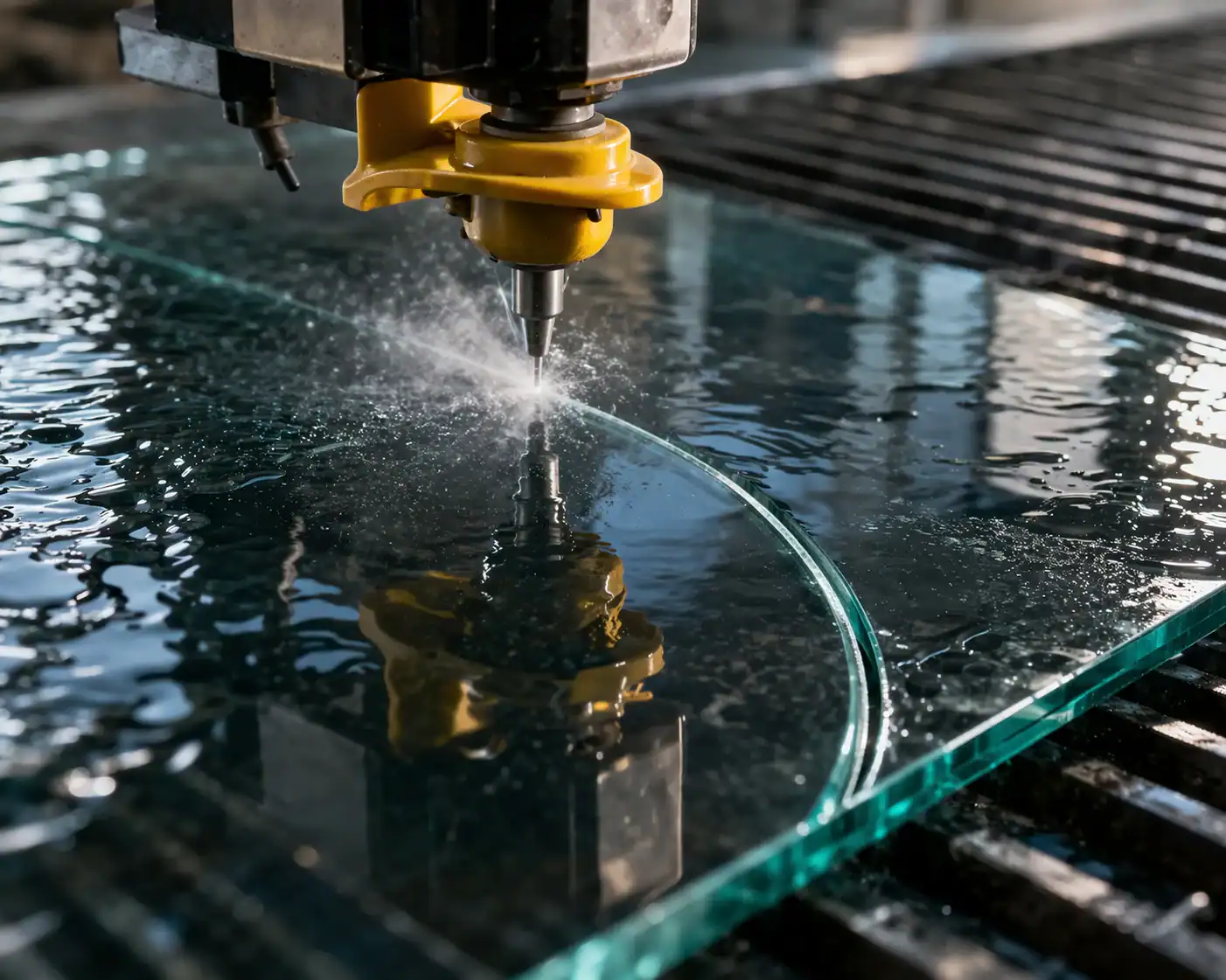
The architectural side of Long Island tells a similar story, just in a different setting. The North Shore’s Gold Coast communities, the Hamptons, and the affluent suburbs throughout Nassau County drive demand for high-end custom architectural elements — decorative metal panels, stone inlays, custom screens, intricate interior metalwork — that require both precision and clean finish quality. We handle all of it: steel, aluminum, marble, granite, glass, and specialty composites, all cut to exact dimensions from a CAD file with no tooling changes and no secondary grinding.
For general manufacturing and custom fabrication across Long Island — from the Hauppauge Industrial Park’s 1,300-plus companies to the fabricators and contractors working out of Suffolk County — the ability to cut intricate geometries and complex shapes from a digital file without special tooling is a genuine operational advantage. No dies to build, no fixtures to set up, no minimum order quantities driven by tooling cost. Just a file, a cut, and a part that fits.
When the job calls for tight tolerances, difficult materials, or complex geometry, the cutting method you choose determines whether the project moves forward smoothly or stalls at the fabrication stage. We handle the full range of what Long Island’s aerospace, marine, architectural, and manufacturing industries actually need — without heat distortion, without excessive secondary finishing, and without the guesswork that comes from shops that cut first and ask questions later.
The difference between a good result and a costly rework usually comes down to equipment quality, file handling, and whether the shop has genuinely done this kind of work before. Those are the details worth asking about before you commit.
If you have a project that needs to be done right the first time, reach out to us. Send your file, describe what you’re working on, and we’ll tell you exactly what we can do for it.
Summary:
Share: