When your parts have to fit perfectly the first time, your cutting method has to be capable of perfect. Here's how modern waterjet technology makes that happen.
If you’ve ever received a batch of parts that looked right but didn’t fit — or sent material out for cutting and gotten it back warped, discolored, or dimensionally off — you already know the problem this page is about. It’s not a one-time quality issue. For a lot of Long Island manufacturers, it’s a recurring cost buried inside every production cycle. Precision waterjet cutting exists to eliminate that cost. Not by being fancier, but by being fundamentally different from the thermal cutting methods most shops default to. Here’s what that difference actually looks like in practice.
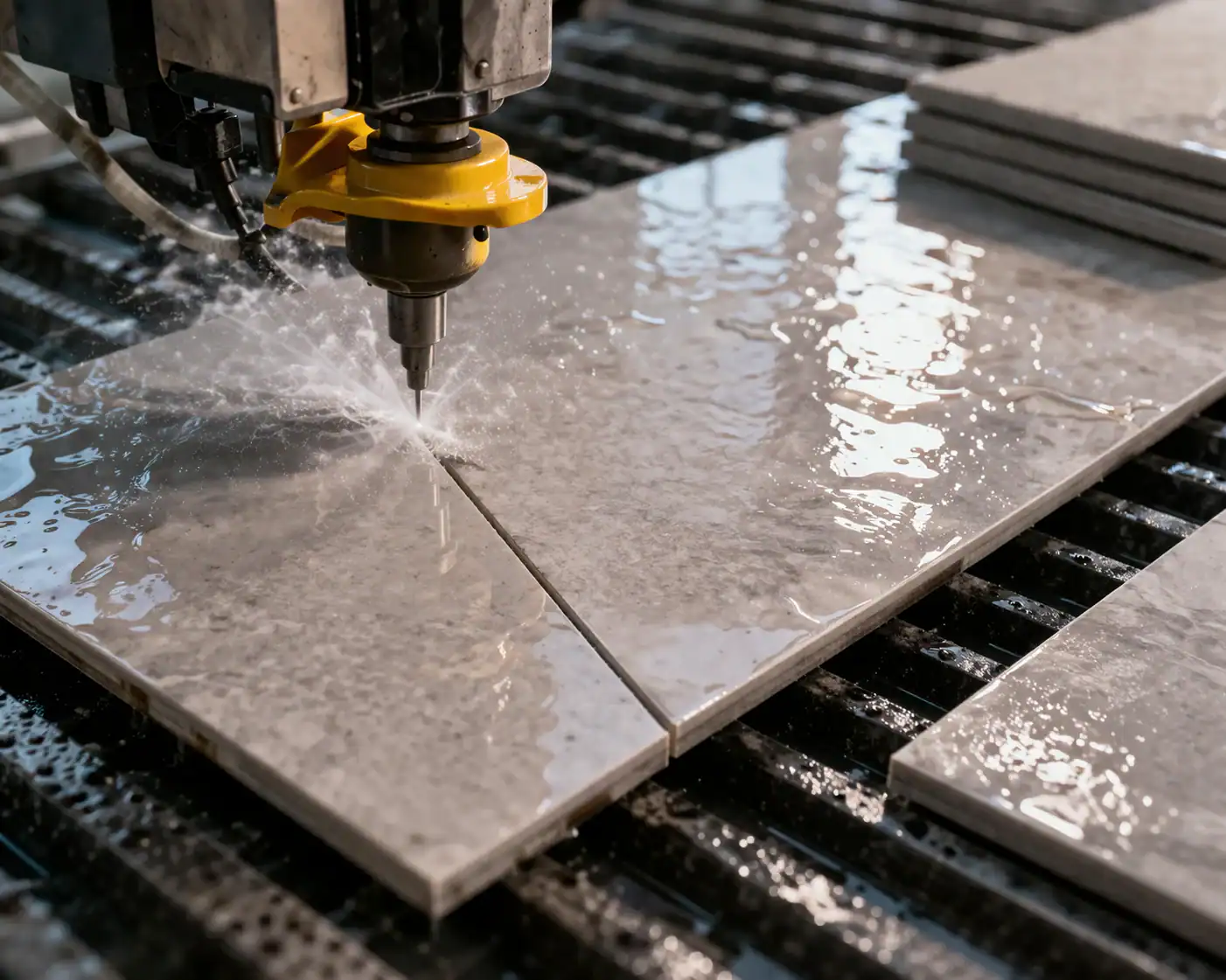
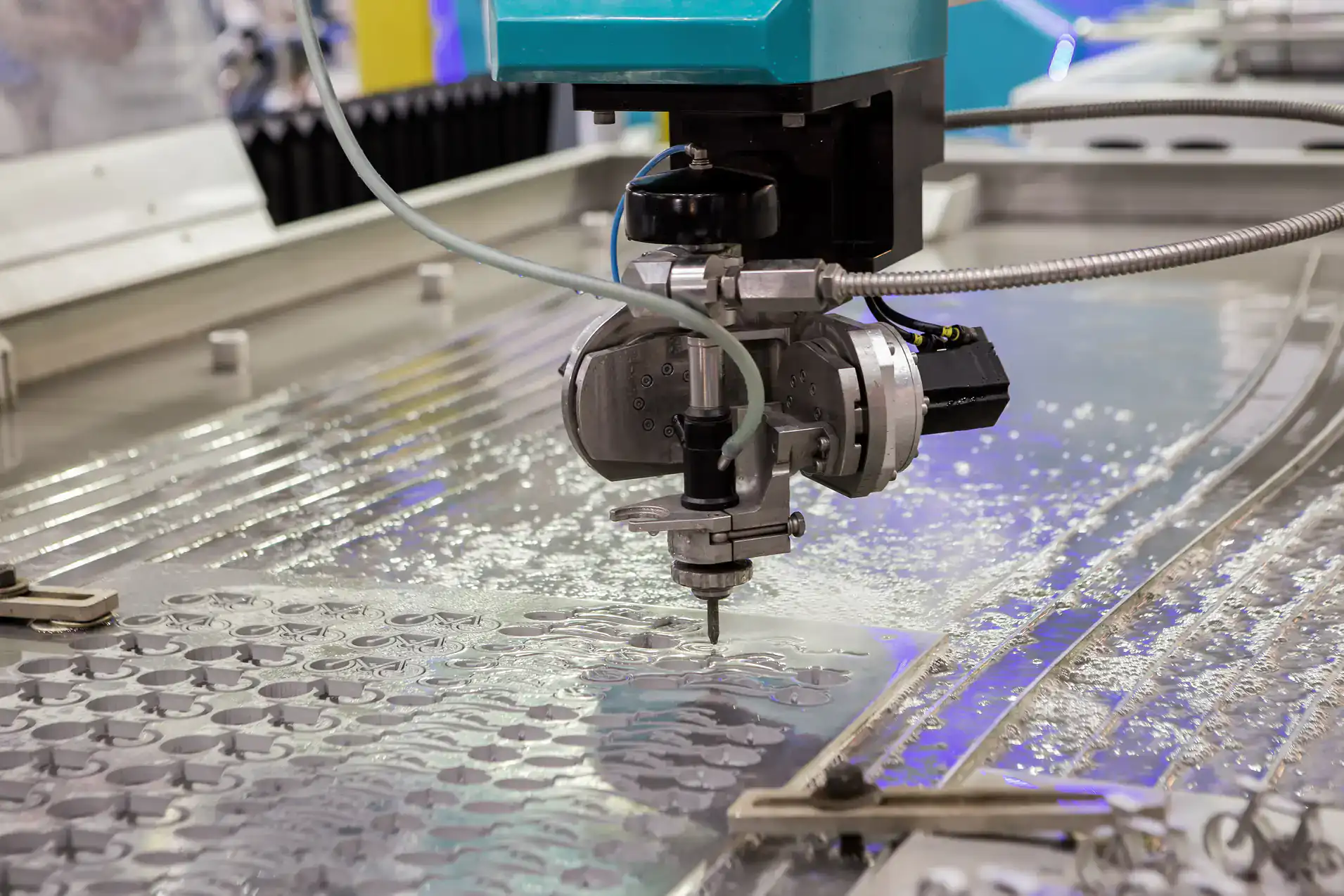
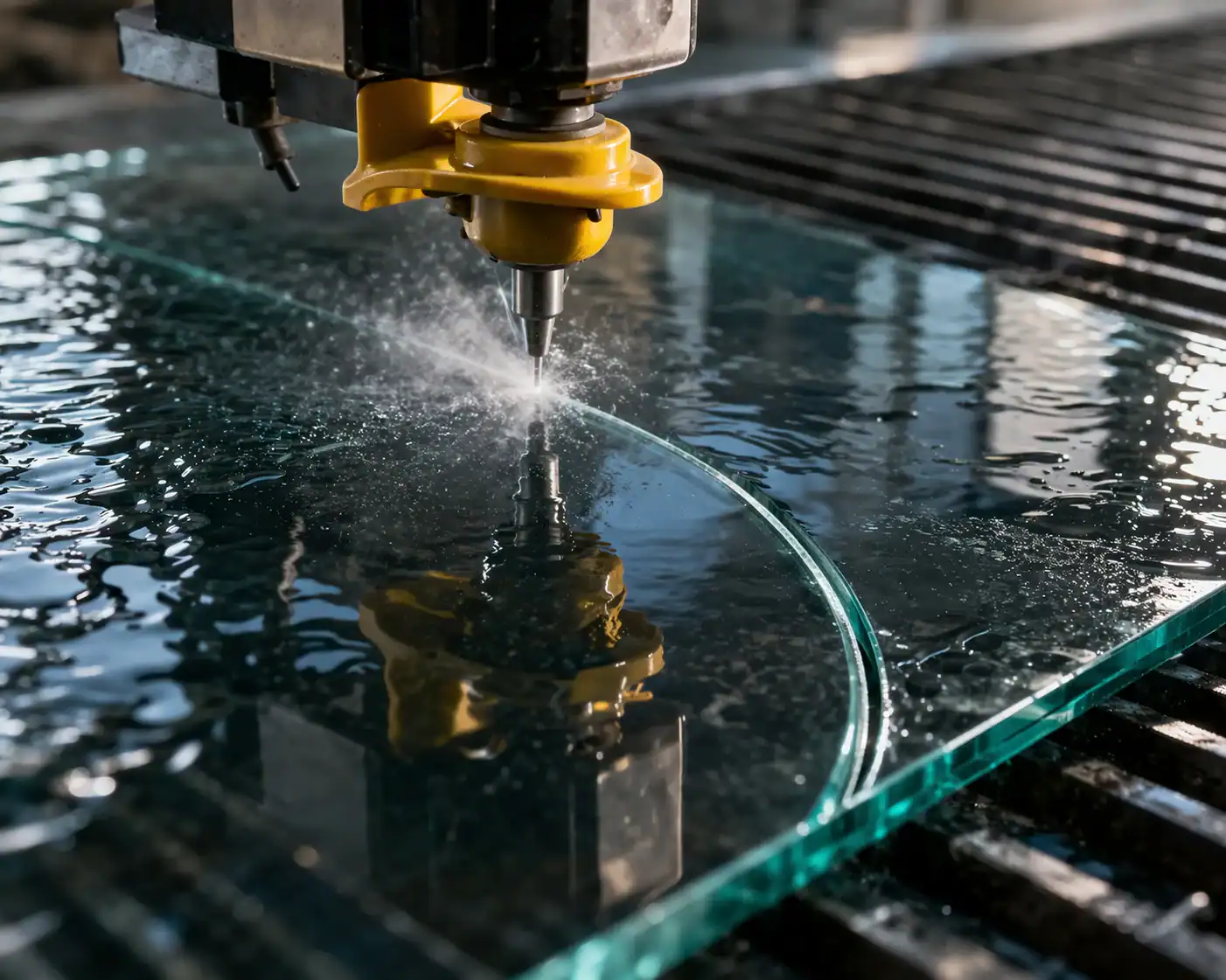
Waterjet cutting uses a high-pressure stream of water — often exceeding 50,000 PSI — mixed with a fine abrasive material to cut through virtually any solid. The stream is thinner than a human hair, CNC-guided, and capable of holding tolerances between ±0.001″ and ±0.005″ depending on the material and its thickness. That level of accuracy isn’t theoretical. It’s repeatable, cut after cut, across a full production run.
What separates precision waterjet cutting from plasma or laser cutting isn’t just the numbers — it’s the physics. There’s no heat involved. The water does the work cold, which means the material you put in is the material you get back, structurally unchanged. No heat-affected zones. No edge hardening. No warping as the part cools down.
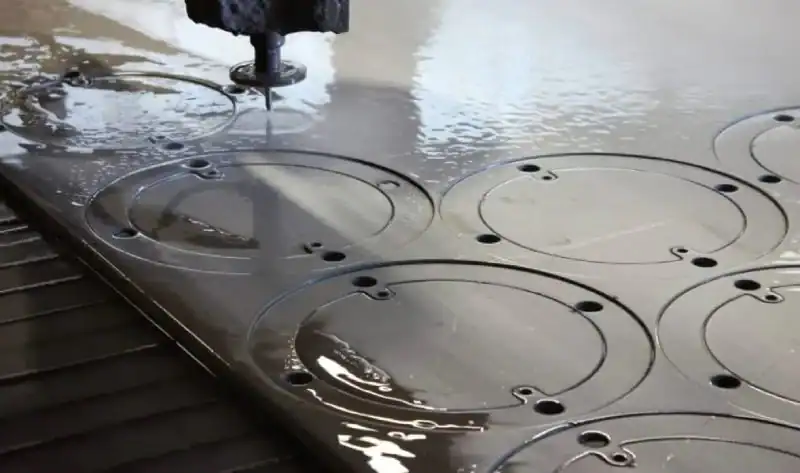
Laser and plasma cutting are fast and cost-effective for the right jobs. But they both introduce heat into the cut zone, and heat has consequences that don’t always show up until the part is in your hands — or worse, on the assembly floor.
Plasma cutting, even high-definition plasma, holds tolerances in the range of ±0.020″ to ±0.030″. That’s workable for rough fabrication. It’s a problem the moment your part has to mate with another component, pass an inspection, or meet a dimensional spec that doesn’t have much room to breathe. The heat-affected zone along the cut edge also changes the material’s microstructure, which matters enormously if you’re working with heat-treated alloys, hardened tool steel, or anything that was processed to a specific hardness before it reached the cutting table.
Laser cutting is more precise than plasma, but it has its own ceiling. Most industrial laser systems struggle to maintain clean, accurate cuts beyond about an inch of material thickness, and they still generate enough heat to cause distortion and edge discoloration on heat-sensitive materials. For titanium, carbon fiber reinforced polymer, composites, and certain aerospace-grade alloys, laser cutting introduces exactly the kind of edge damage that leads to rejected parts.
Waterjet sidesteps all of that. Because there’s no thermal energy being transferred into the material, there’s no heat-affected zone, no microstructural change, and no warping. The cut edge comes off the machine the same way the rest of the part does — clean, accurate, and ready. For a lot of applications, secondary grinding or deburring becomes unnecessary entirely, which is where the real cost savings start to add up. You’re not just paying less for the cut — you’re paying less for everything downstream of it.
This is especially relevant for Long Island’s aerospace and defense supply chain. Companies in that corridor operate under tight material traceability requirements and dimensional specs that leave very little margin. When a part needs to hold ±0.001″ and the material can’t tolerate any heat at the cut edge, waterjet isn’t a preference — it’s the only method that actually works.
This is one of the more common questions we hear, and the honest answer is: almost anything. Steel, stainless steel, aluminum, titanium, brass, copper, carbon fiber reinforced polymer, composites, glass, stone, foam, rubber, wood, plastic — the same machine handles all of them without changing tooling or reconfiguring for a different material type. That versatility is one of the more underappreciated advantages of CNC waterjet cutting, particularly for shops that work across multiple industries or material categories.
Titanium deserves a specific mention because it’s one of the materials where waterjet’s cold-process advantage is most pronounced. Titanium is expensive, difficult to machine, and highly sensitive to heat. Thermal cutting methods alter its surface properties at the cut edge in ways that can compromise structural integrity or fail inspection. Waterjet cuts titanium cleanly, without any of those complications, and holds the tolerances that aerospace and marine applications require.
Carbon fiber reinforced polymer is another material where the method matters. CFRP is prone to delamination — the layers separating from each other — when subjected to heat or mechanical stress at the cut zone. Waterjet’s cold, low-force cutting action keeps the laminate intact and the edge clean. The same logic applies to other composites and hybrid materials that combine layers of different densities or thermal properties.
For hard materials, precision waterjet cutting can handle thicknesses up to about 8 inches while maintaining dimensional accuracy. Softer materials like foam and rubber can go even thicker — up to 12 inches in some cases. That thickness capability, combined with tight tolerances and no heat input, puts waterjet in a category that no single alternative cutting method can fully replicate.
Want live answers?
Connect with a Tri-State Waterjet expert for fast, friendly support.
Long Island’s manufacturing base is dense and demanding. Suffolk County alone is home to more than 3,000 manufacturing companies — two-thirds of the island’s total — and Nassau and Suffolk counties together account for 41% of regional manufacturing spending, the highest share in New York State. The businesses operating in that environment aren’t cutting simple shapes out of mild steel. They’re building aerospace components, marine hardware, medical device parts, architectural metalwork, and custom fabrication runs that have to be right the first time.
That’s the operating context here. And it’s why the shift toward precision waterjet cutting has been as consistent as it has. When your material is expensive, your tolerances are tight, and your timeline doesn’t leave room for rework, the method you choose has real financial consequences — not just technical ones.

One of the things that surprises first-time customers is how direct the process is. You upload your CAD file — DXF, DWG, or STEP format — and that file becomes the cutting path. No dies to build. No fixtures to fabricate. No weeks of tooling lead time eating into your schedule. The CNC system translates the geometry directly into machine motion, and the cut follows your design with the accuracy the file specifies.
Before any cutting starts, every file goes through a review. We look at the geometry, verify the dimensions, check for anything that might cause a problem in production — a radius that’s too tight, a tolerance that needs to be flagged, a detail that could cause issues on the actual material. That step happens before the machine runs, not after. It’s a small thing in terms of time, but it’s the difference between catching an error on a screen and catching it on a scrapped part.
For prototyping, this workflow is a significant advantage. Traditional machining often requires tooling that costs time and money before a single part is made. With waterjet, the first part off the machine can be a finished prototype, cut to the same tolerances as a production run. If the design changes, you update the file and run it again. There’s no tooling to remake, no setup to reconfigure. The iteration cycle is measured in days, not weeks.
We also offer AI-assisted CAD as part of our service, which means if you’re coming in with a concept rather than a finished file, we can help bridge that gap. Not every customer walks in with a production-ready DXF. Some are engineers with a sketch, fabricators with a sample, or designers with an idea that needs to be translated into cuttable geometry. That design-to-cut capability is something most waterjet shops on Long Island don’t offer, and it changes the kind of work we’re able to take on.
Turnaround times for standard precision jobs run between one and three business days. For straightforward parts with standard geometry and material in stock, same-day or next-day delivery is often possible. Complex work — intricate patterns, thick materials, very tight tolerances — typically runs three to five days. Rush services are available when the deadline is the constraint.
**How accurate is waterjet cutting, really?**
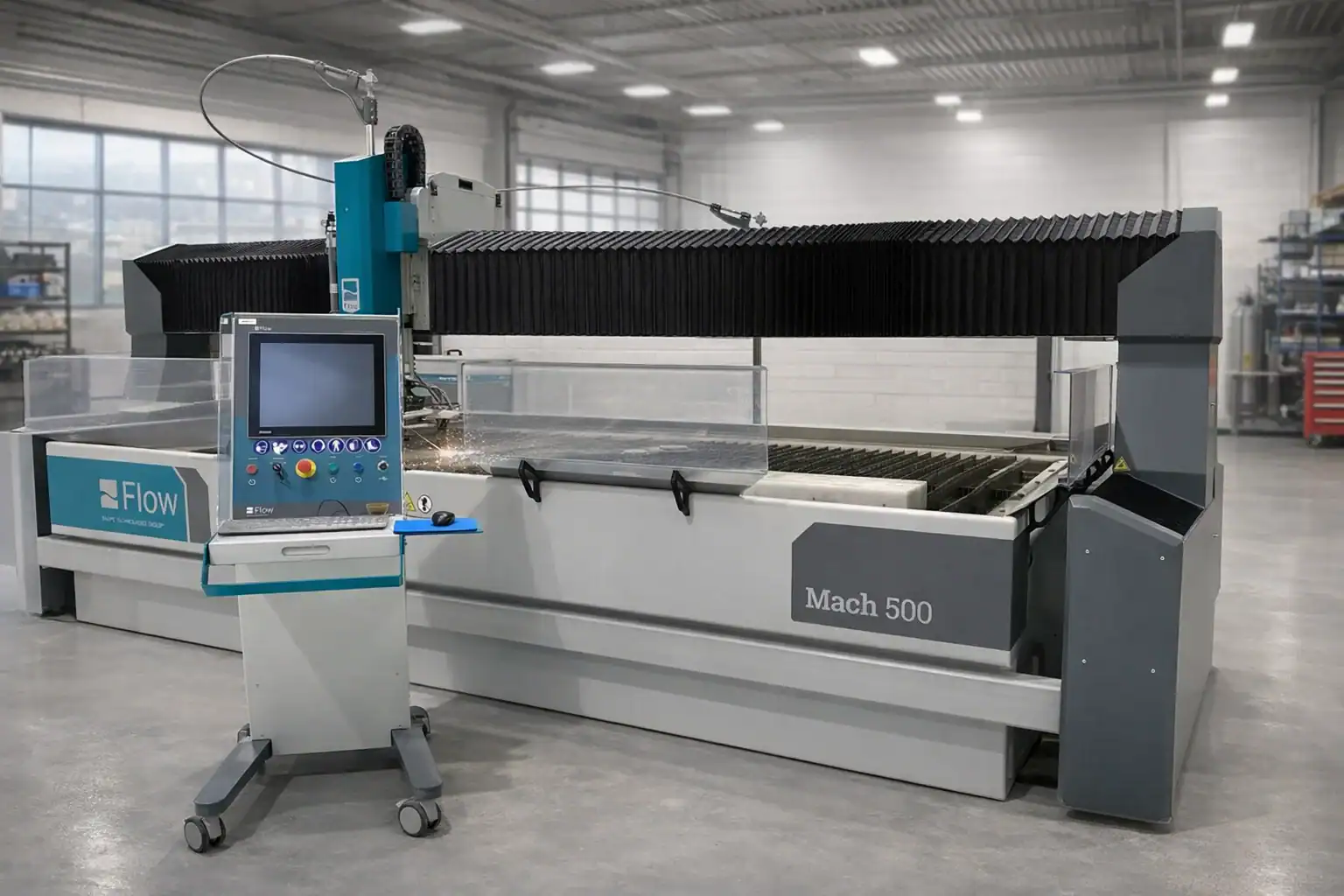
The tolerance range for precision waterjet cutting runs from ±0.001″ on the tight end to ±0.005″ for standard industrial work, depending on the material, its thickness, and the complexity of the geometry. We use the Flow Mach 500 — one of the most capable production waterjet systems available — which holds ±0.005 inches consistently across a full run. For context, plasma cutting in the same application would typically land somewhere between ±0.020″ and ±0.030″. That gap matters when your parts have to fit together.
**Is waterjet cutting more expensive than laser or plasma?**
Per cut, waterjet often costs more than plasma. But that comparison ignores what happens after the cut. If your plasma-cut parts require secondary grinding to clean up the heat-affected zone, or if a percentage of them get rejected because they’re dimensionally out of spec, the cost per acceptable finished part climbs fast. Waterjet’s higher per-cut cost frequently results in a lower total cost when you account for rework, scrap, and secondary operations that don’t need to happen. For tight-tolerance work on expensive material, the math usually favors waterjet by a significant margin.
**What industries on Long Island use precision waterjet cutting?**
Across Long Island, NY, the heaviest users tend to be in aerospace and defense, marine fabrication, construction and architecture, and medical device manufacturing. The aerospace and defense supply chain here is deep — companies like Collins Aerospace and CPI Aero have roots on the island, and the broader network of suppliers and subcontractors in the Hauppauge Industrial Park corridor requires the kind of dimensional accuracy and material integrity that waterjet delivers. Marine fabrication is another strong segment, driven by Long Island’s roughly 1,180 miles of coastline and the demand for corrosion-resistant components in stainless steel, aluminum, and composites. Architectural work — custom panels, decorative metalwork, precision-cut structural components — rounds out a significant share of what we see come through the shop.
**Can waterjet handle production runs, or is it just for prototypes?**
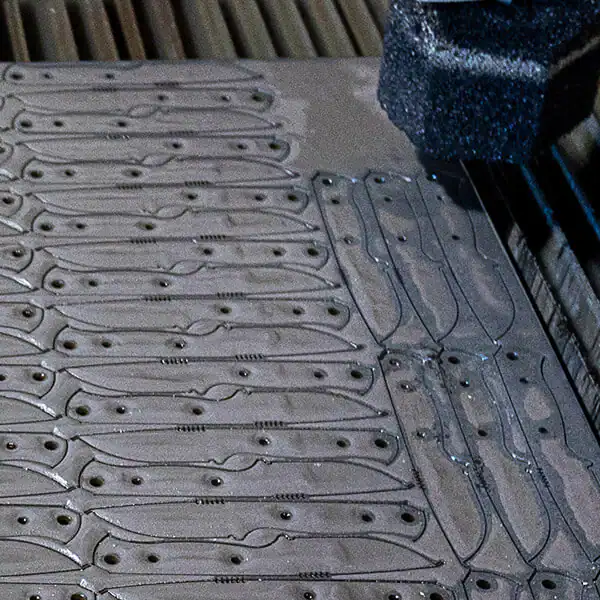
Both. CNC waterjet cutting is fully capable of production runs with consistent, repeatable precision across hundreds or thousands of parts. The same tolerance that applies to the first part applies to the last one. Nesting software — which optimizes how parts are arranged on the material sheet — helps minimize waste and reduce per-part cost on larger runs. Prototypes and one-off custom parts are equally at home on the machine. The workflow is the same regardless of quantity.
**Do I need a finished CAD file to get started?**
A production-ready DXF, DWG, or STEP file is the fastest path to a quote and a cut. But if you’re working from a sketch, a sample part, or an early-stage design, our AI-assisted CAD capability can help you get there. Reach out and describe what you’re working with — we can usually figure out the right path forward from there.
If your work involves tight tolerances, heat-sensitive materials, or parts that have to fit correctly the first time, the answer is probably yes. The cold-process advantage, the dimensional accuracy, and the direct CAD-to-cut workflow add up to something that thermal cutting methods simply can’t replicate on demanding applications.
We’ve been cutting parts for Long Island manufacturers, fabricators, architects, and engineers since 1981 — more than four decades in the same industrial corridor, working through the same material challenges and deadline pressures that our customers face. That history isn’t something we lead with for its own sake. It just means we’ve seen most of what can go wrong, and we’ve built a process designed to prevent it.
If you have a project you’d like to talk through, Tri-State Waterjet is ready to take a look. Upload your file, request a quote, or give us a call at 631-422-0888 — and let’s figure out what your parts actually need.
Summary:
Article details:
Share: