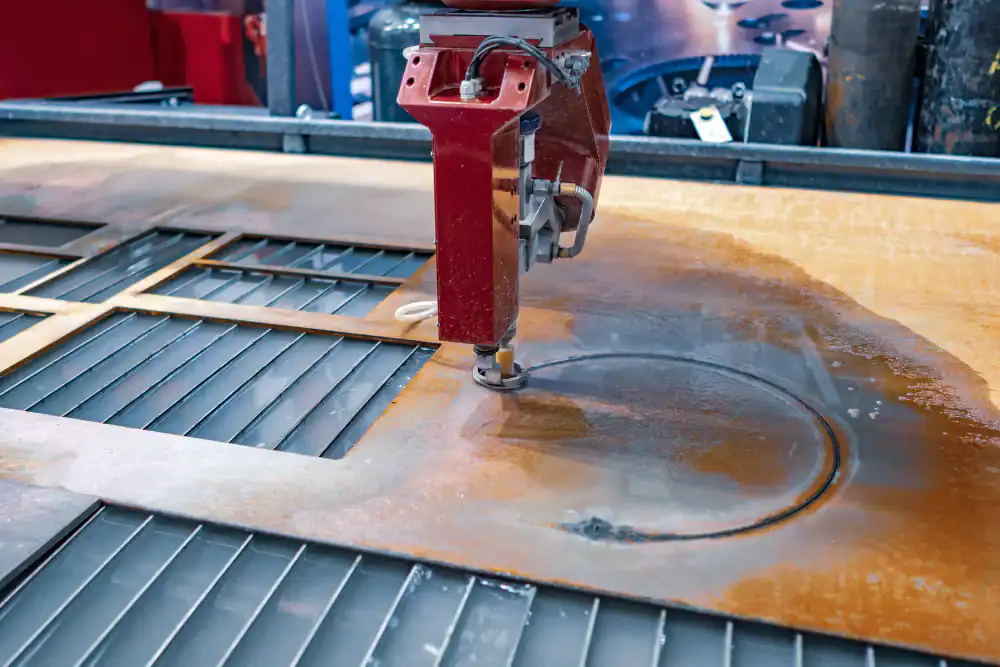
Most waterjet edges are ready to use, but not all of them. Here's how to tell which edges on your part need finishing and which don't.
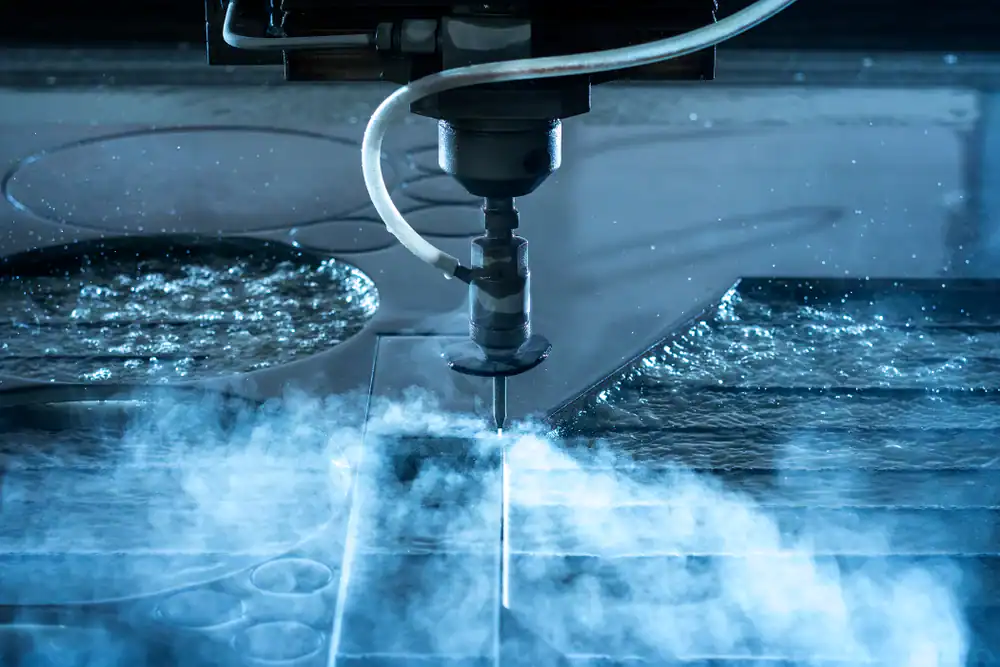
You’ve got a drawing, a deadline, and two quotes that don’t line up. One shop says waterjet edges come off the machine finished. The other mentions deburring as if it’s a given. Neither is lying, but neither is giving you the full picture.
If you build, fabricate, or install parts on Long Island, the question that matters is simple: What will this edge look like when the part comes off the table, and what happens next? We’ll walk through how to answer it, starting with what the machine actually leaves behind.
A waterjet edge is matte and slightly textured, a bit like fine sandblasting. It isn’t bright and glassy like a polished surface, and it doesn’t carry the dross or hardened skin you can get from thermal cutting. For most structural and functional parts, that edge goes straight into welding, powder coating, or assembly.
Here’s the part that gets skipped: waterjet edge quality is a dial, not a fixed result. Industry shops grade it from Q1 to Q5, where Q1 is a fast separation cut and Q5 is the smoothest. The difference comes down to cutting speed. Slow the cut down and the edge gets smoother and more accurate. Speed it up and you see more lines, a rougher bottom edge, and more variation in size.
So whether your parts need secondary finishing depends on which setting was used and what the part does next.
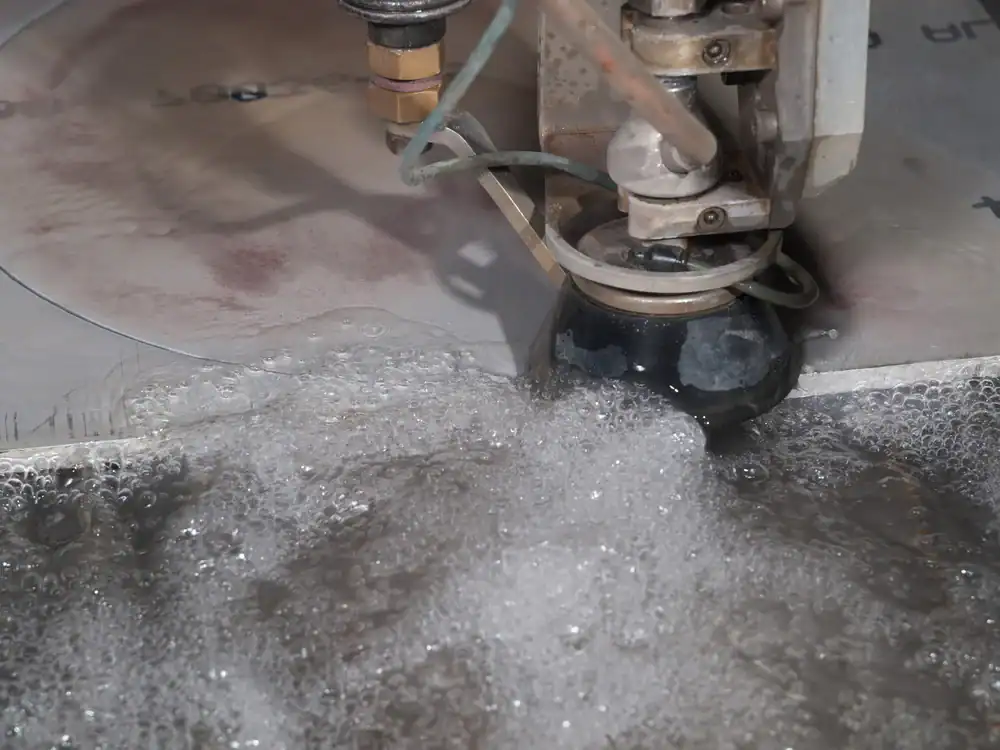
Yes, and most buyers don’t know to ask. A single part can be cut with tight, slow quality on the features that matter and faster, rougher quality everywhere else. If you have holes that will be tapped or surfaces that mate with another component, those get the careful treatment. The long outside edge that’s going to be hidden inside an assembly doesn’t need it.
This is where money gets wasted in both directions. Ask for top-grade quality across the whole part and you’re paying for cutting time you don’t need. Leave edge quality off the drawing and a shop may default to the fastest speed to keep the number low. You then get parts with visible lines, rough exit edges, and sizes that wander. That’s usually when someone ends up deburring or reworking parts by hand, and the savings disappear.
It also explains why two quotes can sit far apart. Cost tracks cutting time, and cutting time tracks edge quality. If the quotes don’t say which quality they’re based on, you’re comparing apples to something else.
For general waterjet work we typically plan around ±0.005″ on standard cuts. Tighter work is possible depending on material, thickness, and part geometry, and we’ll tell you honestly where a feature pushes past what’s realistic. When a tolerance is tighter than waterjet should be asked to hold, the smart move is to rough the part out on the waterjet and machine the critical dimension afterward. We handle milling in-house, so that doesn’t mean a second shop and a second timeline.
Start with what happens to the part after it leaves us. If it’s getting welded, a standard edge is normally ready. If it’s getting powder coated or painted, a standard edge usually works too, though a sharp corner can show coating thin spots and some parts benefit from a light edge break first.
Then think about who touches it. Parts that people will handle—brackets, covers, and trim pieces—often need the sharp corners knocked down for safety. That’s light deburring or edge breaking, not rework of the whole part. Ductile and thin materials can also leave a small burr on the exit side, which is worth a quick pass if the part mates with something.
Next, look at visibility. Polished stainless, display pieces, and anything where the edge is part of the look may call for a finer cut quality, a finishing step, or both. A waterjet edge has its own matte character, and next to the original sheet surface it can look different. Some customers love that and some want it blended.
Last, consider thickness. Once material gets past roughly three inches, taper starts to show unless the machine can compensate for it. Taper isn’t a finishing problem, it’s a planning one, so tell us about it before the cut instead of after.
If you check those four things against your drawing, you’ll know within a few minutes which edges need attention and which don’t.
Want live answers?
Connect with a Tri-State Waterjet expert for fast, friendly support.
With mild steel offcuts, a rough edge is an annoyance. With titanium, brass, copper, or stainless, it’s a scrapped part and a lot of lost material. The more the stock costs, the more edge decisions matter before the first cut instead of after the last one.
Many of the shops and suppliers we work with across Long Island build precision components, where a weakened edge or a part that’s off dimensionally means missed deadlines. Waterjet is a cold cut, so there’s no heat to harden or discolor the edge. On titanium, that leaves a smooth, slightly frosted finish that’s acceptable for many applications as-is. If you need it polished or deburred, the cut surface takes less finishing work than a thermally cut edge would.
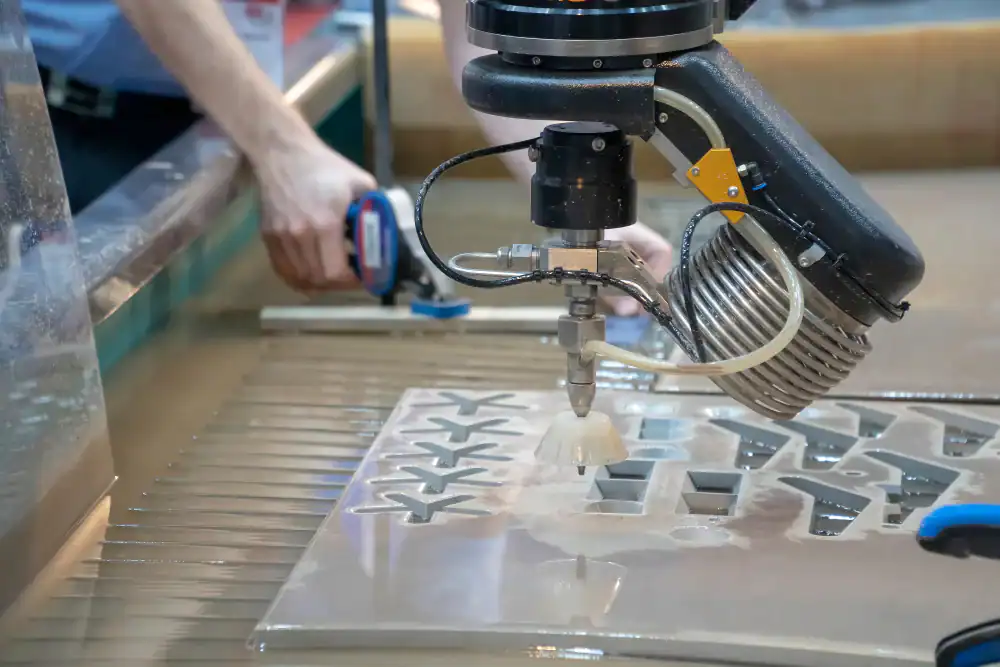
Often it won’t need much, but “often” isn’t good enough on expensive stock. Titanium and stainless both cut cleanly, and for many applications the edge is acceptable straight off the machine. Where the part has a tight mating surface, a cosmetic face, or a feature that will be tapped or reamed, a light pass at those specific spots is normal and cheap compared to the material.
The protection is in the process. Before we run a full batch, we look at the first piece for dimensional accuracy and edge quality. If the edge isn’t where it needs to be for your next step, we adjust the cutting parameters, because slower speeds give smoother edges. That adjustment costs minutes. Finding the problem after fifty parts are cut costs real money.
Local shops across Long Island feel this in particular. Fabricators in Brentwood, aerospace suppliers around Islip, and custom shops across Suffolk and Nassau often work to drawings where a few features are critical and the rest are forgiving. That’s the situation where marking edge quality by feature pays off most. You tell us which edges are critical, we run those slow, and the rest of the part stays fast and economical.
The honest answer is minimal burrs, not zero. The cutting stream produces very little burr compared to many other methods, and for most applications the edge works without grinding. But if a drawing calls for a specific edge condition, light deburring or edge breaking can be specified, and we can handle that in-house along with milling and welding so your parts don’t bounce between shops.
People in South Farmingdale, New Hyde Park, Farmingville, Holtsville, North Babylon, and Smithtown ask us whether the edge is ready for welding or powder coating. For most parts, yes. The ones we flag are the exceptions: mating faces, cosmetic edges, and thin or ductile material where the exit side deserves a look.
Cost is the other question we hear a lot. Does a better edge cost more? Yes, because it takes longer to cut. Every cut we make gets a clean, usable standard edge, and anything finer than that is a choice you make feature by feature, not a flat upcharge on the whole part.
When you send a file, tell us what the part does, which edges are critical, and what the tolerances are. Mark them right on the drawing. Most jobs are typically cut within 24 to 48 hours after we receive and approve your file, so a few extra minutes on the drawing doesn’t cost you days.
Waterjet edges are often ready to use, and sometimes they aren’t. The difference is the quality setting, what your part does next, and how well the drawing says so. Mark your critical edges, ask for the edge quality on every quote, and keep the finishing for the spots that really need it.
At Tri-State Waterjet, we run a Flow Mach 500 out of our West Islip shop and serve fabricators, designers, contractors, and manufacturers across Suffolk and Nassau. We’ll look at your file, tell you what’s realistic for your material, thickness, and feature size, and tell you upfront if a part will need deburring. No surprises after the cut.
Call us at 631-422-0888 or send us your drawing, and we’ll tell you which edges need what.
Summary:
Article details:
Share: