Marble waterjet cutting is reshaping how architects design for 2026. Here's what's driving the shift — and what it means for your next Long Island project.
If you’re specifying marble for a project right now — a lobby floor medallion, a custom kitchen countertop, an inlaid foyer in a Hamptons estate — you already know the stakes. Marble is expensive, unforgiving, and impossible to replace on a tight timeline if something goes wrong at the cutting stage. What’s changed in 2026 is that more architects and designers on Long Island aren’t willing to leave that risk on the table. Waterjet cutting has become the default choice for precision marble work, not just a premium option. Here’s why that shift is happening, what the process actually involves, and what it means for your next project.
Design ambitions have outpaced what traditional cutting methods can deliver. Architects are specifying tighter geometric patterns, multi-material inlays, and larger-format medallions than they were five years ago — and a diamond saw simply can’t execute those designs with the accuracy they require.
Luxury residential renovation on Long Island is as active as it’s ever been, from Gold Coast estates in Oyster Bay and Cold Spring Harbor to high-end gut renovations throughout Nassau County. At the same time, hospitality and commercial projects across Suffolk County are raising the bar on interior finishes. When a hotel lobby floor or a custom residential foyer is the focal point of a design, the margin for error on stone cutting drops to nearly zero.
Waterjet cutting meets that standard in a way that no other method does for marble specifically.
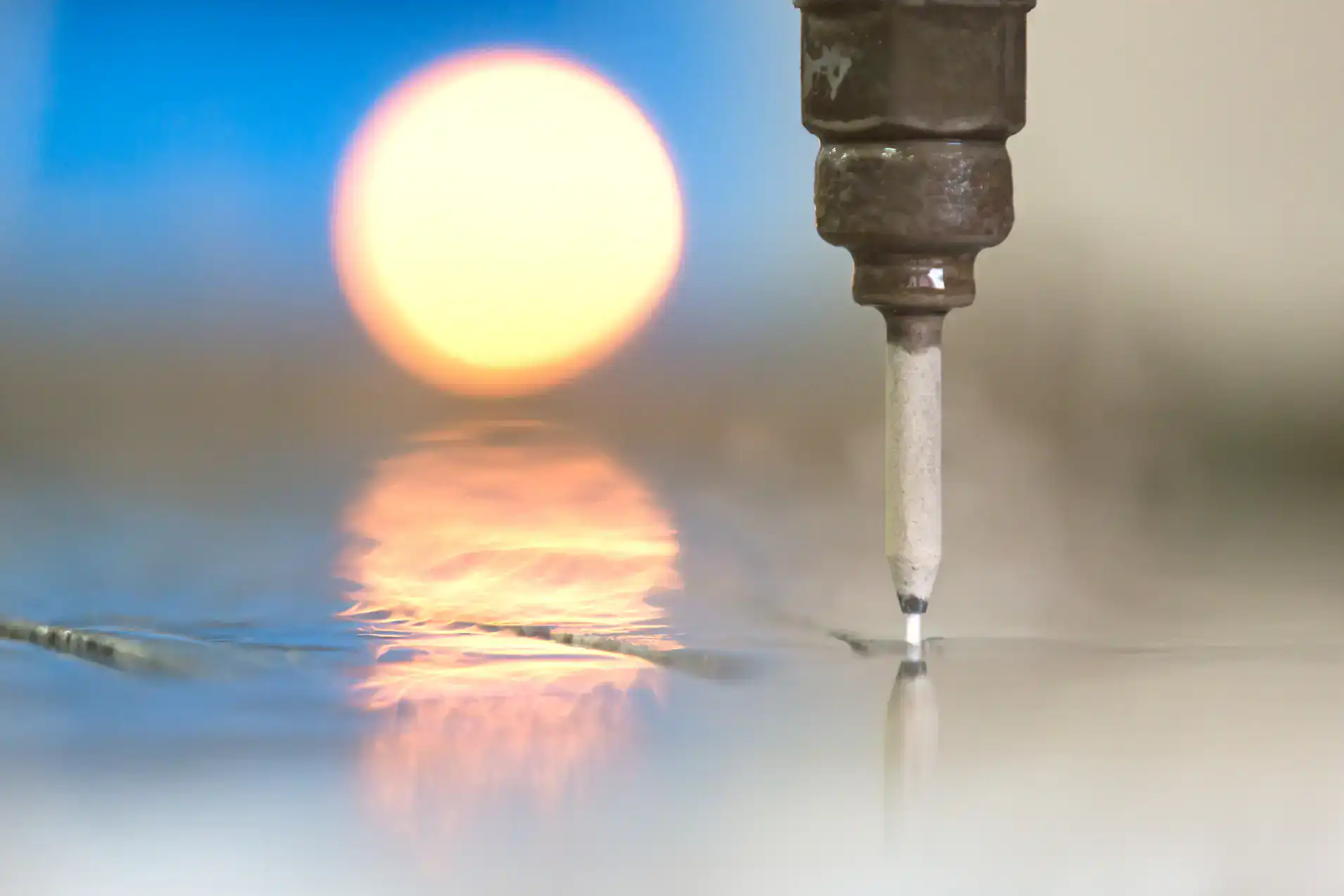
The most important reason is heat — or rather, the complete absence of it. Waterjet cutting uses high-pressure water mixed with abrasive to cut through stone without generating any thermal energy at the cut line. That matters enormously with marble, especially premium varieties like Calacatta and Statuario, where heat from a saw blade can discolor the stone, introduce micro-fractures, or alter the crystalline structure in ways that aren’t visible until the piece is installed and the light hits it wrong.
Beyond heat, there’s the question of precision. Traditional diamond saw cutting holds tolerances around ±1/16 of an inch on a good day. Waterjet cutting holds ±0.001″ to ±0.005″. For a multi-piece floor medallion or a bookmatched countertop with a mitered edge, that level of accuracy is the difference between a seamless installation and one that needs grout lines to hide the inconsistency.
Curved borders, interlocking arabesque patterns, concentric medallions, tight interior radii — none of these are achievable with a saw. Waterjet cutting follows a CNC path, which means if the geometry exists in a CAD file, it can be cut. That opens up a design vocabulary that architects simply didn’t have access to before waterjet became widely available.
The 2026 trend toward combining marble with metal inlays — thin strips of brass, copper, or stainless steel set directly into stone floors — adds another layer to this. Those inlays require both the marble and the metal to be cut to matching tolerances, so they sit flush and tight against each other. A shop that can cut both materials on the same equipment, holding the same precision on both, eliminates a major coordination problem for architects managing multiple fabricators.
Waterjet cutting also produces up to 30% less material waste compared to saw cutting, because of the narrow kerf and the ability to nest parts tightly on a slab. On a $5,000 piece of Calacatta, that’s a real number.
The patterns getting the most attention right now fall into a few distinct categories. Hexagonal mosaics in mixed marble colors are showing up in high-end bathrooms and foyers throughout Long Island’s North Shore communities. Arabesque and Moorish-inspired floor patterns — the kind that reference pietra dura, the Italian stone inlay tradition — are being specified for hotel lobbies and luxury residential entries. Concentric diamond and octagon medallions, often six to ten feet in diameter, are anchoring commercial reception areas and estate foyers from Mineola to Montauk.
What all of these designs share is that they require multiple marble pieces to fit together with near-zero tolerance. A ten-piece medallion where each component is off by even 1/32 of an inch compounds into a visible misalignment at the center. Waterjet cutting eliminates that problem at the source.
Bookmatched marble — where two slabs are cut and mirrored to create a continuous vein pattern across a surface — is another specification that’s increasing. The veining alignment only works if the cut is perfectly straight and square, which again points back to waterjet precision over hand cutting.
The metal inlay trend deserves its own mention. Brass inlays set into white Carrara marble floors have become a defining look in luxury Long Island renovation right now, particularly in Hamptons properties and high-end Nassau County homes. Getting that right requires cutting both materials to tolerances that let them sit flush without visible gaps or proud edges. It’s not a job for a shop that only cuts stone, and it’s not a job for a shop that only cuts metal. It requires a single source that handles both with equal precision.
One design detail that often surprises clients: waterjet-cut marble doesn’t typically require secondary edge finishing. The cut quality from a high-end system produces edges smooth enough for direct installation in most architectural applications, which removes a step from the fabrication timeline and reduces the risk of edge damage during finishing.
Want live answers?
Connect with a Tri-State Waterjet expert for fast, friendly support.
The process starts before the waterjet ever touches your slab. A CAD file — typically a DXF, DWG, or STEP format — is submitted, reviewed by our team, and checked for errors, tight inside corners, and nesting opportunities. A confirmation drawing goes back to the client for approval before any cutting begins. That step is where the most expensive mistakes in marble fabrication get caught.
Once the file is approved, the slab is loaded onto the cutting table and the CNC waterjet executes the programmed path. The waterjet stream — water and abrasive garnet at pressures between 60,000 and 94,000 psi — cuts through the marble cleanly and cold, following the geometry of the file with no deviation.
The result is a cut piece that matches the approved drawing within the stated tolerance, ready for installation without secondary finishing in most cases.
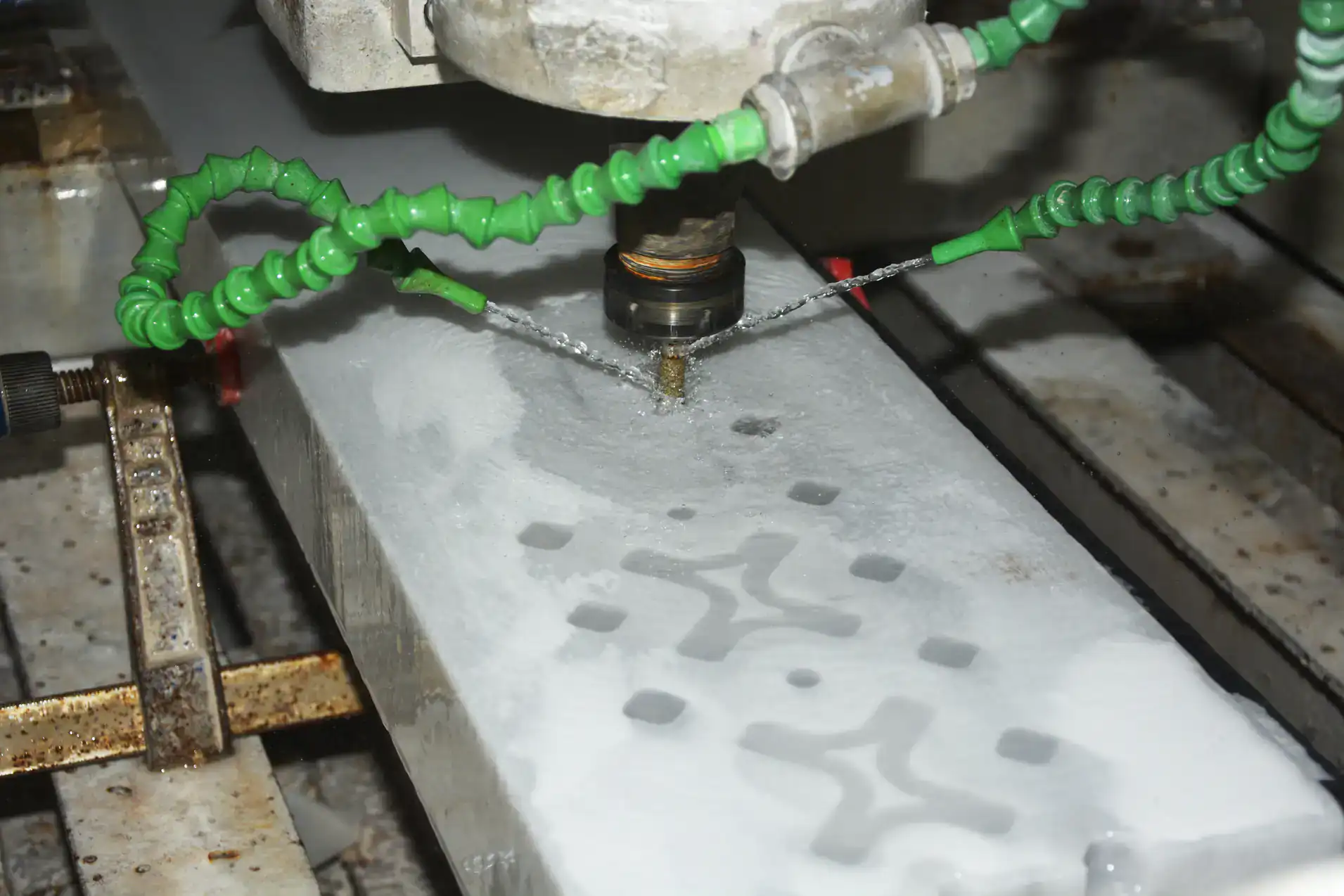
Not every waterjet shop is equipped to handle architectural marble work. The machine matters. Systems like the Flow Mach 500 and OMAX waterjet platforms include dynamic taper compensation — a feature that corrects for the slight angular deviation that occurs when cutting through thicker stone. Without it, the edges of your marble pieces will have a slight bevel that becomes visible when pieces are placed together. With it, the edges are square and true.
The operator’s experience with marble specifically also matters. Calacatta is more brittle than Carrara. Veining orientation affects how a slab should be supported and nested. Thickness affects cutting speed parameters and edge quality settings. A shop that cuts marble regularly knows how to adjust for these variables. A shop that cuts mostly metal and occasionally takes on stone jobs does not.
Ask about the file review process. A quality shop reviews every file before cutting and sends a confirmation drawing for approval. If a shop’s answer is “we just cut what you send us,” that’s a real risk when you’re working with an expensive slab that can’t be replaced on short notice.
Turnaround time is a practical concern, not just a convenience. Long Island’s construction pace is aggressive. When a contractor has an installer scheduled and the cut pieces aren’t ready, every day of delay has a cost. A local shop with a 1–3 business day turnaround for standard marble projects — and rush capacity when the timeline is tight — is a different operational reality than a remote fabricator with a two-week lead time and freight risk on your slab.
Finally, ask whether the shop can cut both the marble and any metal inlay elements you’re specifying. If the answer is no, you’re managing two separate fabricators, two separate timelines, and two separate tolerances that need to match on installation day. That coordination problem is avoidable.
**Will waterjet cutting crack or damage the marble?** The answer is no — provided the shop is running proper equipment and supporting the slab correctly during the cut. The cold cutting process introduces no thermal stress, and a vibration-dampened cutting table prevents the micro-vibrations that can cause fractures in brittle stone. The risk of damage comes from poor setup or inadequate equipment, not from the waterjet process itself.
**Does waterjet cutting work on all marble types?** Yes. Carrara, Calacatta, Statuario, travertine, onyx — all of these cut cleanly with waterjet. The parameters differ by material, but a shop with genuine marble experience adjusts for those differences as a matter of course.
**What file formats do you need?** DXF and DWG are the standard formats for waterjet cutting, and most design software exports to both. If you’re working from a hand sketch or a concept that hasn’t been translated to a CAD file yet, that’s worth discussing with your shop before you assume it’s a problem. We offer CAD support that can take a design concept and turn it into a production-ready file.
**What about slab delivery and pickup on Long Island?** Because we’re based in West Islip, there’s no freight involved. You can deliver a slab directly and pick up the cut pieces without the risk of shipping a $4,000 piece of stone across the country and hoping it arrives intact. For contractors working across Nassau and Suffolk Counties, that’s a practical advantage that adds up over the course of a project.
**What happens if there’s an error in my file?** At a quality shop, it gets caught before cutting starts. The pre-cut file review exists specifically to find dimension errors, geometry problems, and nesting issues before the waterjet touches anything. That review step is worth more than it might seem when you’re working with irreplaceable stone.
The 2026 shift toward waterjet cutting for architectural marble isn’t complicated to explain. The designs being specified today require precision that traditional methods can’t reliably deliver, and the cost of a mistake on premium stone is too high to accept that risk. Waterjet cutting solves both problems — it holds tolerances that make complex multi-piece designs actually work, and the cold process protects the material throughout.
What makes the difference between a good outcome and a frustrating one is the shop you choose. Equipment, experience with marble specifically, a real file review process, and local availability on Long Island all matter more than the per-hour rate.
If you’re working on a project that involves custom marble waterjet cutting — whether it’s a floor medallion for a Hamptons estate, a commercial lobby installation in Nassau County, or a kitchen renovation anywhere across Long Island — we’ve been doing this work from West Islip since 1981. Reach out with your project details and we’ll tell you exactly what’s involved.
Summary:
Share: