The future of waterjet cutting is already running. Here's what the latest automation and precision technology means for manufacturers on Long Island.
Most “future of manufacturing” conversations treat advanced technology like something you prepare for. A trend to monitor. A capability to adopt eventually. But if you’ve been outsourcing precision cutting to a shop that’s still running the same workflow it used ten years ago, the future has already passed you by — and you’re probably paying for it in rework, wasted material, or parts that don’t fit the first time.
We’ve built our operation around what’s actually changing in waterjet cutting technology, why it matters to the kind of precision work Long Island manufacturers depend on, and what to look for when you’re choosing a cutting partner who won’t be obsolete before your next production run.
The word “automated” gets used loosely in manufacturing. In the context of modern CNC waterjet cutting, it means something specific: your CAD file goes in, finished parts come out, and very little manual intervention happens in between.
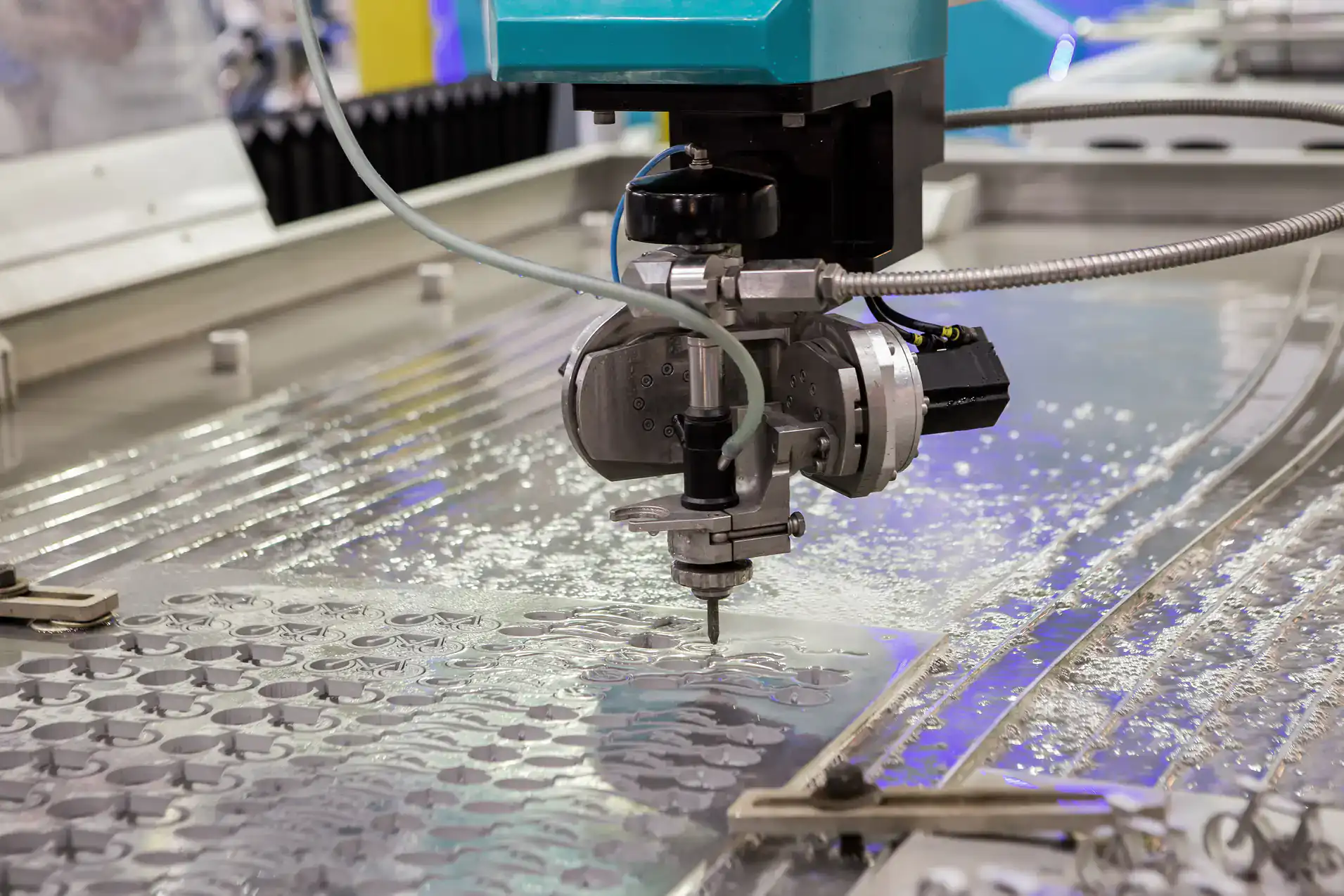
There’s no re-entering dimensions by hand, no manual G-code programming, no operator interpreting your drawing and hoping they got it right. On a system like the Flow Mach 500 — which runs at 94,000 PSI and accepts DXF, DWG, STEP, and IGES files directly into its CNC controller — the machine reads your file, calculates the cut path, accounts for material behavior, and executes.
That direct CAD-to-cut workflow eliminates the single most common source of dimensional errors in precision fabrication: human transcription. What you designed is what gets cut. For Long Island shops running tight production schedules, that’s not a minor convenience — it’s the difference between meeting your deadline and explaining why your parts need rework.

Nesting software isn’t new. What’s new is how good it’s gotten — and how much money the difference represents when you’re cutting expensive material.
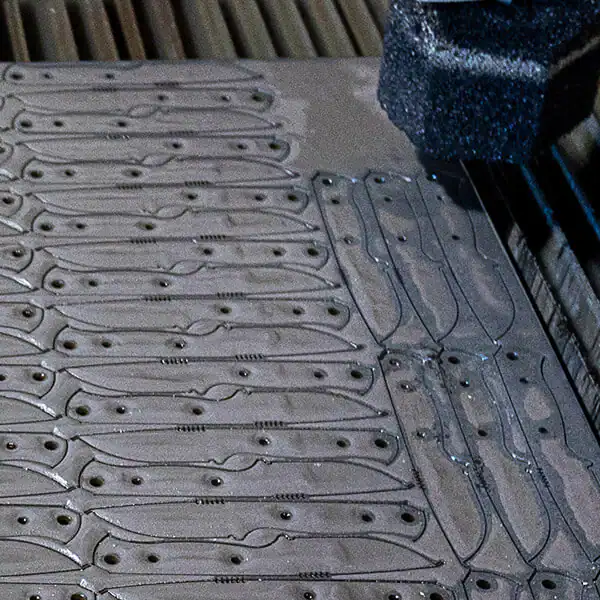
Traditional nesting placed parts on a sheet with reasonable efficiency. AI-driven nesting algorithms do something more sophisticated: they analyze every part geometry simultaneously, rotate and reposition components across thousands of possible configurations, and find the arrangement that extracts the most usable parts from a single sheet of material. Industry data puts the scrap reduction from AI-driven nesting at up to 15% compared to conventional approaches.
On standard steel or aluminum stock, that’s meaningful. On aerospace-grade aluminum, thick stainless plate, or imported marble, it’s significant. If you’re running production volumes — even modest ones — that 15% reduction in material waste compounds across every sheet in your order.
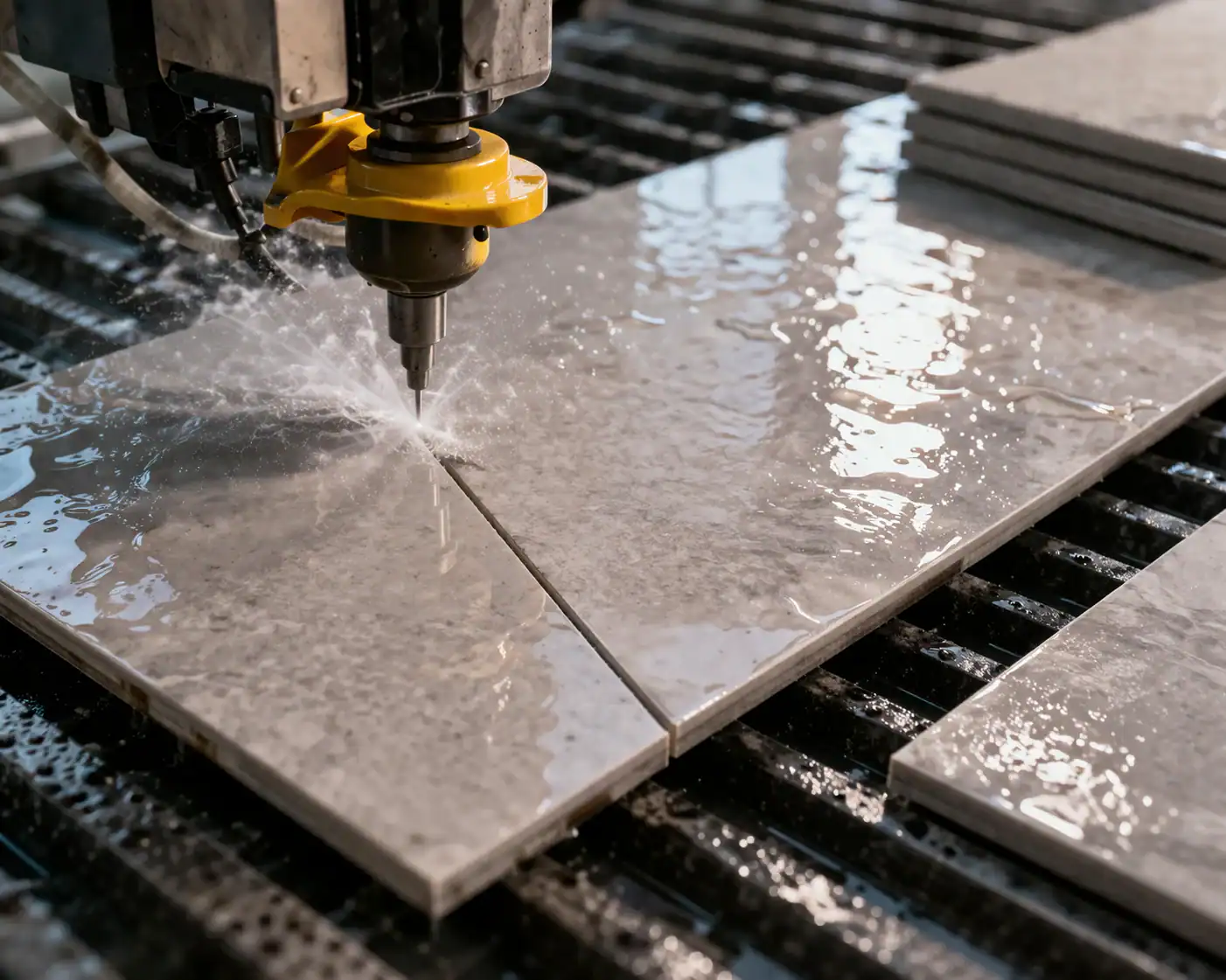
There’s a secondary benefit that doesn’t get talked about as much: kerf width. The cutting stream on a modern waterjet system measures between .020 and .040 inches — thinner than a human hair. That narrow kerf is what makes tight nesting possible in the first place. When parts can be nested closer together without interfering with each other’s geometry, you get more usable parts per sheet.
For Long Island manufacturers dealing with material costs that have risen sharply over the past few years, this kind of efficiency isn’t a nice-to-have. It’s a real line item on the project cost sheet.
Yes — and this is one of the more underappreciated shifts in what modern waterjet cutting can deliver.
Our automated waterjet systems can run overnight or through a weekend with minimal operator involvement. You load the raw material, set the job, and the machine completes the full cut sequence — adjusting pressure, managing abrasive flow, maintaining nozzle position — without someone standing at the controls. When the run is done, the system signals for the next cycle.
This matters for turnaround time in a direct way. Production doesn’t stop when the workday ends. A job that would have taken three days on a manually supervised system can be completed in one when the machine is running lights-out. For Long Island manufacturers managing tight project schedules — whether that’s a construction deadline in Suffolk County, an aerospace component delivery, or a custom fabrication order — that kind of throughput is the difference between making your timeline and missing it.
Our systems also integrate IoT sensors that monitor water pressure, abrasive flow rate, and component wear in real time. When something starts to drift out of spec, the system flags it before it becomes a problem. That predictive maintenance capability means fewer unexpected breakdowns and more consistent output across every part in a run. The first part and the last part should be identical. With sensor-monitored automation, they are.
This is a meaningful contrast to older waterjet shops that rely on operator feel and periodic manual checks to maintain quality. Consistency at scale requires systems designed for consistency at scale — not experience and intuition filling the gaps.
Want live answers?
Connect with a Tri-State Waterjet expert for fast, friendly support.
The global waterjet cutting machine market was valued at approximately $1.23 billion in 2024 and is projected to reach $2.10 billion by 2033 — a growth rate of around 6% annually. That’s not a stagnant industry. It’s one where investment in equipment, software, and automation is accelerating, and the gap between shops running current technology and shops running legacy equipment is widening every year.
The trends driving that growth aren’t abstract. They’re showing up in the specific capabilities buyers are starting to expect: tighter tolerances, faster turnaround, more material versatility, and cleaner integration with the CAD workflows their engineering teams already use.

Pressure is one of the clearest indicators of where waterjet technology is heading. Early commercial systems operated at pressures that limited cutting speed and edge quality on harder or thicker materials. Current leading-edge systems operate at 94,000 PSI — a level that delivers both faster cutting and cleaner edges across a wider range of materials and thicknesses.
At that pressure, modern waterjet systems can cut materials up to 6 inches thick with tolerances held to ±0.001 inches. For context, that’s the tolerance standard that aerospace and defense manufacturing demands. It’s not a capability reserved for specialty applications — it’s what well-equipped shops deliver on standard production runs.
Taper compensation is another area where the technology has made a significant leap. When a high-pressure water stream passes through material, it creates a slight angle on the cut edge — a taper — that can affect dimensional accuracy on tight-tolerance parts. Automatic taper compensation systems adjust the cutting head in real time to counteract this effect, producing cut edges that are genuinely perpendicular without requiring secondary grinding or finishing. On the Flow Mach 500, taper compensation enables bevel cuts up to 60°, which opens up fabrication possibilities that older systems simply can’t match.
For Long Island’s aerospace supply chain — a sector with deep roots in Nassau and Suffolk counties going back to the Grumman era — these aren’t incremental improvements. They’re the difference between a cutting partner who can meet spec and one who can’t. Nassau and Suffolk counties account for 41% of regional manufacturing spending in New York State, and a significant portion of that comes from precision manufacturers who can’t afford to work with shops running equipment that can’t hold the tolerances they need.
The software side of waterjet cutting has evolved just as much as the hardware — and for most buyers, it’s the part that has the most direct impact on their day-to-day experience working with a cutting shop.
Our modern CAM software does more than translate a CAD file into a cut path. It simulates the entire cutting sequence before a single pass is made, flagging potential issues with part geometry, identifying areas where the cut path could be optimized for speed or edge quality, and calculating exact cut time so we can provide an accurate quote before the job starts. That last point matters more than it might seem. When pricing is based on CNC-calculated cut time — accounting for material type, thickness, geometry complexity, and abrasive consumption — you get a predictable number, not a vague estimate that balloons after the fact.
The integration of AI into CAM software is also enabling smarter cutting path generation. Rather than following a fixed sequence, AI-assisted systems evaluate multiple path options and select the one that minimizes machine travel, reduces abrasive consumption, and maintains consistent edge quality across the full cut. Over a production run of hundreds of parts, those micro-optimizations add up to real time and cost savings.
For buyers who work in SolidWorks, Fusion 360, AutoCAD, Rhino, or Illustrator, the practical implication is straightforward: your files load directly into our cutting system without manual re-entry. No one is redrawing your geometry or retyping your dimensions. Our engineering team reviews your file before programming begins — not to redo your work, but to catch anything that would cause a problem at the machine before it becomes scrap.
Suffolk County’s manufacturing sector includes over 2,000 companies, many of which are running complex, multi-step fabrication processes where a single bad cut creates a cascade of downstream problems. Smarter digital controls and tighter CAD integration aren’t luxury features for that market — they’re the baseline expectation for a cutting partner worth working with.
The technology shaping the future of waterjet cutting — AI-driven nesting, ultra-high-pressure systems, automated lights-out production, direct CAD integration, real-time sensor monitoring — isn’t something you’ll see at every shop on Long Island. Most of it is already running at shops that invested in current equipment and built their workflows around it.
If you’re evaluating cutting partners for precision work, the right questions aren’t about years in business or general claims about quality. They’re about specific equipment, specific tolerances, and specific workflows. What system are they running? What PSI? How do they handle your CAD files? What happens before the machine starts cutting?
We’ve built Tri-State Waterjet around those specifics. We run current equipment. We hold tight tolerances. We integrate directly with your CAD workflow. And we’re transparent about what happens before the first cut.
For manufacturers, fabricators, architects, and builders across Long Island who need precision cutting done right the first time, we’re worth a conversation.
Summary:
Article details:
Share: