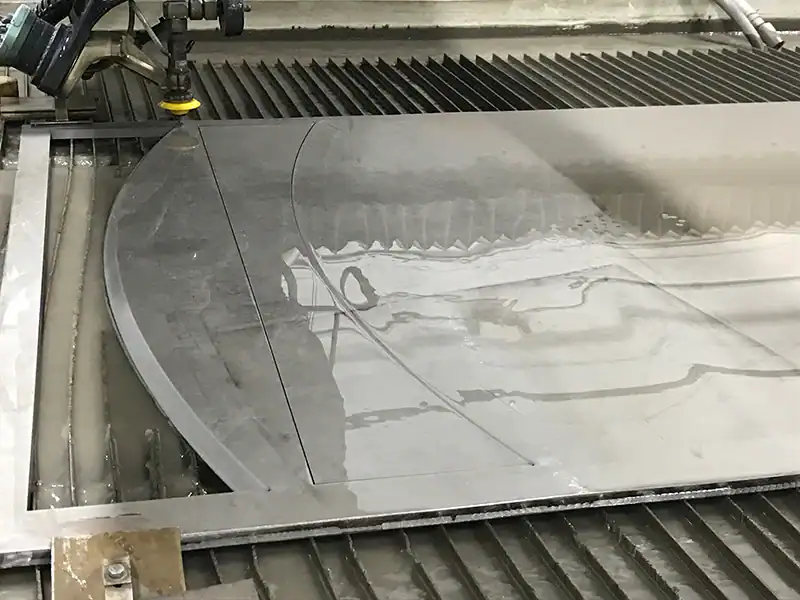
The sink hole is the riskiest cut on your slab. Here's why corners crack, how waterjet changes the odds, and when a bridge saw is plenty.
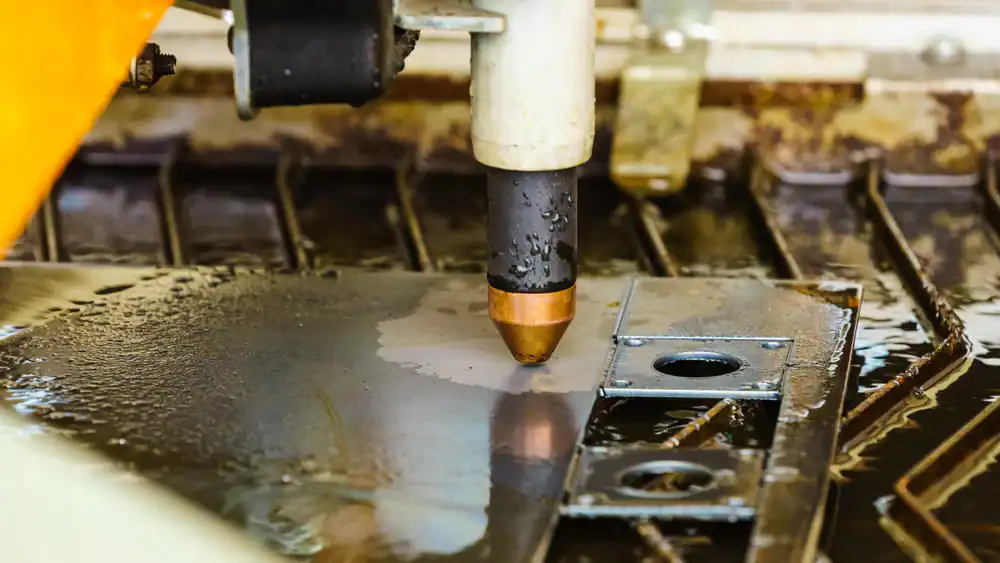
Your slab is probably the most expensive thing on the job. Slabwise puts the slab at roughly 40 to 55 percent of a countertop budget, and it notes that a bad cut on a $6,000 slab can crack it. The sink opening is the riskiest cut that slab will ever see.
If you’re planning a kitchen in Islip, a renovation in Smithtown, or a house out in East Hampton, that’s the moment this page is about. It’s the stretch between buying the stone and making the first cut. Here’s what causes cracks at a cutout, what waterjet actually changes, and how to tell whether you need it.
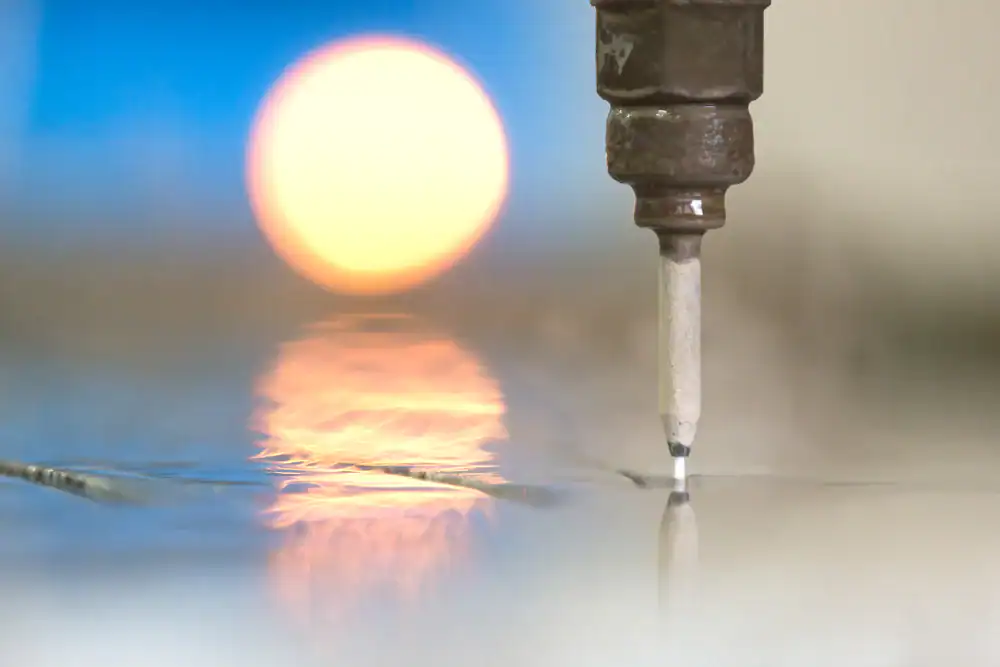
A waterjet cuts stone with a thin stream of water and garnet abrasive pushed through at up to 60,000 PSI. At our West Islip shop that work happens on a Flow Mach 500 system, following a CAD file instead of a person’s hand and eye.
Nothing in that process heats the stone or shakes it the way a saw blade can. The stream is also narrow, typically 0.030 to 0.050 inches, so very little of your slab turns into waste.
None of this makes a slab crack-proof, and we won’t tell you it does. Cracks also come from poor support, fissures in the stone and installation mistakes. What a waterjet does is remove the causes that come from the cutting itself, and the biggest of those is the shape of the corners.
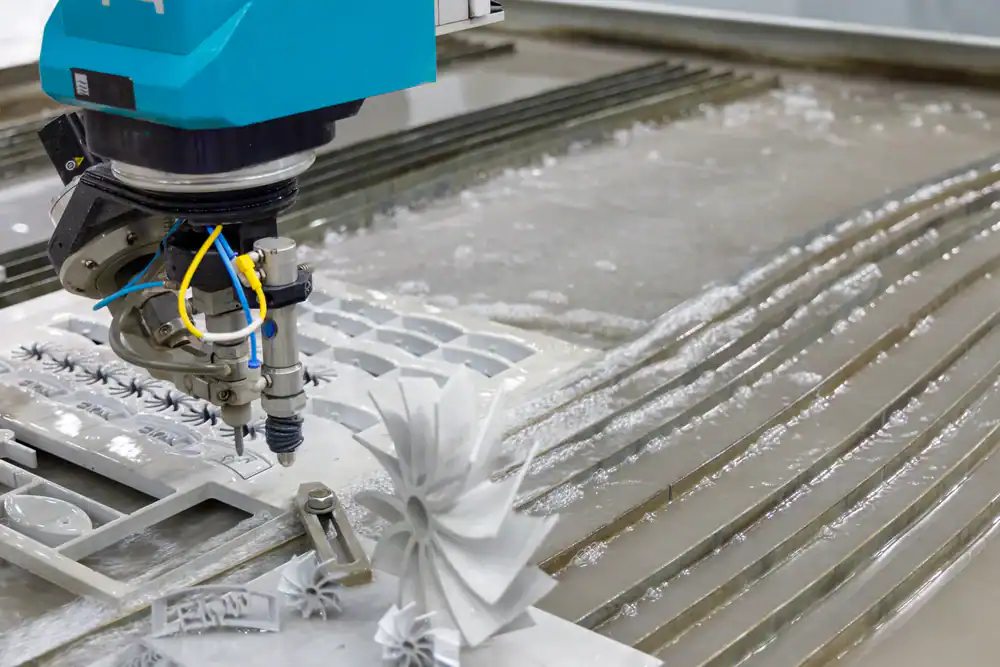
Most of the time it comes down to the inside corners. Fabricator guides, including one from Granite Guy, name stress risers at sink and cooktop corners as the most common reason quartz countertops crack. A sharp corner gathers stress in one tiny spot, and once a hairline starts there, it keeps going.
Radius is the fix. Slabwise says 3/16 inch is the minimum most fabricators accept in granite and natural stone, with 1/4 inch standard. For quartz, 3/16 is generally adequate, though many high-volume shops default to 3/8. The stress numbers back it up: a 3/16 radius drops the stress factor to about 3.0, a 1/4 radius to about 2.5, and a 1/2 radius to below 2.0. A truly square corner is the worst case.
Corners aren’t the only issue. Most fabricators want at least 1.5 to 2 inches of stone between the front of an undermount cutout and the countertop edge. Strips beside a cooktop can end up narrower than that. If the layout can’t shift, a fiberglass or steel rod under the stone can help. Fissures running toward a cutout matter too, which is why it pays to see your actual slab before anyone marks it. Cutting a sink hole while the slab hangs unsupported over a table is another known cause.
Marble is less forgiving, because once a crack starts it travels more easily. Quartz has its own quirk: the resin starts to soften around 150°F, so heat from cutting or grinding isn’t harmless. If a crack does happen, one fabricator guide puts minor repairs at $150 to $500 and larger damage at $500 to $1,500 or more. The real loss is usually the slab and the schedule, not the repair.
Everything starts with the file. We cut directly from CAD drawings, and our in-house design team reviews the file before it’s programmed, flagging tolerance or material conflicts before any stone is touched. That’s where “close enough” gets caught. If the opening has to match a specific sink, the drawing should come from that sink’s spec sheet or template, not from a photo.
Radiused corners come straight out of the cutting path. You pick the radius, we program it, and the machine follows it the same way on every corner. Undermount and drop-in configurations both get accounted for in the drawing, since the edge treatment and the lip are different. On marble we work to tolerances under 1 mm, and the standard fabrication spec we measure against is ±0.5 mm.
Faucet holes are where people tend to underestimate the detail. Hole spacing changes between single-hole, widespread and deck-mounted fixtures. Backsplash clearance can decide whether a faucet handle swings freely or hits the wall. Soap dispensers and air-gap holes add more openings to line up. Because the same machine cuts the sink opening, faucet holes, curves and patterns in one setup, all of it can be laid out against the same drawing.
We cut granite, marble, quartzite, limestone, slate, travertine, soapstone, sandstone and engineered quartz. Marble goes up to six inches thick, which covers heavy islands and waterfall edges. Depending on the edge finish you want, some secondary finishing may still follow the cut. Ask about it up front so it’s in the plan.
Want live answers?
Connect with a Tri-State Waterjet expert for fast, friendly support.
Long Island has plenty of good stone fabricators, and most of them cut sink openings with a bridge saw every week without trouble. A stone waterjet is a different level of equipment. Slabwise lists them at roughly $80,000 to $300,000 or more, which is why many shops, remodelers and designers would rather not own one.
That’s where we come in. Our customers are architects, designers, contractors and fabricators across Long Island, and a good share of what we do is cutting for people who already have the slab and the layout and need one precise piece of the job done. We’re a cutting shop, not a general fabrication shop with a waterjet in the corner.
We’re based in West Islip, with service areas covering Brentwood, Islip, Smithtown, Sayville, Nesconset and East Hampton, serving both Suffolk and Nassau counties. Your slab doesn’t have to travel far.
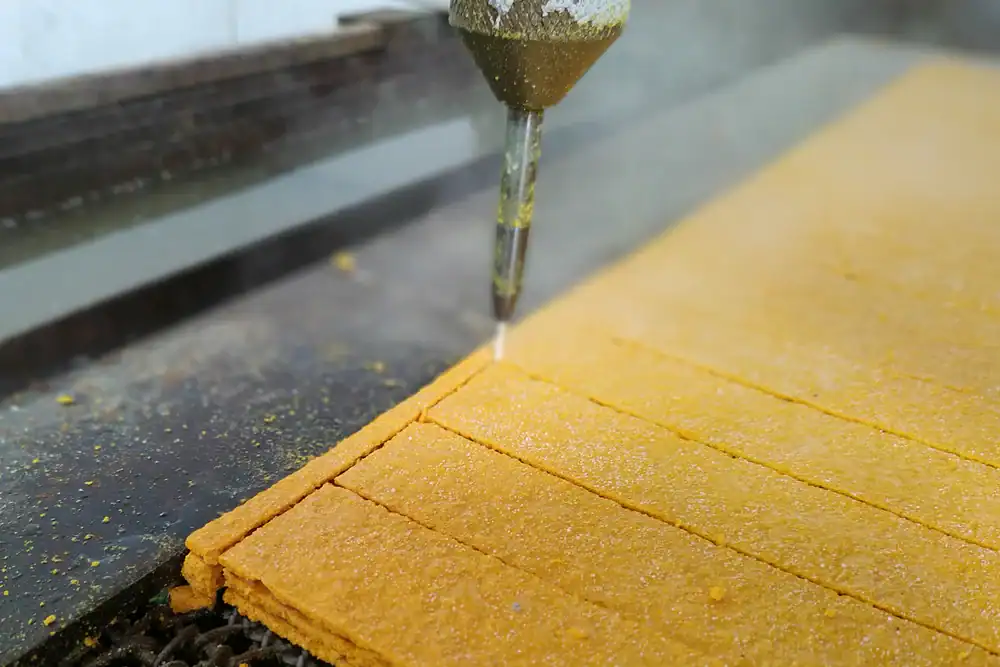
Often, no. For a standard drop-in sink in granite with simple straight cuts, a bridge saw is fast and does the job. Vendor guides say as much, and we’d rather tell you that than sell you a cut you don’t need.
Waterjet earns its keep when the job gets harder. Tight-radius apron-front or integrated sinks are one example. Faucet clusters with several close holes are another. Thick or delicate slabs, like marble and some quartzite, are better off without blade vibration. Sintered stone and large-format slabs are also worth a closer look, and our renovation work covers quartz, sintered stone and big slabs that need to cut cleanly without chipping.
Then there’s the matched-veining work: waterfall edges and book-matched islands, where being a few millimeters off shows from across the room. Picture a large book-matched island in an East End kitchen, the kind of Hamptons-style project where the stone is the whole point. A tight cut there protects both the pattern and the money you’ve put into the slab.
If you’re a Long Island fabricator weighing this up, a good test is simple. Would a miss cost you the slab or the schedule? If the answer is yes, send the cutout out. If it’s a basic undermount in a forgiving stone, keep it in house. Either way, it’s worth asking your waterjet shop how they handle corner radius and file review before you commit.
Start with the sink. A spec sheet or template is far better than a product photo, since the opening has to match the real dimensions. Add the faucet model if there’s a cutout for it, plus any soap dispenser or air-gap holes. Then tell us the material, the thickness, and where on the slab the opening sits relative to the edge and any seams. If you already have a CAD drawing, send that. If not, our design team can review what you have before programming.
A few questions come up constantly. Will waterjet chip my stone? Cutting with water and abrasive avoids the blade heat and vibration that can chip delicate material, though no method suits every slab, which is why file and layout review matter. Can waterjet guarantee my countertop won’t crack? No. It removes cutting-induced problems like sharp corners, but support, strip width and installation still count.
Do you work outside Suffolk? Yes, from our West Islip base we serve Suffolk, Nassau and the wider tri-state area. Is a Long Island project different from one anywhere else? The stone is the same, but the kitchens often aren’t. Between older homes getting new layouts and East End projects with large statement slabs, we see a lot of cutouts where the first cut can’t be a guess.
Finally, ask your fabricator whether the quote itemizes cutouts. A vague quote is where surprise charges and finger-pointing begin.
Here’s the short version. The sink opening is the riskiest cut on your slab, and sharp inside corners are the most common place cracks start. A waterjet cuts the radius you specify straight from the file, with no blade heat or vibration. It won’t fix a bad layout or replace proper support, and a bridge saw is still fine for simple jobs.
If your job involves marble, quartzite, sintered stone, a tight-radius sink, a crowded faucet layout or a matched-vein island, it’s worth getting a second set of eyes on the drawing before the stone is cut. Send us the sink spec sheet or CAD file and tell us about the slab. We’ll tell you plainly whether waterjet makes sense. Reach out to Tri-State Waterjet in West Islip, and we’ll take it from there.
Summary:
Article details:
Share: