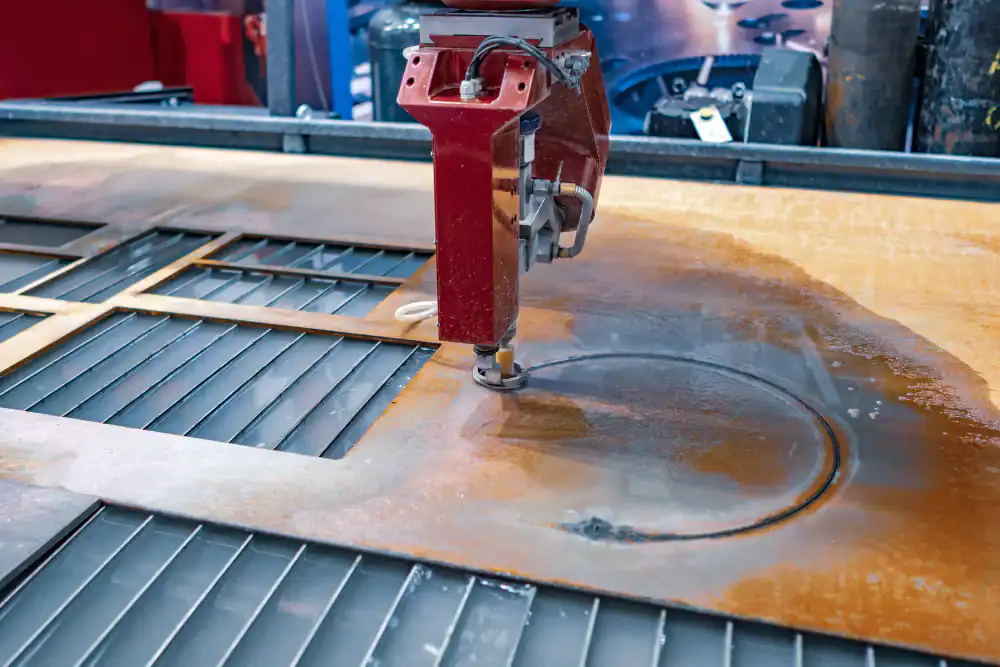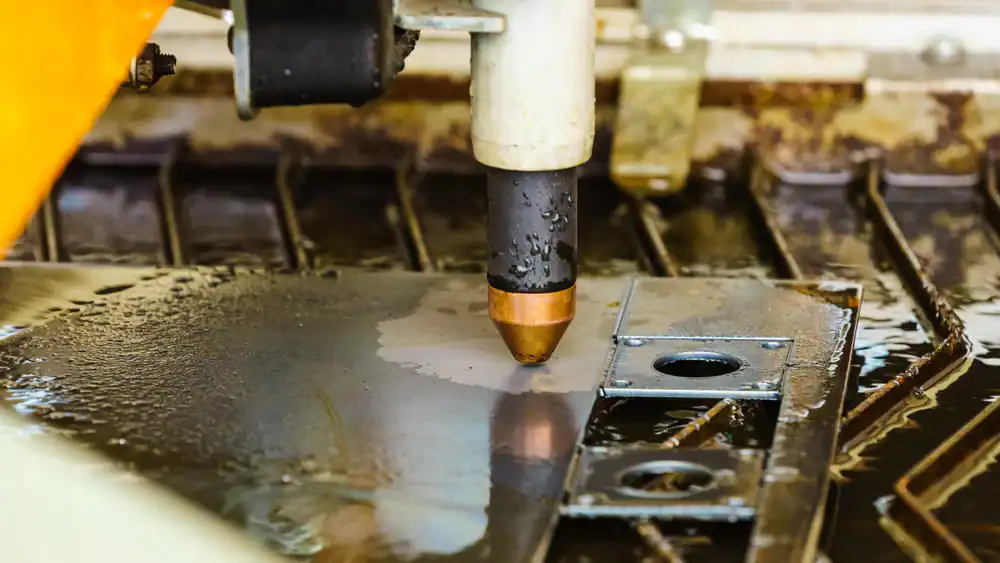
A ±0.005" quote means little without a thickness attached. Here's how taper shows up in thick plate, what 5-axis cutting fixes, and what to ask before you order.
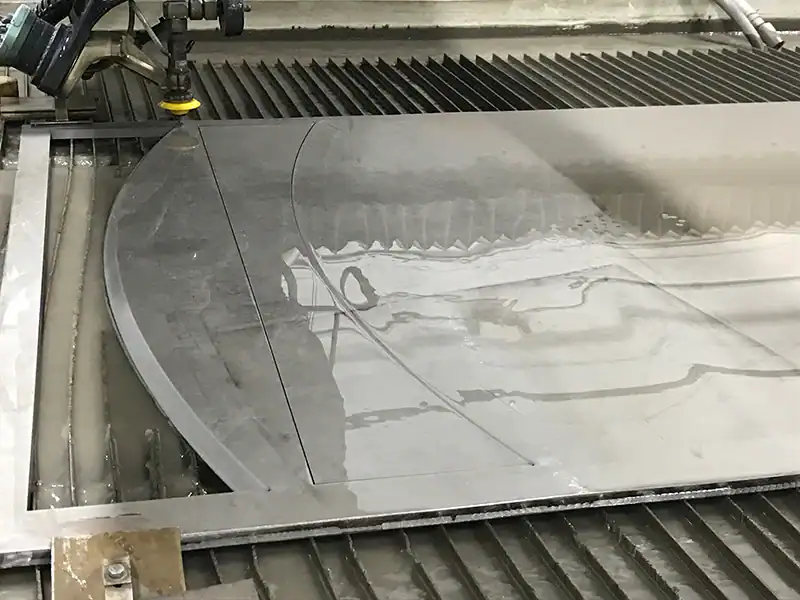
You get the plate back and the edge looks fine until you set a square against it. The top is a hair wider than the bottom, the part won’t sit flush against its mate, and now somebody is grinding it or sending it over to the mill. If you buy thick parts on Long Island—whether for an aerospace supplier near Bethpage, a marine job on the South Shore, or architectural metal—you’ve probably been there. Taper is built into how waterjet cutting works, and it can be controlled. Here’s what causes it, what a quoted tolerance really tells you, and when five-axis cutting is worth paying for.
Taper is the difference between how wide a waterjet cut is at the top of the material and how wide it is at the bottom. The stream loses energy as it travels down through the plate, and it trails behind the nozzle, so the bottom of the cut ends up narrower. You get a slight V instead of a straight wall.
On thin material you’ll never notice. On material an inch or thicker, uncompensated taper can run roughly half a degree to two degrees. A single degree across a 2-inch plate works out to about 0.035 inch of difference between the top edge and the bottom edge—already well outside a ±0.005″ callout.
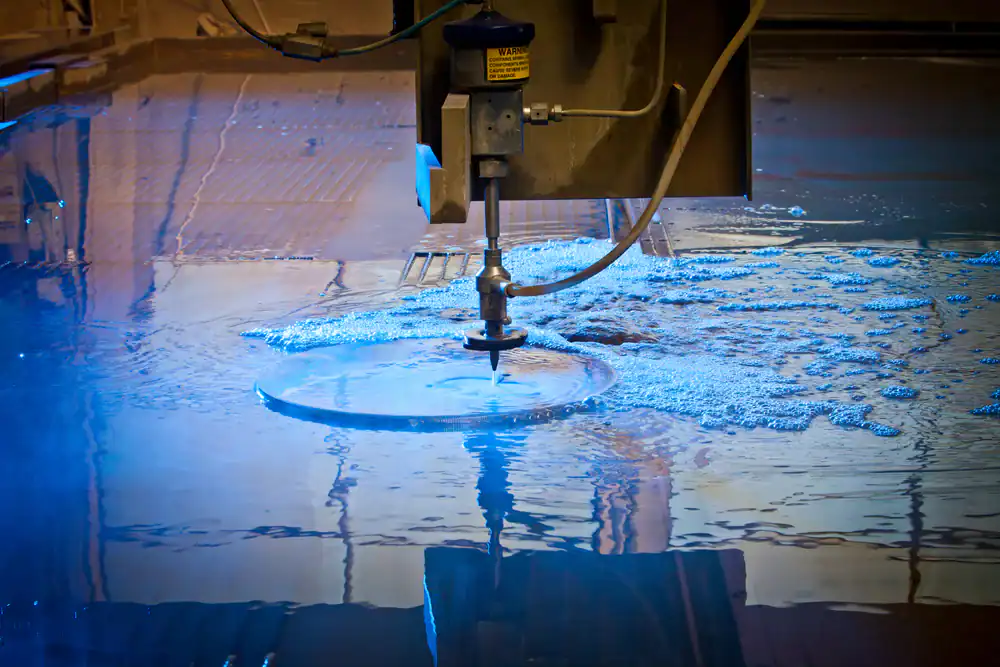
Waterjet taper control is the set of methods that closes that gap. On thick parts, the most effective one is tilting the cutting head.

Think of the stream as a flexible tool rather than a rigid bit. Water and garnet abrasive do the cutting, and as the jet drops through the plate it bends backward, opposite the direction of travel. The thicker the material, the more it lags.
Most of the time that leaves a V-shaped edge, wider on top and narrower at the bottom. Speed changes the shape. Run fast and the V gets more pronounced. Run too slow and you can swing the other way into reverse taper, where the bottom is wider than the top. In very thick material you can even see a barrel shape, with the middle bulging slightly. None of this means a shop did something wrong—it’s physics, and every waterjet deals with it.
Where it becomes your problem is at the joint. A tapered edge is a nuisance on a decorative panel. It’s a real issue when two parts meet along the cut edge—like a plate that presses into a pocket, a stack of spacers, a weld prep, or a bracket that has to bolt up flush. If you run a fab shop along Suffolk Avenue in Brentwood, NY, you’ve probably watched a part that looked right on the face land back on the grinder. The stakes are the same for thick titanium and stainless going to aerospace suppliers around Bethpage, or marine-grade aluminum headed for boats on the South Shore.
One more honest point: even a well-cut thick edge shows light striations toward the bottom for the same stream-lag reason. Square and perfectly smooth aren’t the same thing, and it helps to know which one your part actually needs.
Not much. This is the trap in comparing quotes. One shop says ±0.005″, another says ±0.010″, and the cheaper one looks like the better deal until you ask what material thickness each number was based on. A tolerance with no thickness attached is a sales line, not a spec.
Thickness drives everything. We publish that 1/8″ aluminum can hold about ±0.002″ and 1″ steel about ±0.005″. Hold ±0.005″ on two-inch steel or three-inch aluminum and taper compensation stops being optional, because without it you get a bevel instead of a square edge. Our metal cutting pages show the full range, from roughly ±0.030″ on a fast, rough cut to ±0.002″ with premium calibration. Same machine, very different results depending on how it’s run.
Other Long Island shops publish wildly different numbers too. Some quote ±0.005″ to ±0.010″ up to about an inch and loosen to ±0.010″ to ±0.020″ at two or three inches, and a few say plainly that tight features in thick plate may need a finishing pass. That candor is a good sign. What should worry you is one number quoted for every job.
Speed matters as well. Tighter tolerances mean slower cutting, and slower cutting costs more, so ±0.010″ will generally price lower than ±0.005″ on the same part. That’s why we’d rather ask which edges need the tight number than apply it across the whole part. If you’re collecting quotes across Suffolk and Nassau counties, give every shop the same three things: material, thickness, and the edges that have to be square.
Want live answers?
Connect with a Tri-State Waterjet expert for fast, friendly support.
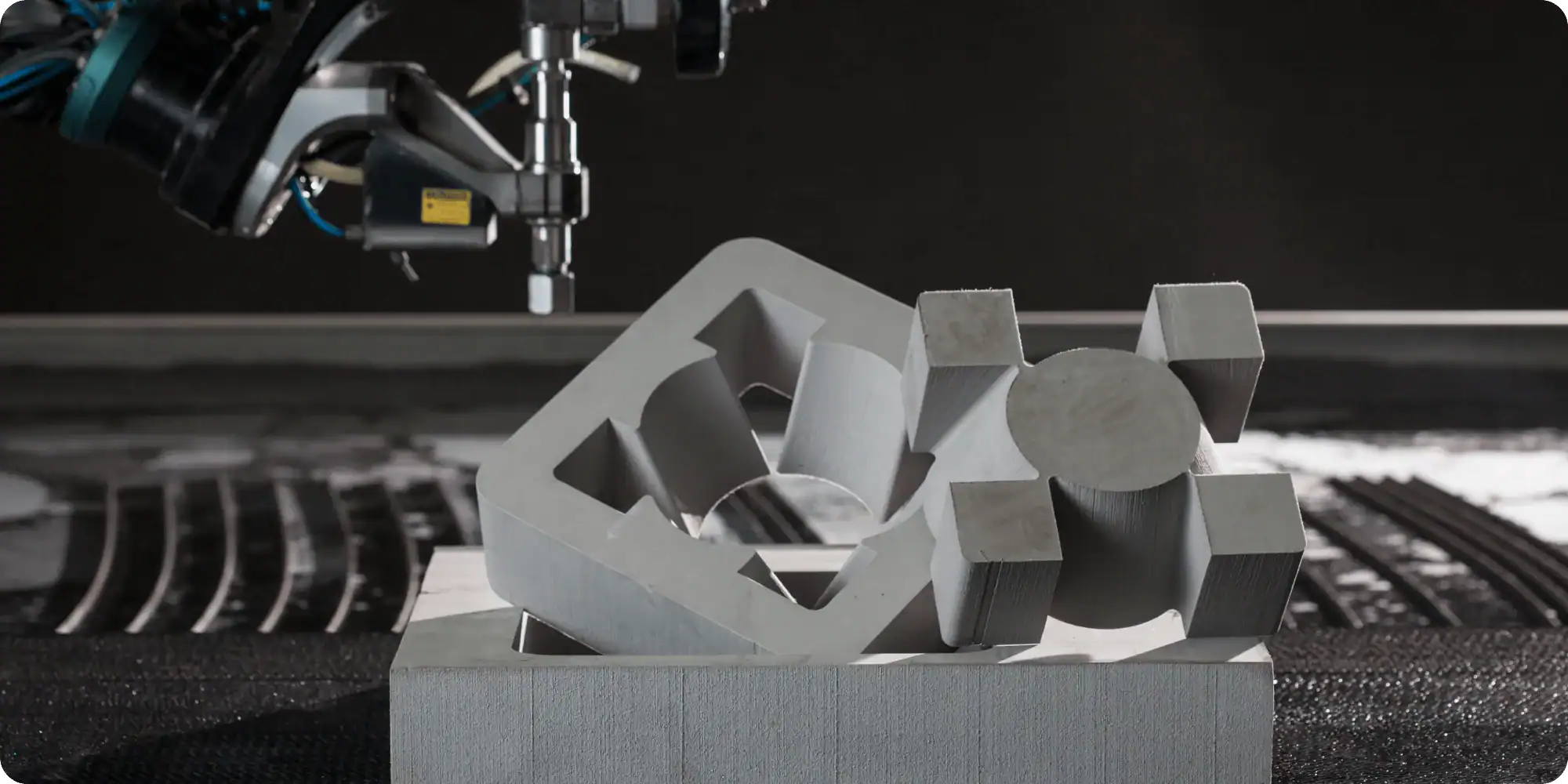
A standard three-axis waterjet cuts with the stream pointed straight down, so the taper lands wherever physics puts it. A five-axis head can tilt and rotate while it cuts, which lets the machine lean the stream against its own lag.
Our Flow Mach 500 runs a 5-Axis Dynamic XD head built for that job. The software adjusts the cut angle as the head moves, so edges stay parallel instead of tapering, even in thick material. In general, a tilting head also steers any taper that’s left over toward the scrap side of the cut—the side you’re throwing away anyway.
The payoff is edges that come off the table closer to square and fewer parts headed to a second operation just to fit.
Sometimes it’s wasted money, and we’ll tell you so. On material around 1/8″ or thinner, taper is so small that compensating for it rarely pays off. We’re not the cheapest shop on Long Island and we don’t try to be, but we’d rather you spend on squareness where it matters than everywhere.
Five-axis taper control earns its keep on thicker parts where the cut edge itself does a job. It presses against another piece, it’s stacked, it’s welded, or it bolts up without shims. Picture the heavier plate that architectural metal and marine work call for—like marine-grade 5052 aluminum or stainless on the South Shore—where parts need to fit the first time. That’s where a square edge saves you the grinder.
You also don’t have to pay for squareness on every feature. If a hole has to be round and a mating edge has to be square, we can compensate where it counts and cut the rest at a faster setting.
And there are limits worth stating now. Tiny holes and narrow slots in thick material can’t always be made fully straight, because a tilted stream can clip the far wall. A critical bore may be better finished by drilling and boring to size, and plenty of machinists will tell you to waterjet the part and then bore it to final dimension. That’s a fair call. If your part is better served that way, we’d say so before you spend a dollar.
Most taper problems start before the cutting does, with a drawing that says nothing about it. A shop can’t guess which edge is the critical one, so it cuts for general accuracy and you find out at assembly.
Start with material and thickness, stated up front, since both change what’s achievable. Then mark which edges must be square and which features carry the tight tolerance. A callout like “this edge perpendicular within ±0.005″” is far more useful than a blanket tolerance across the whole part. If the part mates with something along the cut edge, say so, because that’s where taper bites hardest.
Expect us to review your file before cutting. We check CAD files for tolerance, geometry, and material conflicts before the first cut, so a problem shows up on screen instead of on part number fifty.
Because we’re a walk-in shop at 217 Union Blvd in West Islip, NY, you can bring the file, talk it through with a real person, and pick up finished parts without waiting on freight. Setting a part against a machinist’s square at the counter beats arguing about it over email with a shop in another state. Whether you’re working out of Islip, Central Islip, Copiague, or Melville, that’s an easy question to settle in person.
People also ask whether thick titanium or stainless can come off with parallel edges. With compensation, usually yes on most edges, and your thickness tells us what’s realistic for the features that matter.
Taper is normal, and you can control it. A thick edge starts out slightly angled, a tolerance number only means something next to a thickness, and five-axis cutting earns its cost when edges actually mate with something. On thin stock or a rough feature, it may not.
If you’re sorting out a thick-part order and want to know what’s realistic before you commit, bring it to us at Tri-State Waterjet. Tell us the material, the thickness, and which edges have to be square, and we’ll say plainly whether five-axis taper control makes sense or whether another process fits better. Send the file and the drawing, and we’ll go through it with you.
Summary:

Article details:
Share: