If material costs are eating into your margins, your cutting process might be the problem. Here's how waterjet cutting changes that math.

If you’re buying expensive sheet material and watching a significant portion of it end up as scrap, you already know the pain. What you might not know is how much of that waste is a direct result of how the material is being cut — not the design, not the material itself, but the cutting process.
Waterjet cutting approaches this problem differently. The kerf is narrow. The nesting is optimized before a single cut is made. And because there’s no heat involved, you’re not losing usable edge material to distortion or thermal damage.
Here’s how it actually works — and why it matters for manufacturers on Long Island.
Raw material typically accounts for 40 to 60 percent of total production costs in manufacturing. That means the single biggest variable in your per-part cost isn’t labor or overhead — it’s how efficiently you’re converting purchased material into finished parts.
Most manufacturers focus on design and procurement when trying to control material costs. But the cutting process itself determines how much of what you buy actually becomes product. A wide kerf, poor nesting, or heat-damaged edges can quietly drain yield on every job — and the losses compound across every sheet, every run, every month.
For shops across Long Island, NY — from Hauppauge to Farmingdale to Port Jefferson — this isn’t theoretical. When you’re sourcing titanium or Inconel locally or regionally, every percentage point of recovered material directly affects your ability to compete on price while maintaining margin.
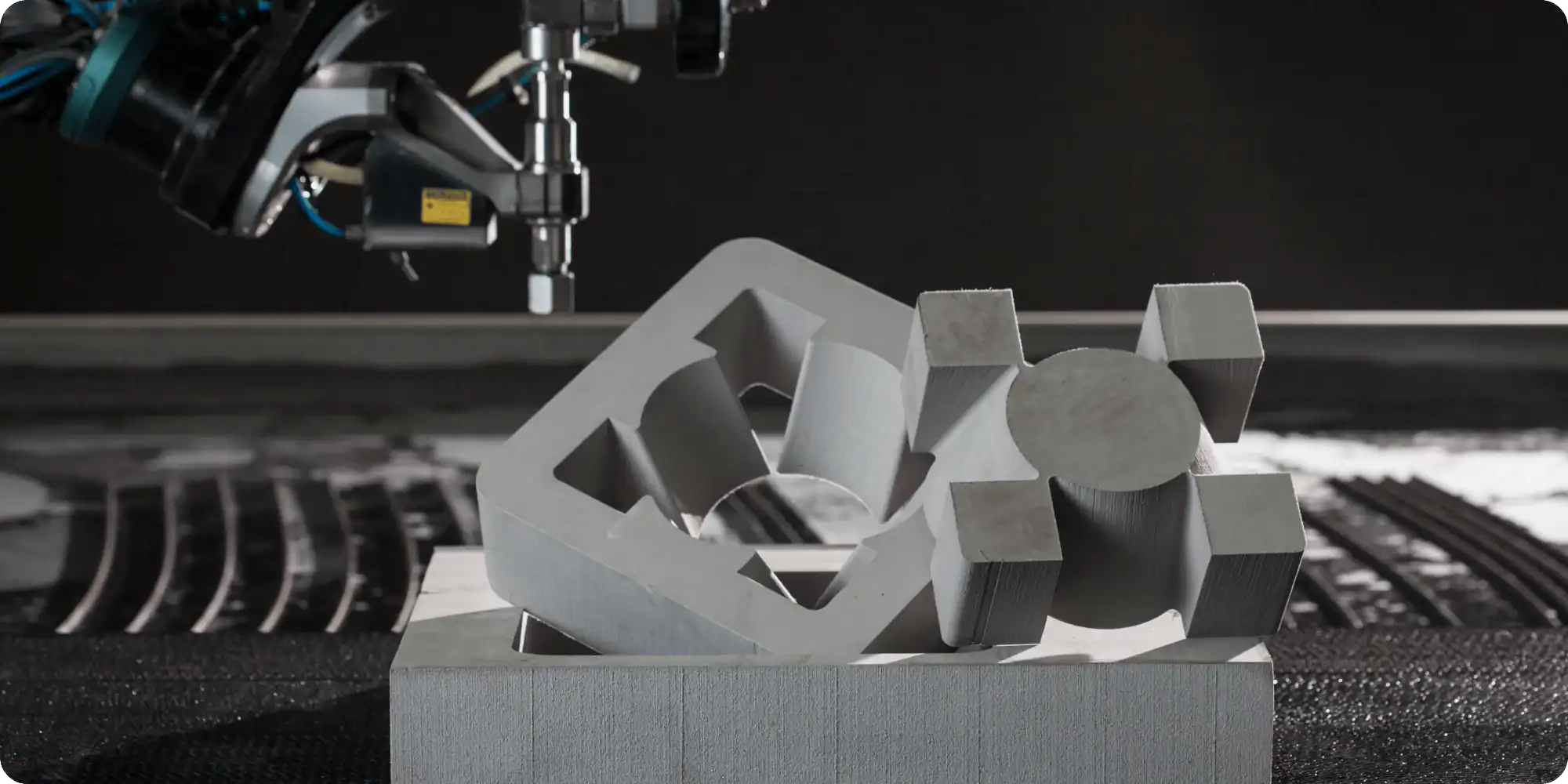
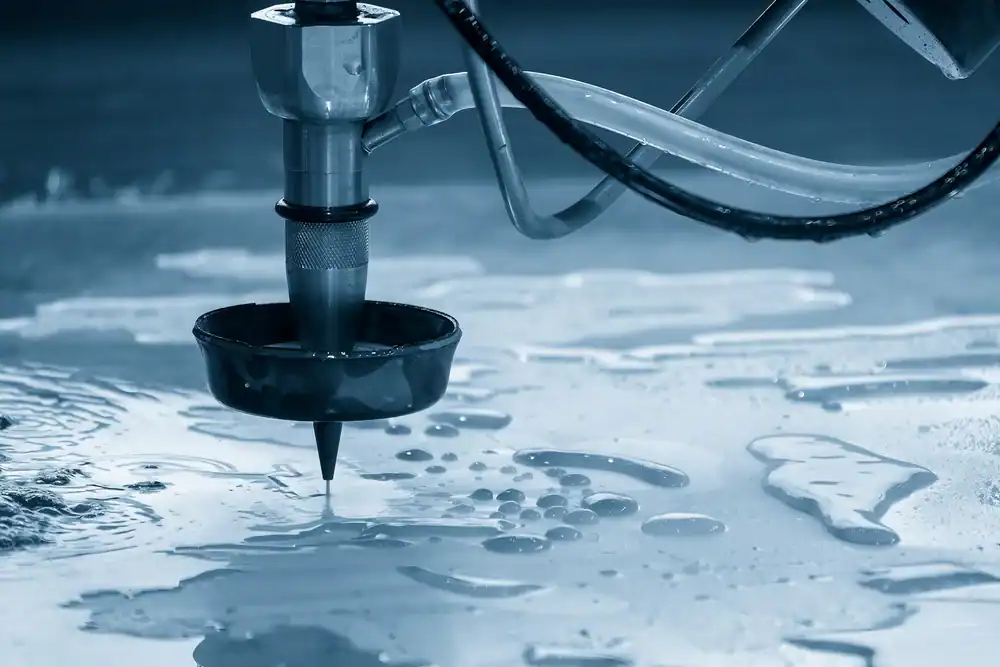
Kerf width is the amount of material removed by the cutting stream as it passes through the workpiece. In waterjet cutting, that width typically runs between 0.020 and 0.050 inches — narrow enough that parts can be nested very close together without one cut interfering with the next.
That might sound like a small number, but it adds up fast. At a 0.040-inch kerf over 100 linear inches of cut, you’re removing roughly 4 cubic inches of material as slurry. Multiply that across a full production run on a sheet of titanium or Inconel, and the cumulative loss becomes significant — especially when you’re paying a premium per pound.
The kerf width also determines how tightly parts can be packed on a sheet. A narrower, more consistent kerf means parts can sit closer together, which means less skeleton left over after cutting. A wider or inconsistent kerf — common when equipment isn’t properly maintained or the process isn’t dialed in — forces more spacing between parts, and that spacing is pure waste.
Waterjet systems maintain consistent kerf width throughout a production run when the equipment is properly set up and maintained. That consistency matters because dimensional variation in the kerf translates directly to dimensional variation in the parts — and parts that fall outside tolerance are scrapped. A scrapped part isn’t just wasted material; it’s wasted cutting time, a delayed schedule, and potentially a reorder of raw stock.
One thing worth understanding: kerf width in waterjet cutting can be compensated for in the CAD/CAM programming. The toolpath is offset by the kerf radius so the finished part dimensions match the design intent. This is standard practice, but it requires the file to be reviewed and programmed correctly before cutting begins — which is exactly why pre-cut file review matters as much as the cutting process itself.
Nesting is the process of arranging part profiles on a sheet of raw material to maximize the number of usable parts per sheet while minimizing the leftover skeleton. Done well, it’s one of the highest-leverage steps in the entire cutting workflow. Done poorly — or not done at all — it can waste 15 to 20 percent of every sheet you buy.
The math is straightforward. The difference between 75 percent material utilization and 92 percent utilization on a single sheet of plate steel is real money per sheet. Across a production run of dozens of sheets, that gap becomes a meaningful line item. Advanced nesting software has been documented to reduce scrap rates from 15 percent down to 5 percent — a two-thirds reduction — and generate material savings that translate to tens of thousands of dollars annually for manufacturers running consistent production volumes.
Waterjet cutting has a specific advantage in nesting that thermal processes can’t match: because there’s no heat involved, parts can share a common cut line. This technique — called common-line cutting — means two adjacent parts share one edge instead of two separate cuts with spacing between them. One pass serves both parts. That eliminates the material between them entirely, reduces total cutting time, and allows for denser nesting layouts than thermal methods can achieve safely.
For manufacturers on Long Island, NY working with aerospace-grade alloys, marine-grade stainless steel, or specialty composites, nesting quality isn’t a secondary consideration. When you’re paying a premium per pound for material, every square inch of recovered yield goes directly to the bottom line. Shops in the Hauppauge corridor and throughout Suffolk County’s manufacturing base deal with exactly these materials daily — and the difference between a shop that nests thoughtfully and one that runs files as-submitted shows up clearly in per-part cost over time.
We review every job file before programming the toolpath. That review includes evaluating nesting opportunities specific to your part geometry — not just running a default layout. The goal is to get you the most usable parts from the material you’re paying for.
Want live answers?
Connect with a Tri-State Waterjet expert for fast, friendly support.
Thermal cutting methods — plasma and laser — generate heat at the cut edge. That heat creates a heat-affected zone, or HAZ, where the material’s properties are altered: hardness changes, grain structure shifts, and the edge may warp or discolor. On precision parts, that zone often has to be machined away before the part can be used.
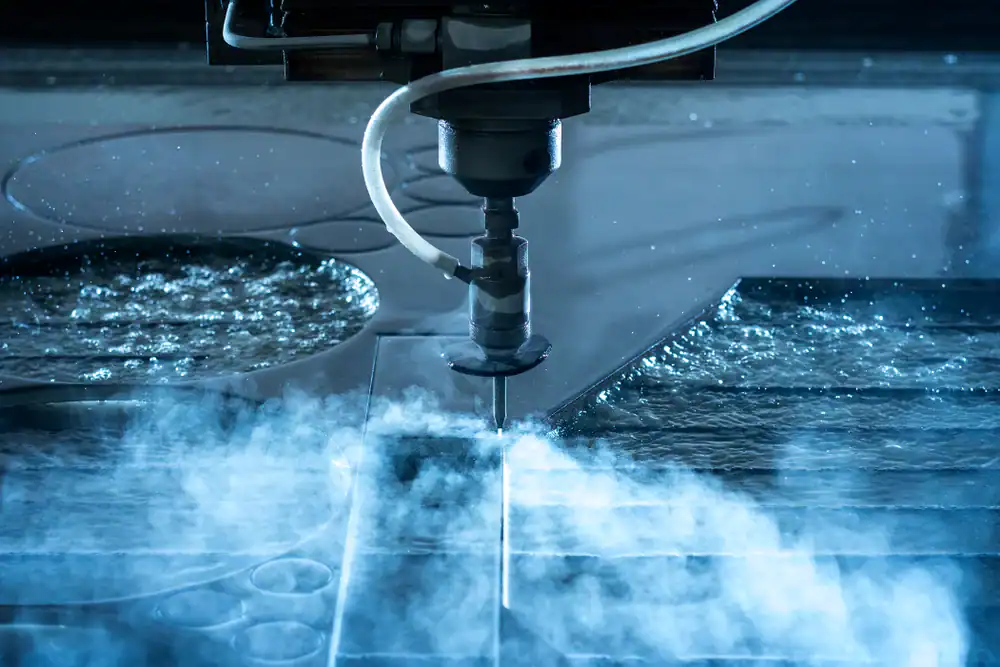
Waterjet cutting is a cold process. There is no heat, no HAZ, and no altered material at the cut edge. The material you receive is the material you designed — dimensionally accurate, with a satin-smooth edge that typically requires no secondary finishing.
Yes — and it saves more than most manufacturers initially account for. When a thermal cut creates a heat-affected zone along the edge, that zone can render portions of the material unusable in its current state. For parts with tight tolerances or surface finish requirements, the HAZ margin has to be removed before the part moves to the next step in fabrication.
That removal has a cost. There’s the material ground or machined away. There’s the labor time for the secondary operation. And there’s the risk that the part, once the HAZ is addressed, no longer meets dimensional requirements — resulting in a scrapped part that consumed raw material, cutting time, and finishing labor before it was rejected.
With waterjet, none of that happens. The edge comes off the table ready to use. For manufacturers running high volumes, that elimination of secondary finishing isn’t just a convenience — it’s a real reduction in per-part cost and a meaningful improvement in throughput. Parts move through the workflow faster because there’s no grinding step between cutting and assembly or inspection.
For Long Island, NY manufacturers supplying aerospace and defense programs — particularly those working to AS9100 quality standards — edge integrity isn’t optional. The precision required by customers in the Hauppauge industrial corridor and throughout Suffolk County’s defense supply chain demands that parts arrive dimensionally correct the first time. Waterjet’s cold cutting process supports that requirement in a way that thermal methods simply cannot replicate on sensitive materials.
We hold tolerances to ±0.005 inches across most materials and geometries. That’s what our Flow Mach 500 CNC system is capable of, and it’s what our customers building to aerospace and defense specifications require.
Here’s something most conversations about waterjet cutting and material waste skip entirely: the most expensive scrap is the part that never should have been cut the way it was.
A geometry error in a CAD file, a tolerance that the nesting layout doesn’t respect, a part orientation that creates an avoidable stress concentration — these problems don’t reveal themselves during cutting. They reveal themselves when the finished part fails inspection, or when it doesn’t fit the assembly it was designed for. At that point, the material is gone, the cutting time is gone, and the schedule has slipped.
Pre-cut file review is the first line of waste defense, and it’s a step that doesn’t get enough attention. Before we program a toolpath, we review the file for geometry issues, tolerance concerns, and nesting opportunities. If something looks like it will cause a problem, we flag it before the machine starts — not after. That conversation costs nothing. A scrapped part from a preventable error costs everything that went into making it.
This matters especially for manufacturers running first-time jobs on expensive materials. If you’re cutting titanium or carbon fiber for the first time with a new shop, you want to know that your file has been reviewed by someone who understands the material behavior, the kerf dynamics, and the nesting implications — not just queued up and sent to the machine.
We’ve been cutting parts on Long Island, NY since 1981. That’s more than four decades of working with the materials, the tolerances, and the industries that define manufacturing in this region — aerospace, defense, marine, architecture, and custom fabrication. When we review a file, we’re drawing on that experience, not just running software.
The connection between your cutting method and your material costs is direct — and it’s one of the more controllable variables in a manufacturing operation where a lot of costs aren’t. Narrow kerf width, optimized nesting, common-line cutting, and a cold process that delivers usable edges without secondary finishing all work together to put more of what you buy into finished parts.
For manufacturers on Long Island working with expensive alloys, tight tolerances, and demanding customers, that efficiency isn’t a luxury — it’s a competitive necessity. The cost of doing business here is real, and every square inch of recovered material yield contributes to margin.
If you’re looking at your scrap rates and wondering whether your current cutting process is part of the problem, it’s worth having that conversation. Reach out to Tri-State Waterjet and send us your file — we’ll review it, talk through the nesting approach, and give you a clear picture of what to expect before anything gets cut.
Summary:
Article details:
Share: