Not sure if waterjet cutting makes sense for your prototype, your production run, or both? Here's how to think through it.
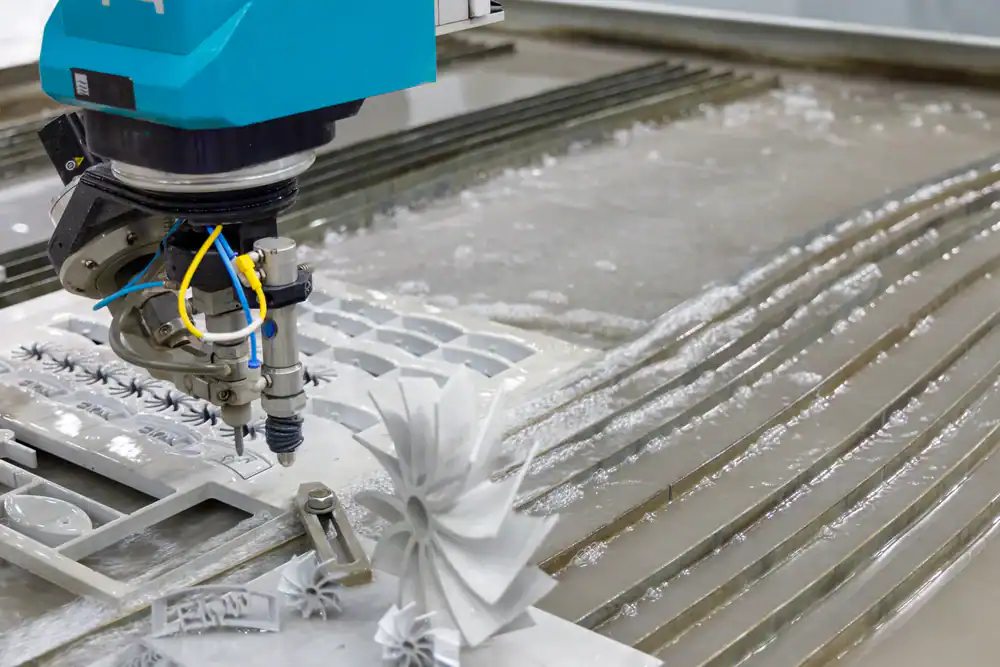
You’ve got a design that needs to be tested before anything gets ordered in quantity. Maybe it’s a custom bracket, a structural panel, a gasket, a component that has to fit perfectly the first time. You need a prototype — but you also don’t want to spend the next three weeks waiting for it, and you definitely don’t want to discover at production that the prototype was cut by a different process on different equipment and the parts don’t actually match.
That’s a real problem. And it’s more common than it should be. Here’s how waterjet cutting solves it — and when it’s the right call for your project.
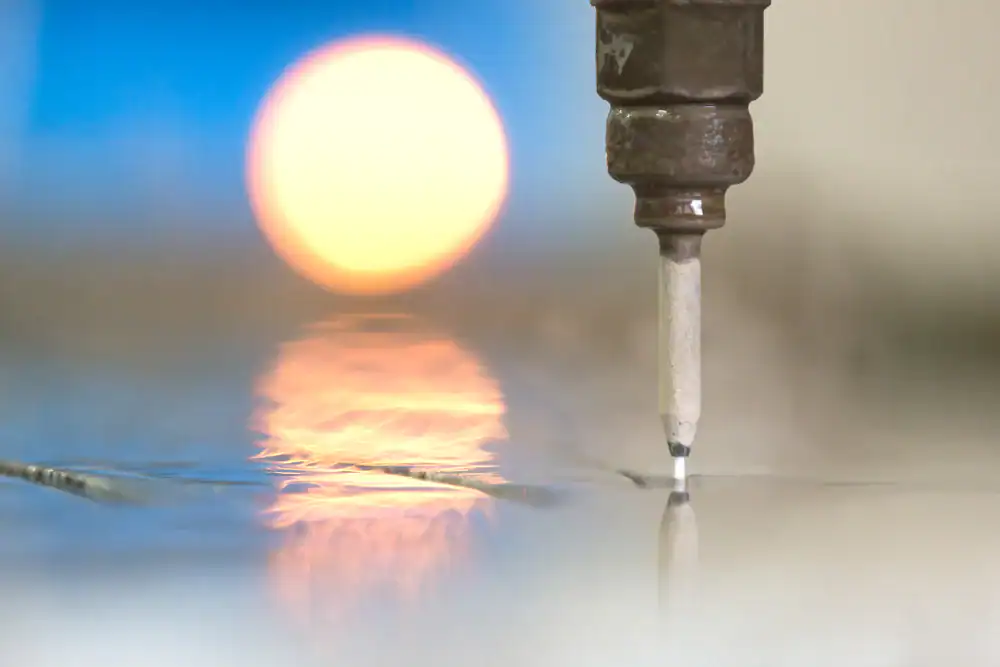
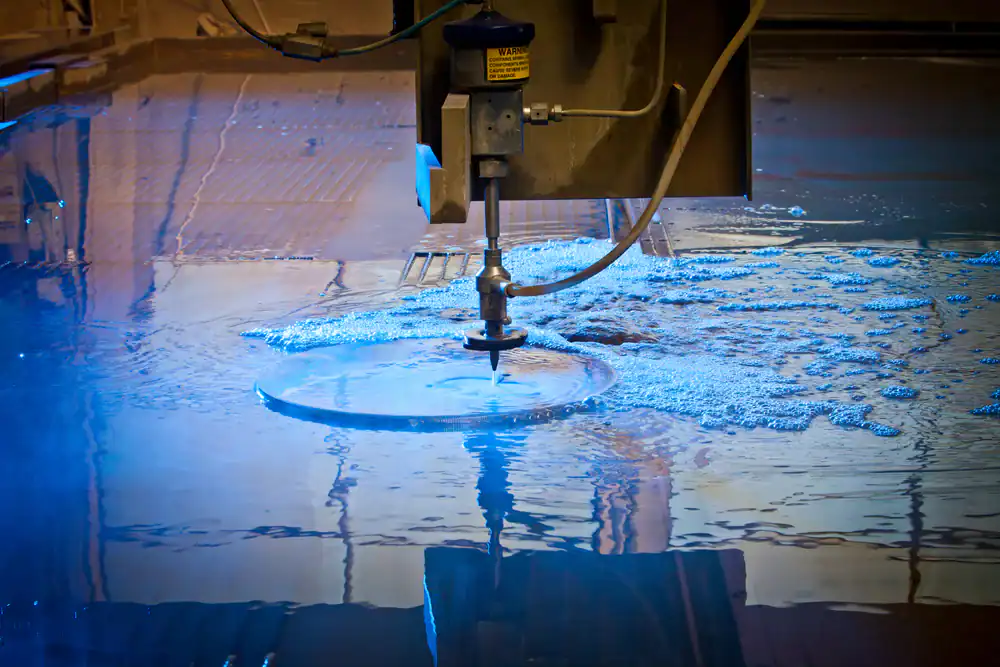
Waterjet cutting uses a high-pressure stream of water — mixed with abrasive particles and operating at around 60,000 PSI — to cut through material directly from a CAD file. There are no dies, no molds, no fixtures. You send us a DXF, DWG, or STEP file, we review it, and the machine cuts your part.
For prototype work, that last part matters more than it might seem. Because there’s no tooling involved, a design change isn’t a cost — it’s a five-minute CNC program update. You can iterate as many times as your design requires without a single dollar in tooling modifications. The only variable cost is material and machine time.
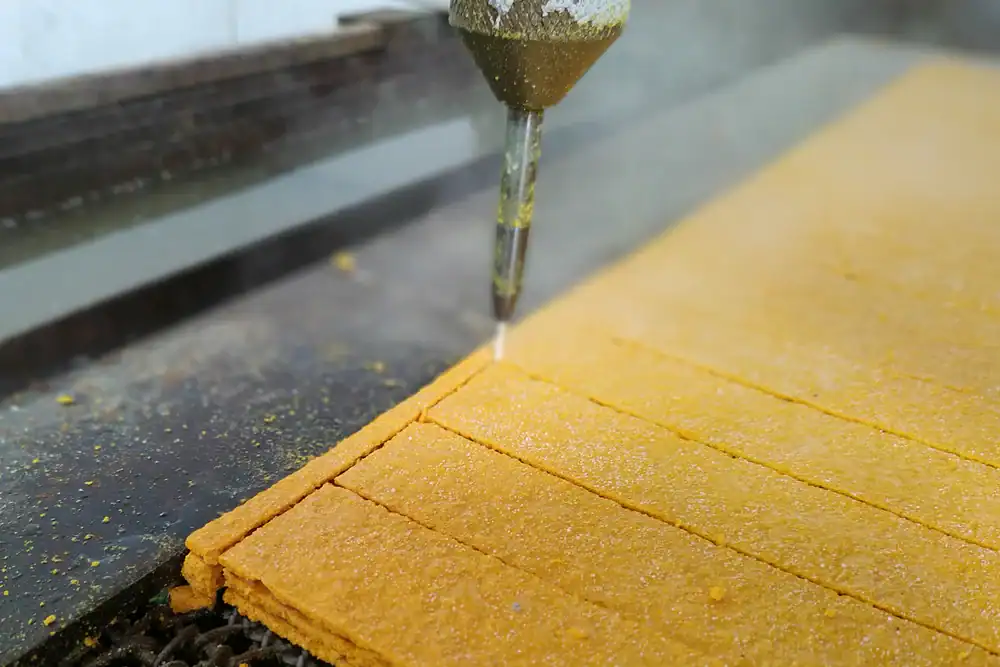
Here’s something that doesn’t get talked about enough: most prototyping methods push you toward a substitute material. You prototype in aluminum because it’s cheap, then move to stainless steel for production. You prototype in a soft composite to test the geometry, then switch to a harder material for the real run. It feels efficient. It usually isn’t.
When you test in a proxy material, you’re validating the shape — but not how that shape behaves in the material you’ll actually use. Stiffness, weight, edge behavior, fit tolerance — all of these shift when the material changes. You can end up with a prototype that passes every test and production parts that don’t perform the way you expected.
Waterjet cuts aluminum, stainless steel, titanium, tool steel, brass, copper, composites, carbon fiber, rubber, plastics, stone, marble, and glass. The process doesn’t change based on material — the machine adjusts. So there’s no reason to prototype in a stand-in when you can prototype in the exact material your production parts will be made from. What you test is what you’ll get.
For engineers in Long Island’s defense supply chain — think about the precision fabrication work that feeds into aerospace programs across Suffolk County — this matters at a very practical level. Titanium and hardened tool steel don’t respond the way aluminum does. Testing in the right material isn’t a luxury; it’s the difference between a prototype that tells you something useful and one that just confirms the geometry.
We review every file before cutting begins. That means if there’s a tolerance concern, a geometry issue, or something in the file that won’t cut cleanly, we flag it before material gets touched. It’s a step that costs us a little time upfront and saves everyone a lot of frustration downstream.
This is one of the first questions engineers ask, and it deserves a direct answer. Our Flow Mach 500 system holds tolerances from ±0.001 inches to ±0.005 inches depending on the material and geometry. For most precision mechanical applications — and for the kind of aerospace and medical device work that’s common around the Stony Brook University research corridor and the Hauppauge Industrial Park — that range covers the vast majority of real-world requirements.
What that means practically is that your prototype isn’t an approximation. It’s a precise representation of your design, cut to the same standard we’d hold on a production run. You’re not getting a “close enough” part to check the rough shape — you’re getting a part you can actually test under real conditions.
The cold-cutting process is part of why this works. Waterjet doesn’t generate heat. There’s no heat-affected zone, no warping, no change in material hardness, no residual thermal stress in the cut edge. What goes in is what comes out — same material properties, clean edges, ready to use. For buyers coming from laser or plasma cutting backgrounds, this is sometimes surprising. The edge quality on a waterjet cut is different. You’re not grinding or deburring to compensate for thermal distortion; the part is typically ready to use directly off the table.
Turnaround for standard precision jobs runs 1 to 3 business days. Simple parts with material in stock are often ready same-day or next-day. For engineers across Long Island who need to iterate quickly rather than wait on shipping from a remote online service, that timeline makes a real difference in how fast a design can move from concept to tested prototype.
Want live answers?
Connect with a Tri-State Waterjet expert for fast, friendly support.
The short answer: more often than most people expect. Waterjet is CNC-controlled, which means the program that cut your prototype cuts your hundredth part with the same tolerances. There’s no requalification process, no vendor switch, no moment where you have to re-prove your design because the production process is different from the prototype process.
That continuity is worth more than it sounds. Changing processes between prototype and production — even between two theoretically equivalent processes — introduces variables. Tolerances shift. Edge profiles change. Parts that fit perfectly in the prototype don’t fit the same way in production. Waterjet eliminates that risk by keeping the process identical from part one to part one thousand.
Waterjet is not the right process for every production volume. At very high volumes — tens of thousands of identical simple parts in thin sheet metal — stamping or laser cutting will typically outperform waterjet on cost per part because the fixed tooling cost gets amortized across enough pieces to justify it.
But that crossover point is further out than most buyers assume. For complex geometries, thick materials, or parts that require tight tolerances across the full cut profile, waterjet remains competitive well into production volumes because it eliminates the secondary operations that other processes generate. No deburring. No grinding to remove heat distortion. No rework to hit tolerances that the initial cut missed. Those hidden costs add up fast, and they’re easy to miss when you’re comparing quotes on a per-part basis.
For the kind of short-to-mid-run production work that’s common among Long Island manufacturers — custom components for the marine sector, structural parts for architectural projects, precision components for defense subcontractors in the Hauppauge area — waterjet is often the most cost-effective option across the full range from 1 part to several hundred. The absence of tooling means there’s no volume floor. You don’t need to order 500 parts to justify the setup. One part costs the same per-unit as the first piece in a larger run.
If you’re under a few hundred parts, waterjet is almost certainly worth evaluating seriously. If you’re heading toward thousands of identical simple parts, it’s worth having a conversation about where the economics shift for your specific geometry and material.
Yes — and this is one of the most underappreciated advantages of keeping your prototype and production work with the same shop on the same equipment.
When we cut your prototype on our Flow Mach 500, we’re using the same CNC program, the same machine settings, and the same tolerance standards we’ll use when you come back for a production order. There’s no gap between what you validated and what gets manufactured. The prototype isn’t a proof-of-concept on a different machine that “should” translate to production — it’s the first article of your production process.
For engineers in Long Island’s aerospace supply chain, this matters in a very specific way. CPI Aerostructures and the network of precision fabricators that support programs across Suffolk County operate in an environment where tolerance stack-up across a production run is a real concern. When you know that part one and part five hundred were cut by the same program on the same machine, you don’t have to wonder whether dimensional drift crept in somewhere between prototyping and full production. We hold tolerances within ±0.003 inches from the first part to the thousandth.
The practical implication for product development is that your prototype phase and your production phase aren’t two separate vendor relationships — they’re one continuous process. You iterate in prototyping, lock the design, and scale up without switching anything. No new quotes from a different shop, no re-validation period, no “these production parts don’t match what we tested” conversation. That’s not a small thing when schedules are tight and margins are thin, which describes most of the manufacturing environment on Long Island accurately.
The decision between waterjet and another cutting process usually comes down to three things: how complex your geometry is, how sensitive your material is to heat, and whether you need your prototype and production parts to behave identically. When any of those factors point toward precision and consistency over raw throughput, waterjet is usually the right answer.
For Long Island engineers and manufacturers — whether you’re in a Hauppauge fabrication shop, developing a component for the defense supply chain, or working on a custom one-off for a marine or architectural project — the ability to prototype in your actual production material, iterate without tooling costs, and scale into production without changing anything is a meaningful operational advantage.
Tri-State Waterjet is based in West Islip and works with engineers and fabricators across Long Island and the broader tri-state area. If you have a project you’re thinking through, reach out and we’ll take a look at what you’re working with.
Summary:
Article details:
Share: