Cracked slabs, rejected files, and quotes that don't add up. Here's how custom waterjet cutting really works for glass, marble, and metal on Long Island.
If you’re about to hand over a marble slab, a sheet of glass, or a plate of stainless to a shop with a waterjet, one question is probably running in the back of your mind: what if it comes back ruined? That’s a fair worry on Long Island, where the stone or glass for a Gold Coast kitchen or a Hamptons bathroom is often one of the priciest parts of the job. Add a file that keeps getting kicked back and a quote that’s hard to read, and the whole thing feels riskier than it should. Here’s how custom waterjet cutting works, what it handles well, and what to ask before you commit. We’ll start with the materials people worry about most.
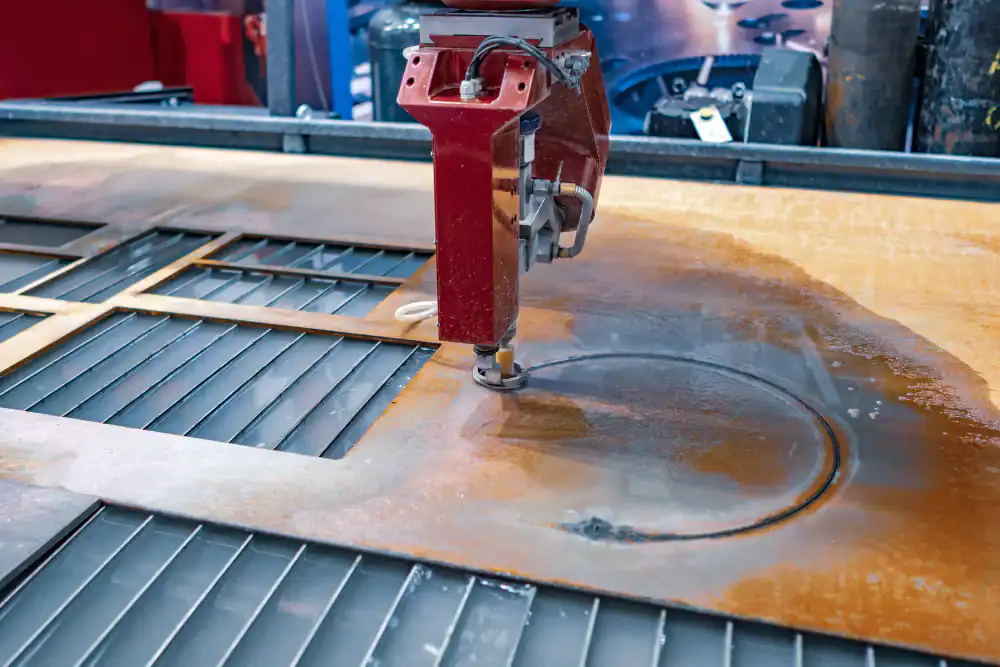
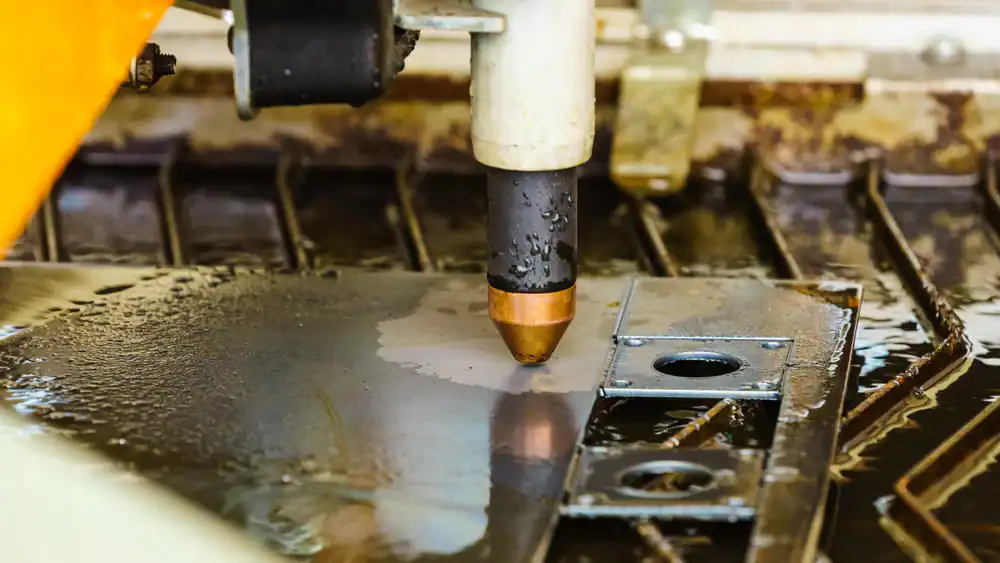
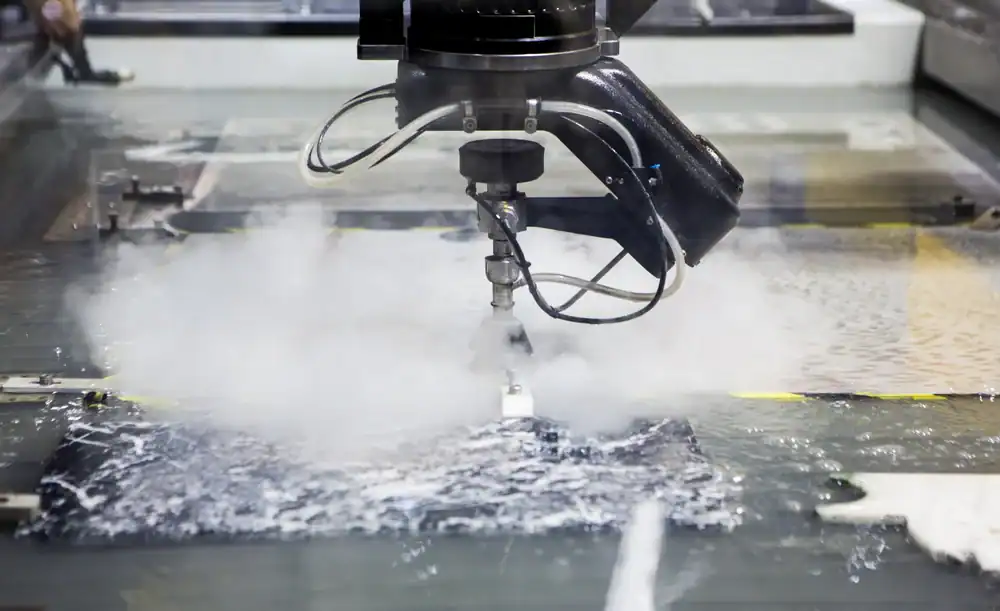
A waterjet pushes water through a tiny nozzle at up to 60,000 PSI and mixes in fine garnet, a hard, sand-like abrasive. That stream does the cutting, and a CNC controller steers it along the path from your file, so the shape you drew is the shape you get. We run a Flow Mach 500 at our West Islip shop.
Because the stream cuts cold, nothing grinds against your material and no heat builds up in it. That matters most when the material is expensive or fragile, which is why we’ll cover stone and glass before metal. Marble, granite, tile, glass, ceramics, composites, wood, and metals from aluminum to titanium all go through the same machine, so one shop can handle a project that mixes several of them.
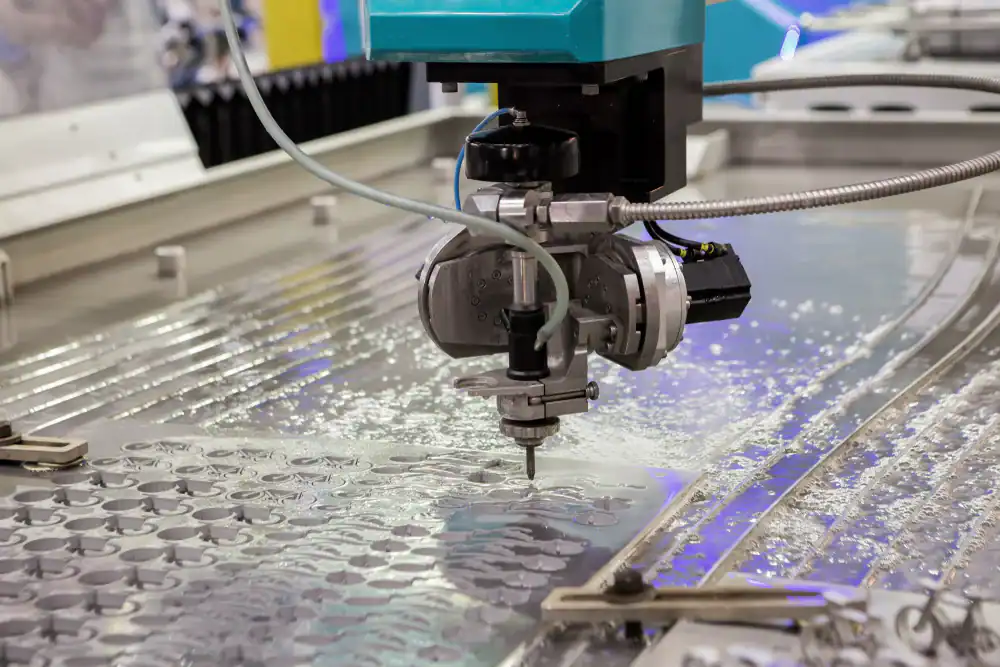
Of all the ways to cut these materials, waterjet is the one least likely to crack them. Most cracked stone comes from stress—either a blade vibrating through the slab or heat making one section expand faster than the rest. A waterjet has neither.
Natural marble often has veins and weak seams, and a saw tends to find them the hard way. A cold cut with no vibration is far kinder to them. That’s a big deal for the work we see between the Gold Coast and the Hamptons, where a designer or homeowner may be supplying a slab that took months to source.
We cut standard 3/4″ stone for countertops and sink cutouts, 2″ slabs for furniture, and 4 to 6″ pieces for architectural elements. We also cut intricate marble inlays and tight curves that a saw can’t follow. Builders working in East Hampton’s high-end custom home market tend to ask about this first, because a mistake on one slab can set a whole schedule back.
Glass follows the same logic. Cutting without thermal stress lets us produce custom shapes, cutouts, and decorative pieces without the cracking that heat can cause, and we cut glass for projects in places like Wantagh and Mineola.
Cold cutting lowers the risk, but it doesn’t erase it. Very thin or brittle material still needs the right piercing and fixturing at the start of each cut. That’s why we run test cuts on unfamiliar materials before we ever touch your good piece.
Yes, you can send a sketch. We cut from DXF, DWG, and AI files, and if all you have is a sketch or a set of drawings, our in-house team can build or clean up the CAD file for you. A lot of first-time buyers assume they need a perfect file before they can even ask for a quote, and that assumption stalls more projects than any cutting problem does.
What we look for before a single cut are the three mistakes that cause the most trouble. An open contour is a line with a small gap in it, so the machine can’t tell what’s inside the shape and what’s outside. Duplicate lines stacked on top of each other make it cut the same path twice. And a file that isn’t drawn at true 1:1 scale gives you a part that’s the wrong size.
On a sheet of aluminum, any of those is an annoying and avoidable mistake. On a slab of natural stone or a custom glass panel, it’s expensive. Catching it on a screen costs nothing.
Being local helps here. If you’re a contractor or fabricator coordinating with other trades, a quick call to our West Islip shop usually beats a week of back-and-forth emails. We serve Suffolk and Nassau counties, and fast turnaround matters when your tile setter, countertop crew, or sign installer is waiting on your part. Sign shops and installers send us lettering and logos the same way: a file or a sketch, then a review before cutting.
Want live answers?
Connect with a Tri-State Waterjet expert for fast, friendly support.
Metal is where most people expect waterjet to live, and it’s a big part of what we run. Stainless steel, aluminum, brass, copper, bronze, titanium, steel, Inconel, and Hastelloy all cut cleanly, from thin sheet to multi-inch plate.
Long Island has the demand to match. Hauppauge Industrial Park is home to roughly 1,300 companies and more than 55,000 workers, according to the Regional Plan Association, and the aerospace supply chain that grew up around Grumman in Bethpage still runs through Nassau County. Marine fabrication along the North and South Shores adds its own steady stream of brackets and structural pieces. Then there’s the architectural side, with decorative metal screens, custom signs, and channel lettering for projects from the Gold Coast to the Hamptons. Different customers, same machine.
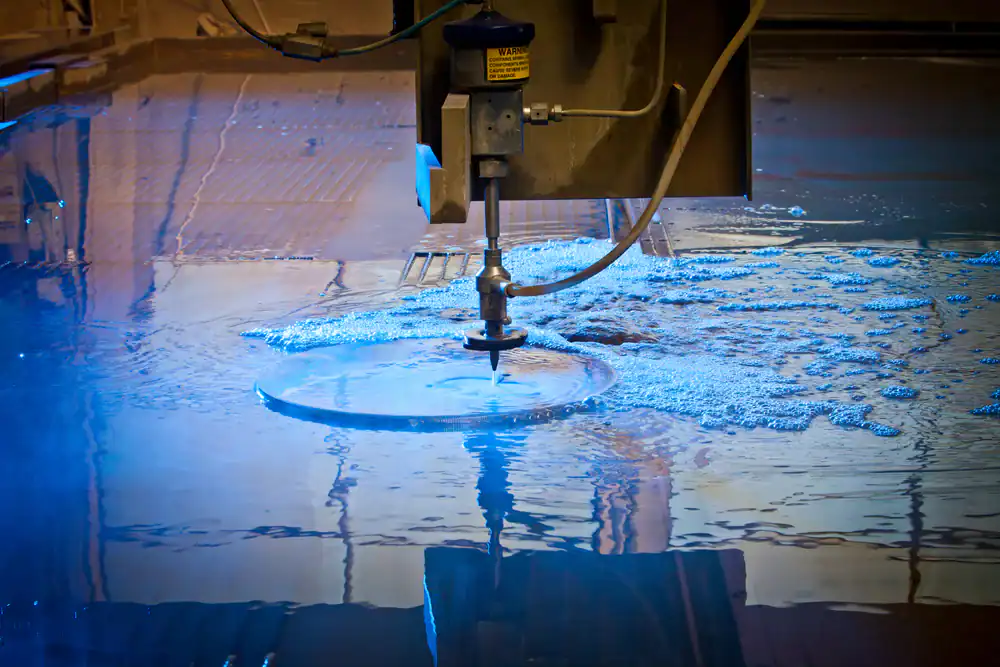
We hold tolerances in the thousandths of an inch, and because the cutting is CNC-driven, the first part comes off the table the same way the hundredth does. That’s what makes waterjet useful for prototypes. An engineer in Hauppauge can approve one bracket, then order a run of them, without wondering whether the process changed between part one and part one hundred. One-off jobs are welcome too. A single part is still a real job.
Edges are the next thing people ask about. For most brackets, panels, gaskets, and custom shapes, the edge comes off the machine in good shape, so you aren’t paying for grinding or secondary machining unless your spec calls for it. Since the cut is cold, you also don’t get the warping, discoloration, or hardened edges that heat can leave behind.
Here’s what a good shop will tell you, and what we’ll tell you. Every waterjet cut has a slight taper, because the stream widens a little as it travels through the material. The thicker the material and the faster the cut, the more you’ll see it. Small start and end marks can also show on an edge. If a particular edge has to be square or will be on display, tell us when you send the file, and we’ll adjust the cutting speed and plan the job around it.
Often, yes, especially on thin steel. If your part is a quarter-inch or thinner and the tolerances are loose, a laser shop may well quote you less, and we’d rather tell you that up front than win a job that doesn’t suit the process. Waterjet earns its price on thick material, heat-sensitive material, stone, glass, composites, and any part where the edge quality matters. It can also save you money in other places, through less grinding, less wasted material, and no parts ruined by heat.
Waterjet quotes are driven by the material, its thickness, how many times the stream has to pierce the material to start a cut, how well the parts can be nested together on a sheet, setup, and any finishing you need. That’s why a part with a lot of small holes can cost more than you expected. Ask any shop to walk you through those pieces.
We’re not the cheapest option in the area, and that’s intentional. You’re paying for equipment that holds its tolerances, operators who nest parts to cut down on material, and turnaround that keeps your project moving. We also won’t upsell you on services you don’t need.
When you compare shops on Long Island, ask about material and thickness limits, whether the bed fits your largest panel, the tolerance they can hold, how they handle files, and whether they’ll test-cut your material. If you’re buying for an industrial program, ask about quality certifications too, and see how quickly they answer your quote request. That tells you plenty.
Waterjet is the gentlest way to cut the expensive stuff, whether that’s marble, glass, or a plate of titanium. A file review before cutting catches the mistakes that ruin material, and a sketch is enough to get started. Laser is sometimes the cheaper call on thin steel, and a straight answer on that is worth more than a low quote on the wrong process.
If you’ve got a project in mind, send your file or your sketch to Tri-State Waterjet. We’re at 217 Union Blvd in West Islip, NY, and you can reach us at 631-422-0888. We’ll review the file, tell you what we’d do and why, and give you a quote with no pressure. With 40+ years of experience, we’ve seen most of what can go wrong on a first job, and we’ll help you avoid it.
Summary:
Article details:
Share: