If your fabricator said your stone design "can't be done," they were thinking about their saw — not about waterjet cutting.
If you’ve ever brought a stone design to a traditional fabricator and been told it’s too intricate, too risky, or just not possible — that answer was about the tool, not the design. Bridge saws cut straight lines. Routers struggle with tight curves. And when the material is a $2,000 slab of Calacatta marble, most shops aren’t going to push the limits of what their equipment can handle.
Waterjet cutting works differently. For custom stone work across Long Island — where the projects are complex, the materials are expensive, and the expectations are high — that difference matters more than most people realize.
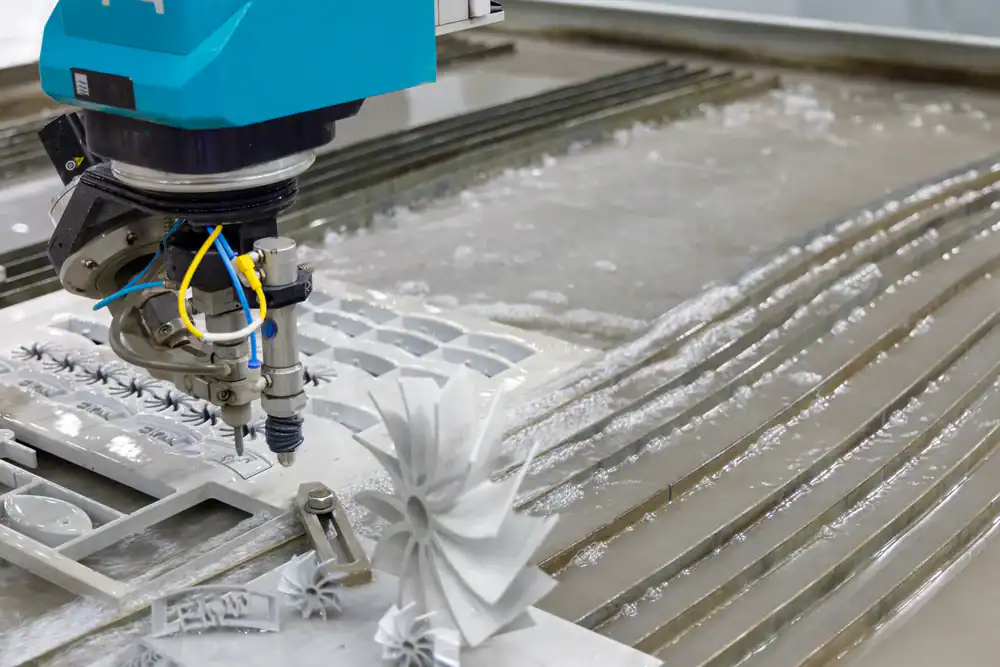
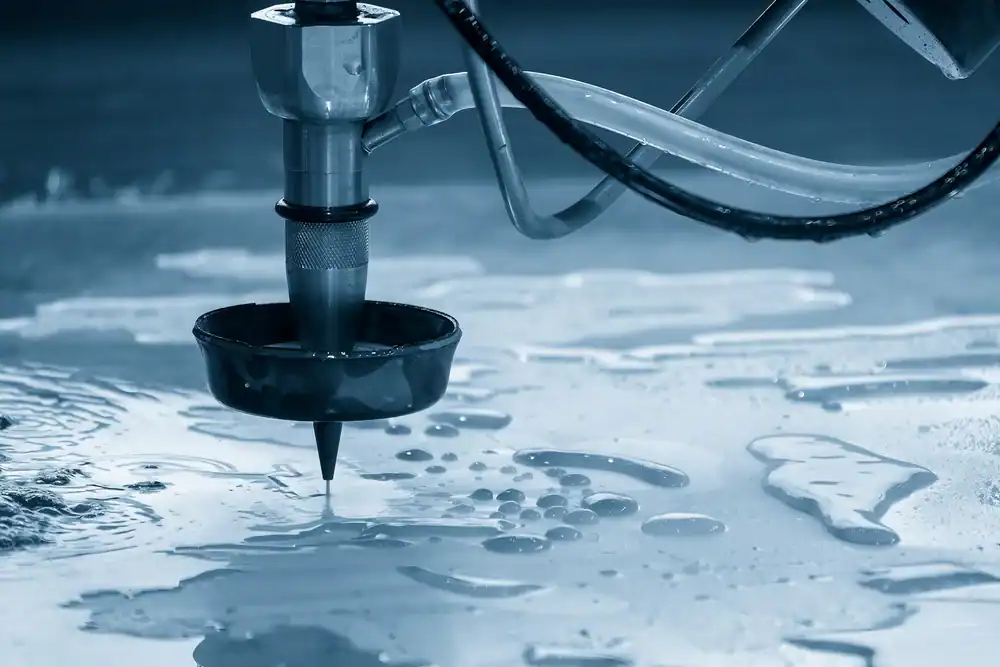
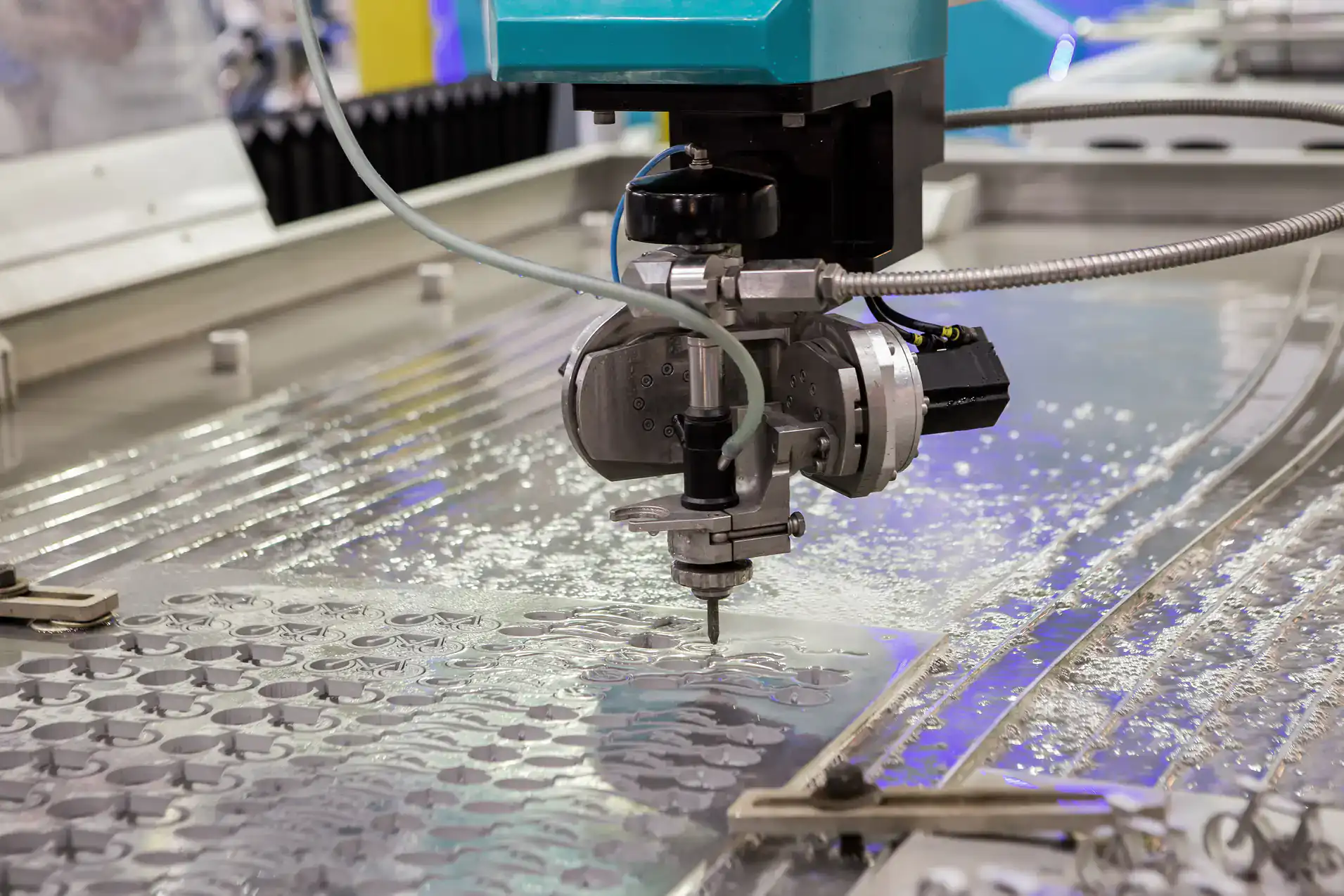
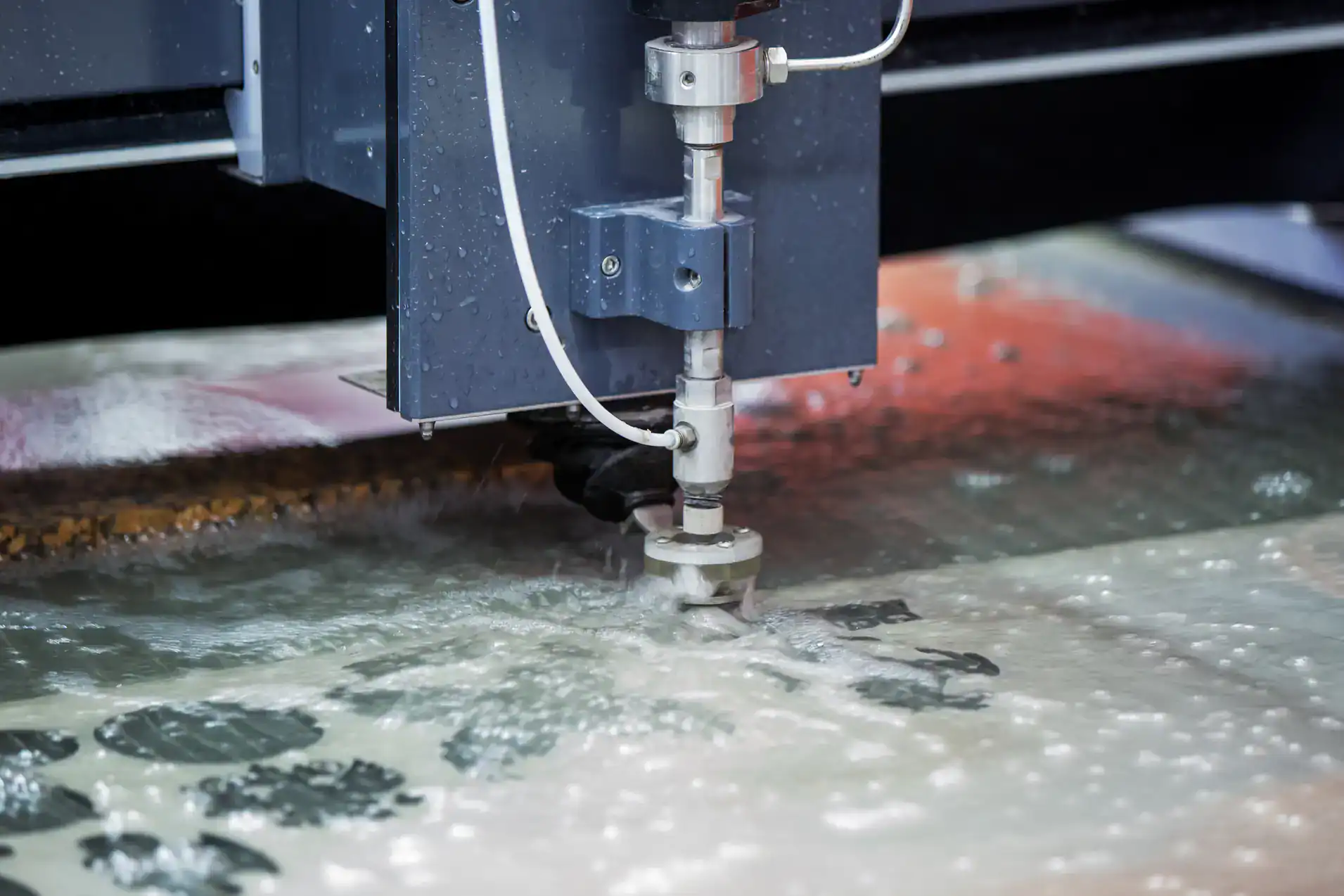
A waterjet cutter uses a highly pressurized stream of water — up to 60,000 PSI — mixed with a fine abrasive material called garnet to cut through stone. There’s no blade, no heat, and no mechanical contact with the surface. The stream follows a path defined by a CAD file, cutting exactly what the design calls for, whether that’s a straight countertop edge or a 12-point compass rose inlaid into a marble foyer floor.
The process is cold by nature. No friction, no heat buildup, no vibration transmitted into the stone. That matters because marble and other natural stones are brittle — they don’t respond well to the stress that traditional cutting tools generate. Waterjet sidesteps that problem entirely.
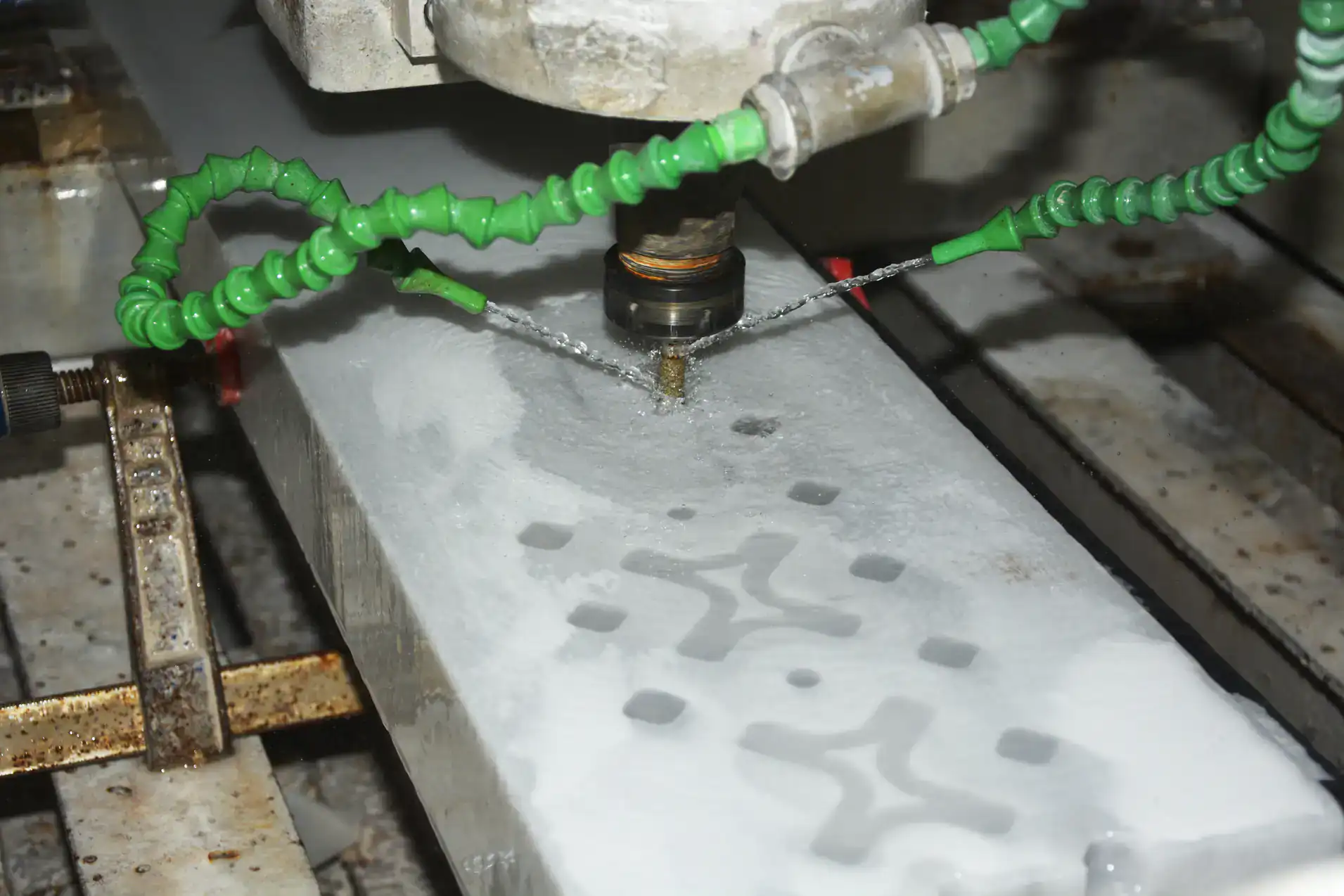
Bridge saws are workhorses. They’re fast, they’re reliable for straight cuts, and most stone fabrication shops have one. But they’re constrained by geometry — a circular blade can only approach a cut from certain angles, and navigating tight interior curves or interlocking shapes requires multiple passes, repositioning, and a lot of hand finishing afterward.
The result is a design that’s been simplified to fit the tool, not the other way around. Routers can handle curves better, but they generate significant heat and vibration, and they’re not well-suited for brittle stone like marble or onyx. Angle grinders are even more limited — useful for finishing work, but not for precision cuts in expensive material.
What this means in practice is that most Long Island homeowners and contractors have been designing around their fabricator’s equipment without realizing it. If a designer sketches a custom floor medallion with interlocking geometric shapes and presents it to a traditional stone shop, the shop will either decline the job, simplify the design, or quote a price that reflects the labor involved in doing it the hard way.
Waterjet removes that ceiling. The cutting head moves in any direction the software tells it to — tight radii, compound curves, interlocking shapes, interior cutouts, lettering cut directly into stone. If the geometry can be drawn in a CAD file, we can cut it. That’s not a marginal improvement over traditional methods. It’s a fundamentally different set of possibilities.
For Long Island projects where the design intent is specific — a custom medallion for a Dix Hills foyer, a brass-inlaid marble feature wall in a Hamptons renovation, a logo cut into granite for a commercial lobby in Hauppauge — waterjet is often the only method that can actually deliver what the client envisioned.
This is the question we get more than any other, and it makes sense. If you’re working with a slab of Carrara or Calacatta marble that cost several hundred dollars per square foot, the idea of running it through any kind of cutting process is nerve-wracking.
Here’s the straightforward answer: a properly operated waterjet does not crack marble. The cracking risk with traditional saws comes from heat and vibration — two things waterjet cutting doesn’t produce. The water stream is cold. There’s no blade spinning against the stone surface, no friction building up, no mechanical stress transferring into the material. The stone that goes in comes out structurally intact.
The nuance worth knowing is that technique still matters. Brittle stones like marble require specific piercing methods at the start of each cut — low-pressure entry, careful speed management — to prevent any blowout at the entry point. This is where operator experience makes a real difference. A shop that primarily cuts metal and occasionally takes stone jobs may not have developed that expertise. A shop that regularly handles marble, granite, quartzite, and limestone will approach each material differently, because each one behaves differently under the stream.
We review every file before a single cut is made. Geometry errors, tolerance issues, and material compatibility questions get resolved on screen — where fixing them costs nothing — not after the slab has been cut wrong. For an expensive or irreplaceable piece of stone, that step isn’t optional. It’s the difference between a successful project and a very expensive mistake.
On Long Island, where Nassau County homeowners are investing in $800,000-plus homes and expecting the finishes to match, there’s no margin for error on a premium stone job. The pre-cut review is how we protect that investment.
Want live answers?
Connect with a Tri-State Waterjet expert for fast, friendly support.
The range of stone work that waterjet cutting can handle is wider than most people expect. Countertops and sink cutouts are the obvious ones — and we handle those cleanly, with tolerances down to ±0.003 inches that leave no gaps around undermount sinks or cooktop openings.
But the more interesting applications are the ones that traditional fabrication simply can’t execute at a reasonable cost or quality level. Floor medallions, custom inlays, decorative borders, geometric patterns, stone logos for commercial lobbies, fireplace surrounds with curved profiles, architectural panels for feature walls — these are the projects where waterjet cutting earns its place. On Long Island, where the luxury renovation market is as active as anywhere in the country, these aren’t rare requests. They’re increasingly standard.
One of the more technically demanding applications in custom stone work right now is the brass-into-marble inlay — a design trend that’s moved from Hamptons showrooms into Nassau County renovations and high-end commercial spaces across Long Island. The look is striking: warm brass channels or geometric shapes set flush into white marble, with no visible gap between the two materials.
Getting that result requires both materials to be cut to the same tolerances, so they fit together without gaps, proud edges, or the need for filler. That’s where most projects run into trouble. A stone shop can cut the marble. A metal shop can cut the brass. But coordinating two separate shops to produce a matched set — where the marble cutout and the brass insert are dimensionally identical — introduces alignment errors that show up as visible gaps at installation.
We cut both materials in the same session, from the same CAD file, on the same system. The marble and the brass are cut as a matched set, with tolerances held to ±0.003 to ±0.005 inches across both materials. When the pieces arrive on site, they fit. That’s not something you can replicate by coordinating two separate fabricators.
The same principle applies to any multi-material stone design — stone with glass accents, granite with stainless inlays, marble with copper detailing. Our Flow Mach 500 system handles all of those materials without equipment changes or process adjustments. For designers and contractors working on high-end Long Island projects where the design calls for mixed materials, that single-source capability removes a coordination problem that has derailed more than a few renovation timelines.
A custom stone floor medallion is one of those details that defines a space. Done well, a medallion in a foyer or great room reads as intentional and crafted — the kind of detail that appears in luxury listings and gets remembered by guests. Done poorly, with visible grout lines, mismatched radii, or pieces that don’t sit flush, it reads as exactly what it is: a difficult fabrication job that didn’t quite come together.
Waterjet cutting is how the good ones get made. The CAD file defines every piece of the pattern — the geometry, the dimensions, the relationship between each element — and the machine cuts them all to the same tolerances. When the pieces are assembled, they fit together with minimal grout lines or none at all, depending on the design. The result is a medallion that looks like it was engineered, because it was.
We work with granite, marble, limestone, travertine, quartzite, and other natural stones for medallion and pattern work. We can cut from client-supplied CAD files or help develop a production-ready file from a sketch or concept. For historic restoration projects in Suffolk County — where matching an existing stone pattern precisely is the whole point — the ability to cut to exact dimensions is especially valuable. A waterjet can reproduce a pattern to within a few thousandths of an inch, which means replacement pieces match the original without hand-fitting.
Logos and lettering cut directly into stone are another application that comes up regularly for commercial clients — lobby floors, exterior signage panels, branded architectural elements. The same process that cuts a medallion cuts a company logo into a granite slab. Long Island’s commercial construction activity, including the manufacturing and professional services corridor around Hauppauge, generates consistent demand for this kind of work alongside the residential renovation market.
Waterjet cutting makes custom stone work possible at a level of precision and design complexity that traditional fabrication can’t match. No heat, no vibration, no cracking risk, and no design ceiling imposed by what a saw blade can physically navigate.
For Long Island homeowners, designers, and contractors working on projects where the stone matters — where you’re investing in premium material and expecting the result to look exactly like the design — the cutting method isn’t a detail. It’s the whole job.
If you have a project in mind, a file ready to go, or just a design you’ve been told can’t be done, reach out to Tri-State Waterjet. We’ll review your file before anything is cut, answer your questions about the material and the process, and give you a straight answer about what’s possible.
Summary:
Article details:
Share: