If you're juggling multiple vendors for a single project, there's a better way. Waterjet cutting handles more materials than most people realize — from one shop, one process.
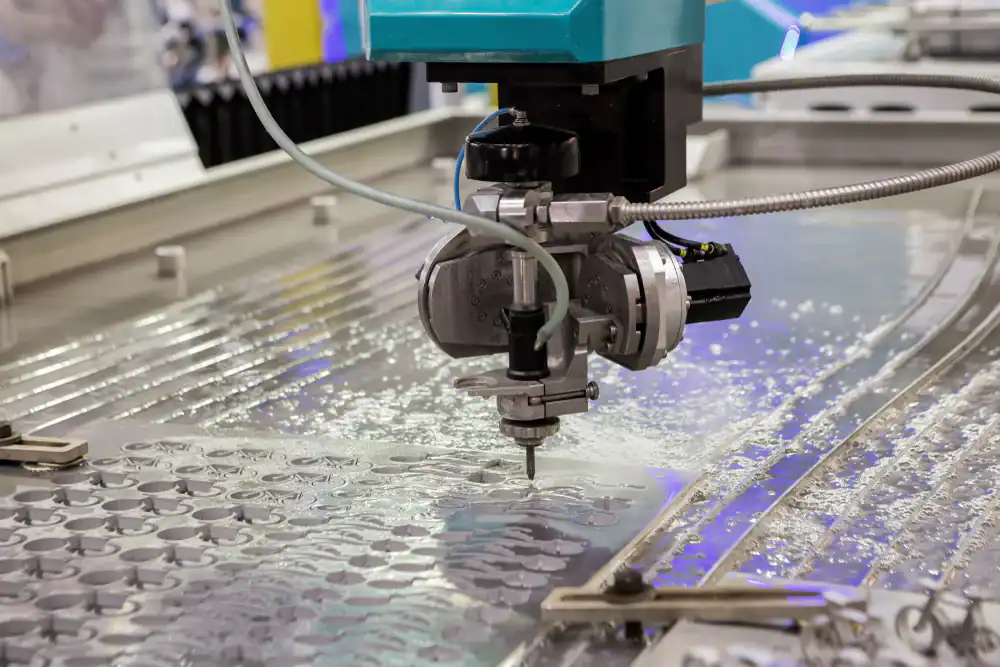
If you’re working on a project that involves more than one material — say, stainless steel alongside granite, or carbon fiber next to acrylic — you’ve probably dealt with the headache of sourcing each one from a different shop. Different lead times. Different file requirements. Different quality standards. And you’re the one holding it all together.
We handle that differently. One machine cuts virtually every material you’re likely to work with, to tight tolerances, without heat damage, and often without any secondary finishing. This page explains how waterjet cutting works, what it’s right for, and why it’s become the go-to process for designers, engineers, and fabricators across Long Island.
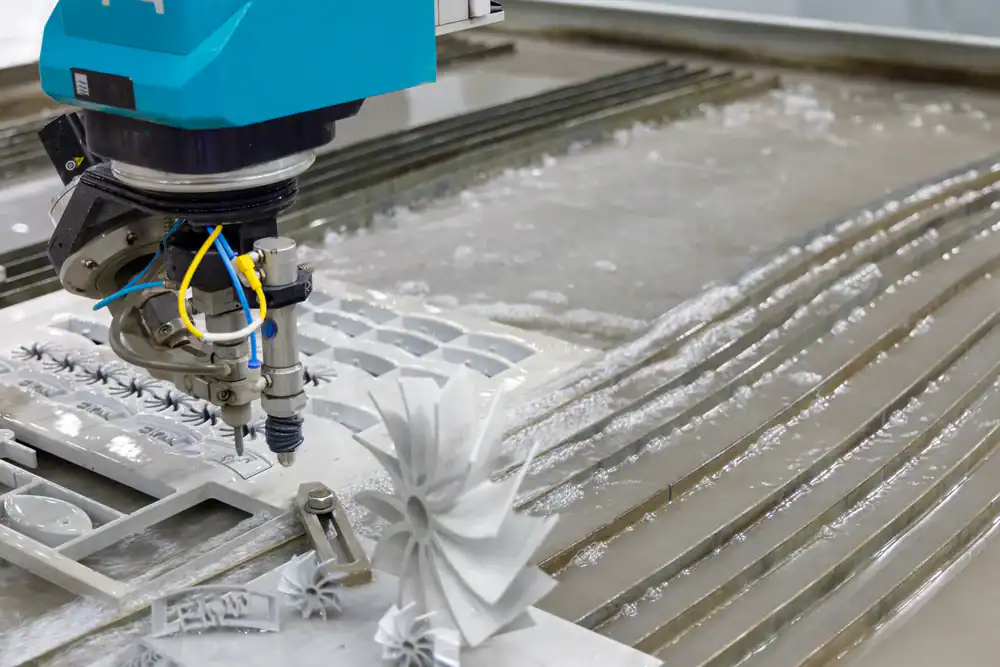
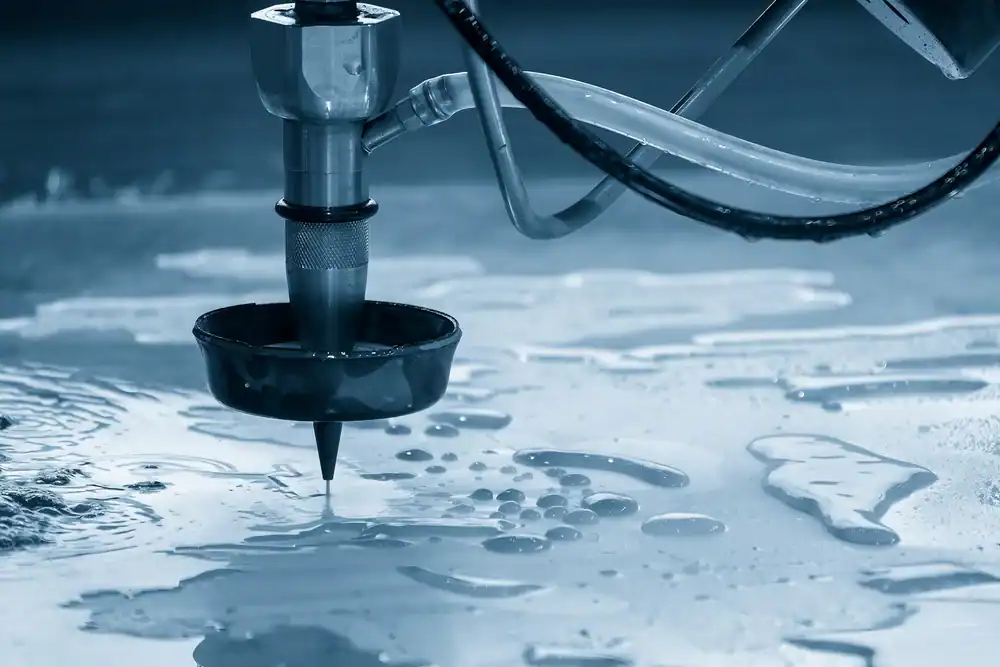
At its core, waterjet cutting uses a high-pressure stream of water — around 60,000 PSI — mixed with a fine abrasive material called garnet, directed through a precision CNC-controlled nozzle. That stream cuts through material by eroding it, not burning it or shearing it. Because there’s no heat involved, the process is called cold cutting, and that distinction matters more than most people initially realize.
The machine doesn’t care whether it’s cutting aluminum, marble, carbon fiber, or polycarbonate. The process is the same. What changes is the feed rate and the cutting parameters — both of which are dialed in from your CAD file before the first cut is made. That’s what makes waterjet uniquely suited to multi-material projects: you’re not switching processes or vendors, you’re just adjusting settings.
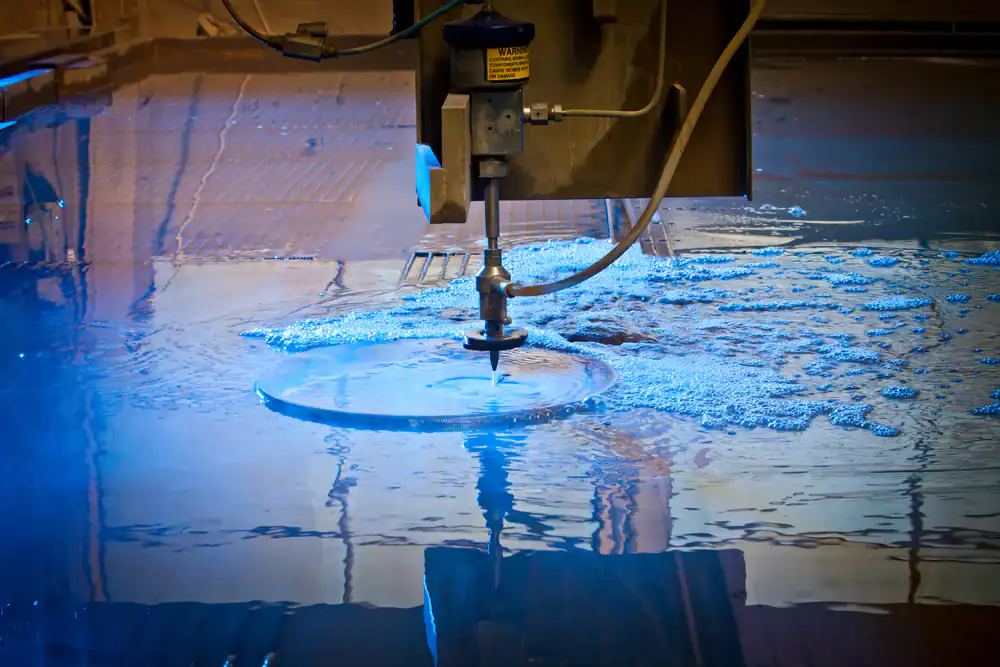
The short answer is almost everything. Metals are the obvious starting point — steel, stainless steel, aluminum, titanium, brass, copper, tool steel, and specialty alloys all cut cleanly. But the list goes well beyond metals, and that’s where waterjet separates itself from laser and plasma cutting.
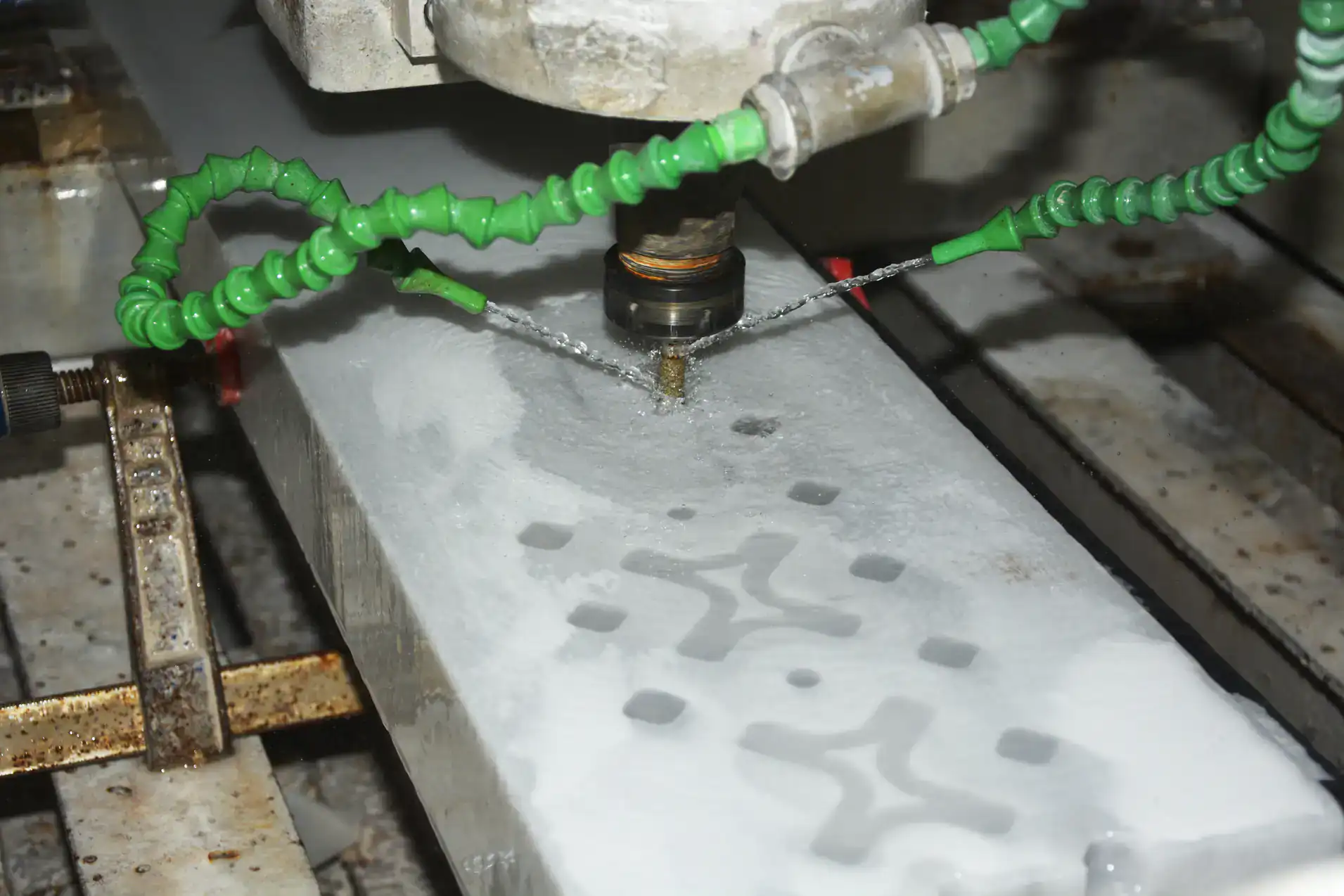
Stone is one of the more surprising capabilities for people who haven’t seen it in action. Granite, marble, quartz, and slate can be cut to any geometry — intricate curves, tight inside corners, custom inlay shapes — without chipping or cracking. Traditional diamond saw cutting is limited to straight lines and basic curves. Waterjet opens up design possibilities that simply aren’t achievable any other way.
Glass cuts cleanly too, including architectural and decorative glass. Composites like carbon fiber reinforced polymer (CFRP) and fiberglass are handled without the delamination or frayed edges that mechanical cutting tends to cause. Plastics — acrylic, polycarbonate, HDPE — come off the machine with clean, smooth edges. Foam, rubber, and wood round out the material list.
The practical implication for designers and engineers working on multi-material projects is significant. If your installation involves a stainless steel frame, granite inlay panels, and acrylic diffusers, you don’t need three vendors. You need one CAD file and one shop. That’s not a small thing when you’re managing a project timeline and trying to keep tolerances consistent across every component.
One thing worth clarifying: there’s a difference between pure waterjet and abrasive waterjet. Pure waterjet — water only, no garnet — is used for soft materials like foam, rubber, and food products. Abrasive waterjet, which is what we use for metals, stone, glass, and composites, adds garnet to the stream to handle harder materials. For most industrial and architectural applications, abrasive waterjet is what you’re working with.
If you’ve ever had a part come back from a laser cutter with a heat-affected zone along the edge — discoloration, warping, hardened material that throws off your tolerances — you already understand why the cold cutting distinction matters. Laser and plasma cutting both use heat to sever material. That heat doesn’t just disappear at the cut line; it bleeds into the surrounding material and changes its properties.
For steel and aluminum, a heat-affected zone might mean edge hardening that makes secondary machining more difficult, or dimensional distortion that causes fit problems during assembly. For composites like carbon fiber, it’s more serious — heat burns the resin matrix that holds the fibers together, compromising the structural integrity of the part. For glass, thermal stress can cause cracking. For plastics, it means melted or discolored edges that require rework.
Waterjet eliminates all of that. The cutting stream operates at ambient temperature. There’s no thermal stress, no warping, no discoloration, no metallurgical change at the cut edge. Parts come off the machine in the same condition the material went in — just shaped the way you need them.
This is particularly relevant for anyone working with aerospace-grade materials, high-performance composites, or architectural glass, where material integrity isn’t negotiable. It’s also why waterjet is often the only viable cutting method for certain materials, not just the preferred one. When a composite sheet costs several hundred dollars per square foot, a clean first cut isn’t a nice-to-have — it’s the entire point.
The other benefit that often gets overlooked is edge quality. Abrasive waterjet produces burr-free edges in most materials. That means parts typically go straight from the cutting table to welding, powder coating, or assembly without deburring, grinding, or edge finishing. On production runs, eliminating that step adds up quickly.
Want live answers?
Connect with a Tri-State Waterjet expert for fast, friendly support.
Long Island’s manufacturing base is more diverse than most people outside it realize. The Hauppauge Industrial Park alone houses over 1,300 companies and employs more than 55,000 workers across manufacturing, defense, technology, and professional services. Add the aerospace supply chain running through Nassau County — rooted in Grumman’s legacy in Bethpage — and the marine fabrication industry along both the North and South Shore, and you have a regional economy that generates a wide range of precision cutting needs.
What ties a lot of those needs together is the demand for custom work. One-off prototypes, short production runs, architectural components, specialty hardware — these aren’t jobs that fit neatly into a stamping or machining workflow. Waterjet cutting is built for exactly this kind of work, and we’ve been serving Long Island’s manufacturing community since 1981.
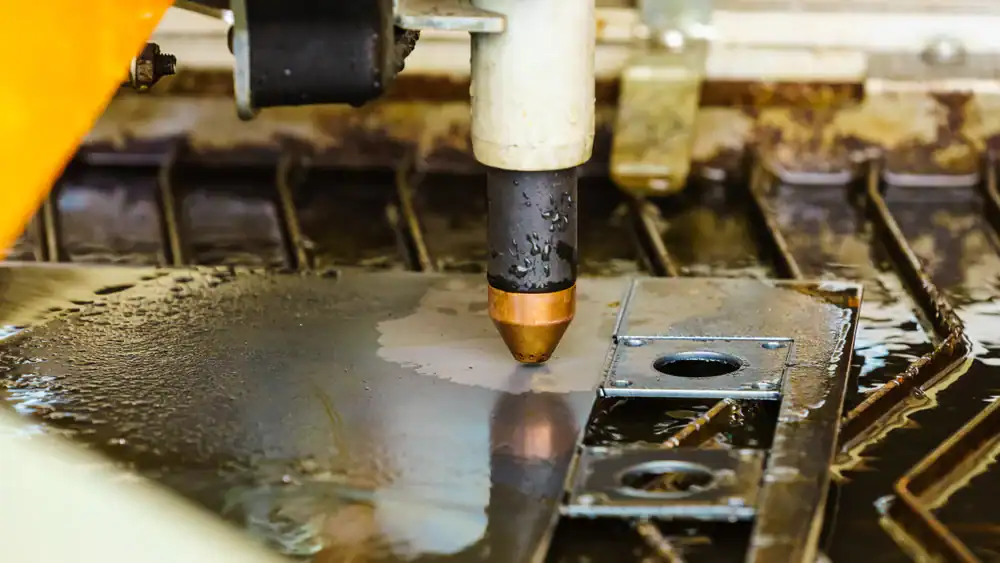
One of the most practical advantages of waterjet cutting for engineers and product designers is that it requires no tooling. No dies, no fixtures, no molds. You submit a DXF, DWG, or STEP file, the geometry gets programmed directly, and cutting begins. If the design changes — even significantly — the update takes minutes in software, not weeks in a machine shop.
For anyone who’s been through the process of building custom tooling for a prototype that gets revised three times before production, this is a meaningful shift. Traditional methods tie up capital and time in tooling that often becomes obsolete before the first production run. Waterjet sidesteps that entirely.
The other thing that makes waterjet well-suited to prototyping is process continuity. The same machine, the same settings, and the same tolerances that cut your prototype will cut your production run. There’s no requalification process, no vendor switch, no “the production parts don’t match the prototype” problem that comes from moving between processes. What you validate in prototyping is exactly what you get at scale.
For Long Island engineers working in the defense supply chain or developing components for the growing biotech and medical device community around Stony Brook University, this consistency matters. Tolerance stack-up across a production run is a real concern in precision manufacturing, and a process that holds ±0.003 inches from the first part to the thousandth is worth paying attention to.
**How precise is waterjet cutting?** We hold tolerances from ±0.001 inches to ±0.005 inches depending on the material and application. For most standard fabrication work, ±0.003 inches is what you can expect. The key to hitting those numbers consistently is taper compensation — a feature on our Flow Dynamic Waterjet systems that corrects the slight angular deviation that occurs when cutting through thick material. Without it, parts can come out with angled edges that cause assembly problems. With it, the geometry you draw is the geometry you get.
**Is waterjet cutting more expensive than laser or plasma?** Waterjet operating costs run roughly in the middle — higher than plasma, lower than laser. But that comparison is incomplete if you’re only looking at the cutting step. Waterjet typically eliminates secondary operations: no deburring, no edge finishing, no rework for heat damage. On multi-material projects where you’d otherwise be coordinating multiple vendors, the cost comparison shifts further. One process, one vendor, one lead time.
**Can waterjet cut carbon fiber without damaging it?** Yes — and it’s one of the better applications for waterjet specifically because of what other methods do to CFRP. Dry mechanical cutting generates hazardous carbon dust. Heat-based cutting burns the resin and compromises structural integrity. Waterjet cuts CFRP with a controlled stream that severs fibers cleanly, suppresses dust, and leaves no heat damage. For composite work in aerospace, automotive, or performance applications, it’s the method that makes sense.
**How long does a typical job take?** Most standard jobs are complete in one to three business days. Simple parts can often be turned around same-day or next-day if material is in stock. Complex projects with intricate patterns, thick materials, or very tight tolerances may take three to five days. Rush service is available when timelines are tight.
**Do you serve all of Long Island, NY?** We’re based in West Islip and serve clients across Suffolk County and Nassau County, including the Hauppauge Industrial Park corridor, Ronkonkoma, Farmingville, North Babylon, Central Islip, and surrounding communities. We also work with clients across the tri-state area — New York, New Jersey, and Connecticut — but our core market is Long Island, and local turnaround is a genuine advantage we can offer here.
**What file formats do you need?** DXF, DWG, and STEP files are all accepted. Every job goes through a pre-cut CAD review before anything is programmed or cut. That review catches tight inside corners, tolerance concerns, and any geometry issues that could cause problems — before they become expensive mistakes. If your file isn’t quite production-ready, we also offer AI-assisted CAD support to help bridge the gap.
The case for waterjet cutting on multi-material projects comes down to a few things that are hard to argue with: no heat damage, no tooling costs, consistent tolerances across every material, and the ability to go from prototype to production without switching processes or vendors. For designers and engineers on Long Island dealing with complex custom fabrication work, those aren’t abstract benefits — they’re the difference between a project that runs smoothly and one that doesn’t.
Long Island’s manufacturing community has specific needs that a generic cutting service doesn’t always understand. The defense supply chain in Nassau County, the fabricators in the Hauppauge Industrial Park, the architectural and renovation market from the Gold Coast to the Hamptons, the marine industry along the coastline — these are real industries with real tolerances and real deadlines.
If you have a project that involves multiple materials, a prototype that needs to be right before you commit to a production run, or a part that can’t afford heat damage or dimensional error, reach out to us. We’ve been doing this work on Long Island since 1981, and we’re straightforward about what we can deliver.
Summary:
Article details:
Share: