If you're trying to figure out whether waterjet is the right process for your project, this guide breaks it down by material — no fluff, just straight answers.

You already know you need precision cutting. What you’re not sure about is whether waterjet is the right call for your specific material — whether that’s a carbon fiber panel, a slab of granite, a piece of architectural glass, or a thick plate of titanium.
That’s a fair question, and it deserves a real answer. Not a marketing pitch, not a vague list of everything a waterjet has ever touched. Just a clear breakdown of what the process does well, where it has limits, and how to know which side of that line your project falls on. That’s what this guide covers.
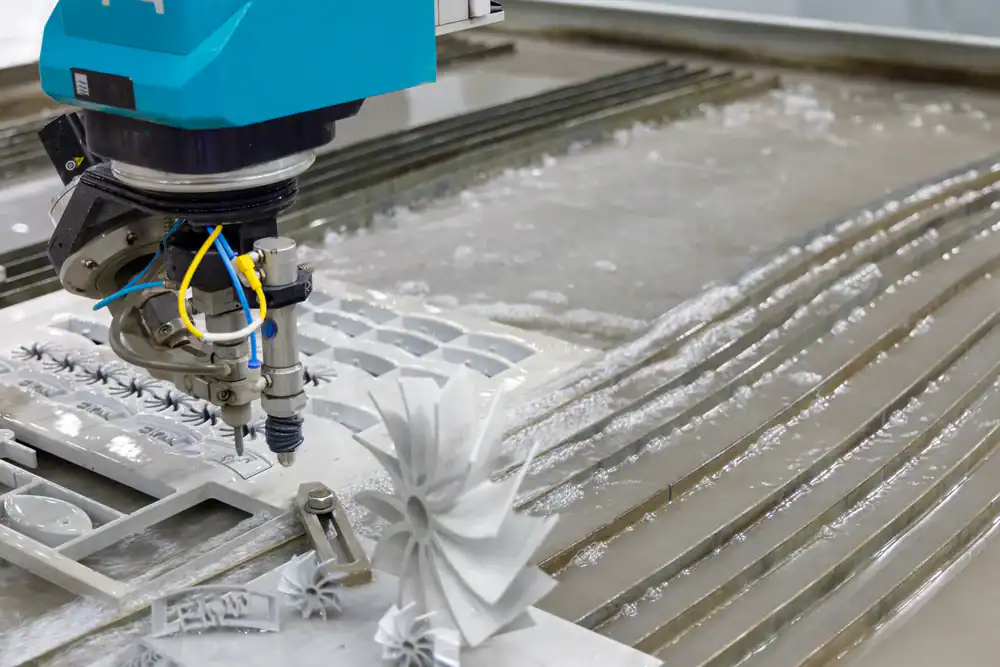
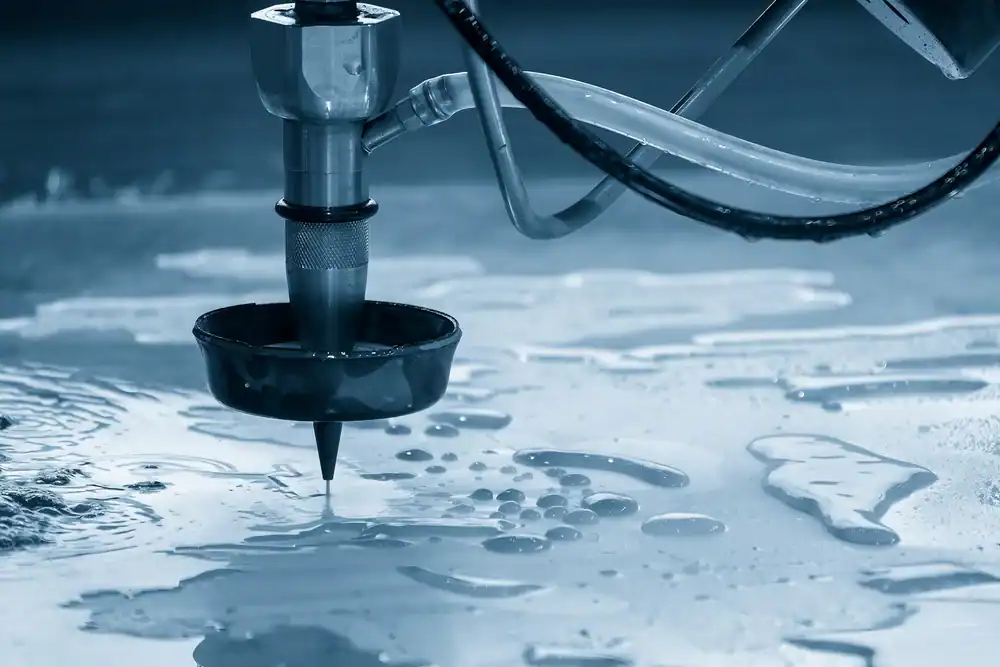
Before getting into specific materials, it helps to understand what’s actually happening during the cut. Abrasive waterjet cutting uses a high-pressure stream of water mixed with garnet — a naturally occurring abrasive mineral — to erode material rather than melt it, shear it, or burn through it. The stream moves at supersonic speeds and follows a CNC-controlled path programmed directly from your CAD file.
Because there’s no heat involved, the material coming off the table is the same material that went on it. No hardened edges. No warped geometry. No discoloration or thermal stress. That’s the reason waterjet is the right process for a wide range of materials that other cutting methods simply can’t handle cleanly.

The short answer is most of them — and often in thicknesses that would challenge or defeat other processes entirely.
Steel, stainless steel, and aluminum are the workhorses of waterjet cutting. Steel can be cut cleanly up to around 12 inches thick while maintaining dimensional accuracy. Aluminum cuts quickly, particularly in thinner gauges, and comes off the table with smooth edges that typically don’t require secondary deburring. Stainless holds up well to the abrasive stream and doesn’t present the edge hardening problems you’d see with plasma or laser on certain alloys.
Titanium is where waterjet really separates itself from the alternatives. Titanium is notoriously difficult to cut — it’s hard, it work-hardens quickly under mechanical cutting, and it’s heat-sensitive in ways that make laser and plasma problematic for applications that require preserved material properties. Waterjet cuts titanium without generating heat, which means the cut face retains the same properties as the rest of the part. For aerospace and defense supply chain work — the kind that’s common throughout the Hauppauge, NY industrial park corridor — that matters enormously.
Copper and brass present a different challenge for laser cutting: they’re reflective, and a laser beam scattered back into the cutting head is a real operational problem. Waterjet doesn’t care about reflectivity. The abrasive stream cuts copper and brass the same way it cuts anything else, making it the practical choice for electrical components, decorative metalwork, and custom fabrication involving these materials.
Exotic alloys — Inconel, Hastelloy, tool steels — are also well within waterjet’s capability. These are materials that push the limits of most cutting processes, but the abrasive waterjet stream handles them without the edge degradation or heat-related complications that other methods introduce.
Yes — but with an important nuance that separates experienced operators from inexperienced ones.
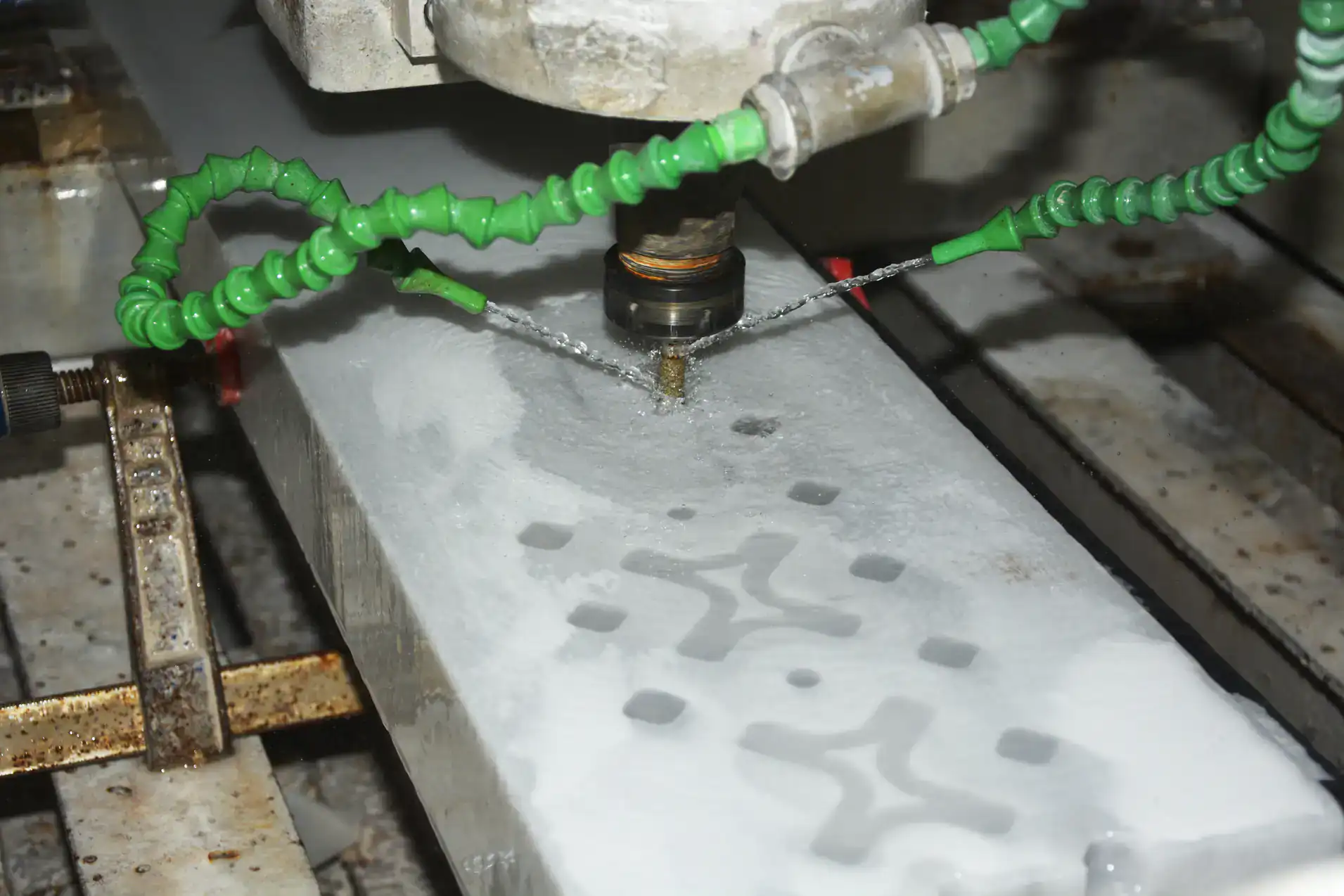
Brittle materials like granite, marble, slate, and architectural glass can absolutely be cut with a waterjet. Stone cuts cleanly and holds detail well — intricate patterns, tight curves, and decorative inlays are all achievable. Granite and marble can be cut up to around 18 inches thick for most varieties. On Long Island, NY, where the architectural and interior design market is active across North Shore communities, Gold Coast estates, and Hamptons projects, waterjet-cut stone is a common element in custom countertops, floor medallions, decorative panels, and feature walls.
Glass is where technique matters most. Standard plate glass and architectural glass cut well with waterjet — up to around 4 inches thick for most types. But the process requires a low-pressure pierce at the start of each cut. When you’re cutting a continuous path in metal, the machine can pierce at full pressure. With glass, that initial pierce at high pressure would crack or shatter the material before the cutting path even begins. A skilled operator reduces the pressure for that first pierce and ramps up once the stream is moving through the cut. It’s a straightforward technique, but skipping it or getting it wrong ruins the piece.
Tempered glass is the exception. Tempered glass is under internal stress by design — that’s what makes it safety glass. A waterjet pierce, regardless of pressure, will cause it to shatter. If you have tempered glass, waterjet isn’t the right process. That’s worth knowing before you schedule a job.
Ceramics and tile generally cut well with waterjet, though very hard ceramics — those with a Mohs hardness above approximately 8.5 — may require specialized abrasives beyond standard garnet. For most tile and ceramic applications, including custom mosaic work and architectural detailing, standard abrasive waterjet cutting handles the job cleanly.
Want live answers?
Connect with a Tri-State Waterjet expert for fast, friendly support.
This is where a lot of buyers are surprised by what waterjet can do — and where choosing the wrong process gets expensive quickly.
Composites, advanced plastics, and specialty materials each have characteristics that make conventional cutting methods problematic. Waterjet sidesteps most of those problems, not because it’s magic, but because it removes material without heat, without tool contact, and without the mechanical force that causes delamination or structural damage in layered materials.

For carbon fiber reinforced polymer, fiberglass, Kevlar, and similar composites, waterjet is one of the most practical cutting methods available — and in many cases, it’s the only one that doesn’t create a secondary problem.
Mechanical cutting of carbon fiber — routing, sawing, drilling — generates fine airborne carbon dust that is hazardous to breathe and damaging to nearby electronics and machinery. It also causes tool wear at a rate that makes production runs expensive. Thermal cutting methods risk delaminating the resin matrix that holds the fibers together, which compromises the structural integrity of the part. Waterjet eliminates both of those issues. There’s no heat, no tool contact, and no airborne carbon dust. The abrasive stream cuts through the composite cleanly, and the part comes off the table with its structural integrity intact.
Fiberglass presents a similar situation. The dust generated by mechanical cutting of fiberglass is a respiratory hazard, and the material tends to fray or delaminate at cut edges when the cutting method isn’t well-suited to it. Waterjet handles fiberglass cleanly, and for applications where dust is a particular concern, the material can be cut submerged — which keeps any particulate contained in the water rather than in the air.
Composites can be cut up to around 6 inches thick while maintaining structural integrity. For most aerospace-adjacent fabrication, automotive composite work, and industrial applications, that range covers the vast majority of real-world jobs.
Hard plastics — acrylic, polycarbonate, HDPE, Delrin, and similar engineering plastics — cut cleanly with abrasive waterjet. These materials are common in custom fabrication, industrial components, and architectural applications, and waterjet handles them without the melting or edge distortion that laser cutting can introduce in thicker plastic stock.
Soft materials — rubber, foam, gasket material, textiles — are actually cut with pure waterjet, meaning the abrasive is removed from the mix entirely. A pure water stream at high pressure is sufficient to cut soft materials cleanly, and it does so without the compression or tearing that mechanical cutting causes. Gaskets and seals, in particular, are a common waterjet application because the process holds tight tolerances in rubber and elastomers without distorting the material.
Wood cuts well with waterjet, though porous wood species can absorb water during the cut. For most decorative and structural wood cutting applications, this isn’t a functional problem — the material dries and performs as expected. It’s worth mentioning if your application involves particularly moisture-sensitive wood.
The honest answer on what waterjet cannot cut: tempered glass, as mentioned above, and diamond — there’s no abrasive harder than diamond, so the stream simply can’t erode it. Beyond those two, the practical limits are mostly about thickness and hardness, not material category. For very hard ceramics or extremely thick sections of dense material, cutting speed slows significantly and the economics of the job change, but the capability is usually still there.
If your project involves heat-sensitive materials, thick stock, reflective metals, brittle materials, or advanced composites — waterjet is almost certainly worth a serious look. If you’re working with thin sheet metal and need the absolute fastest cycle time, laser may be the better fit. The right answer depends on your material, your tolerance requirements, and what the part needs to look like when it’s done.
Here’s what we suggest: don’t guess. Send us your file, tell us what you’re working with, and we’ll give you a straight answer on whether waterjet is the right process and what the job actually involves. We review every file before cutting starts — not as an upsell, but because catching a problem before the machine runs is always better than catching it after.
Tri-State Waterjet has been cutting parts on Long Island, NY since 1981. If you have a material question this guide didn’t answer, reach out — we’ve likely cut it before.
Summary:
Article details:
Share: