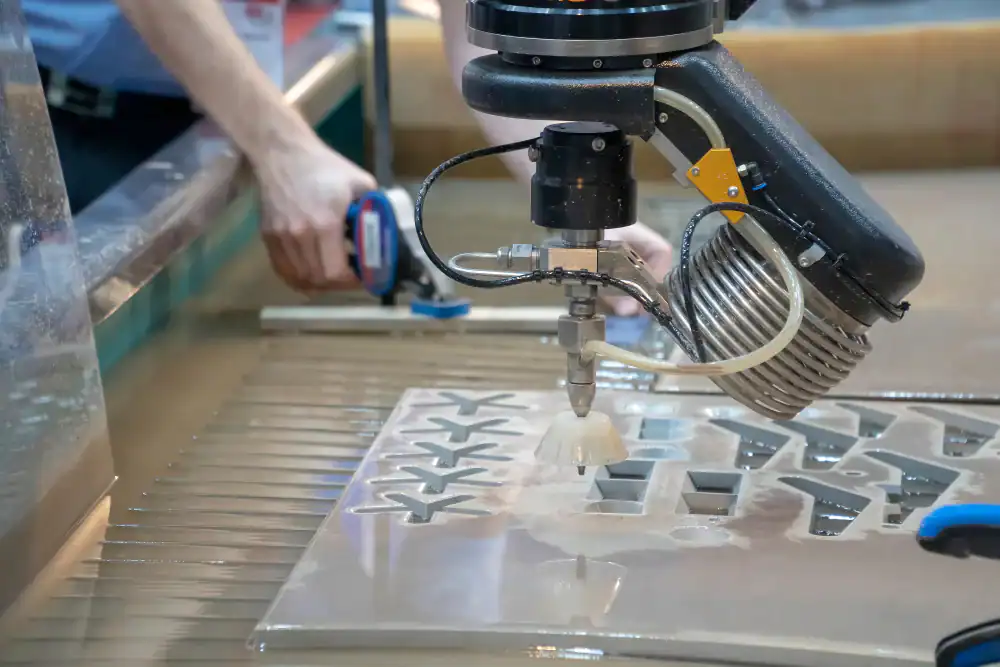
Metal waterjet cutting is evolving fast. Here's what Long Island manufacturers need to know about the technology trends driving precision, efficiency, and less waste in 2026.
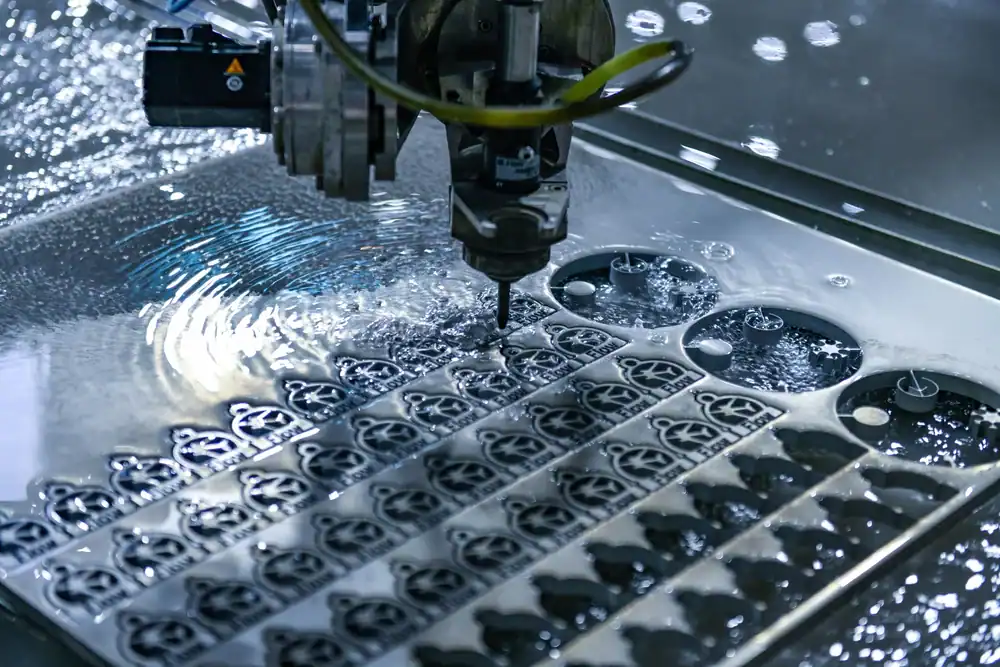
If you’re running production on Long Island — whether that’s in the Hauppauge corridor, down in North Babylon, or anywhere across Suffolk County — you already know the pressure to do more with less. Tighter tolerances, faster turnarounds, and material costs that leave no room for waste. The good news is that metal waterjet cutting technology has been quietly catching up to those demands. AI-driven nesting, smarter CNC systems, and tighter integration with the rest of the shop floor are changing what’s possible. Here’s what’s actually happening in the industry right now, and what it means for the work you’re doing.
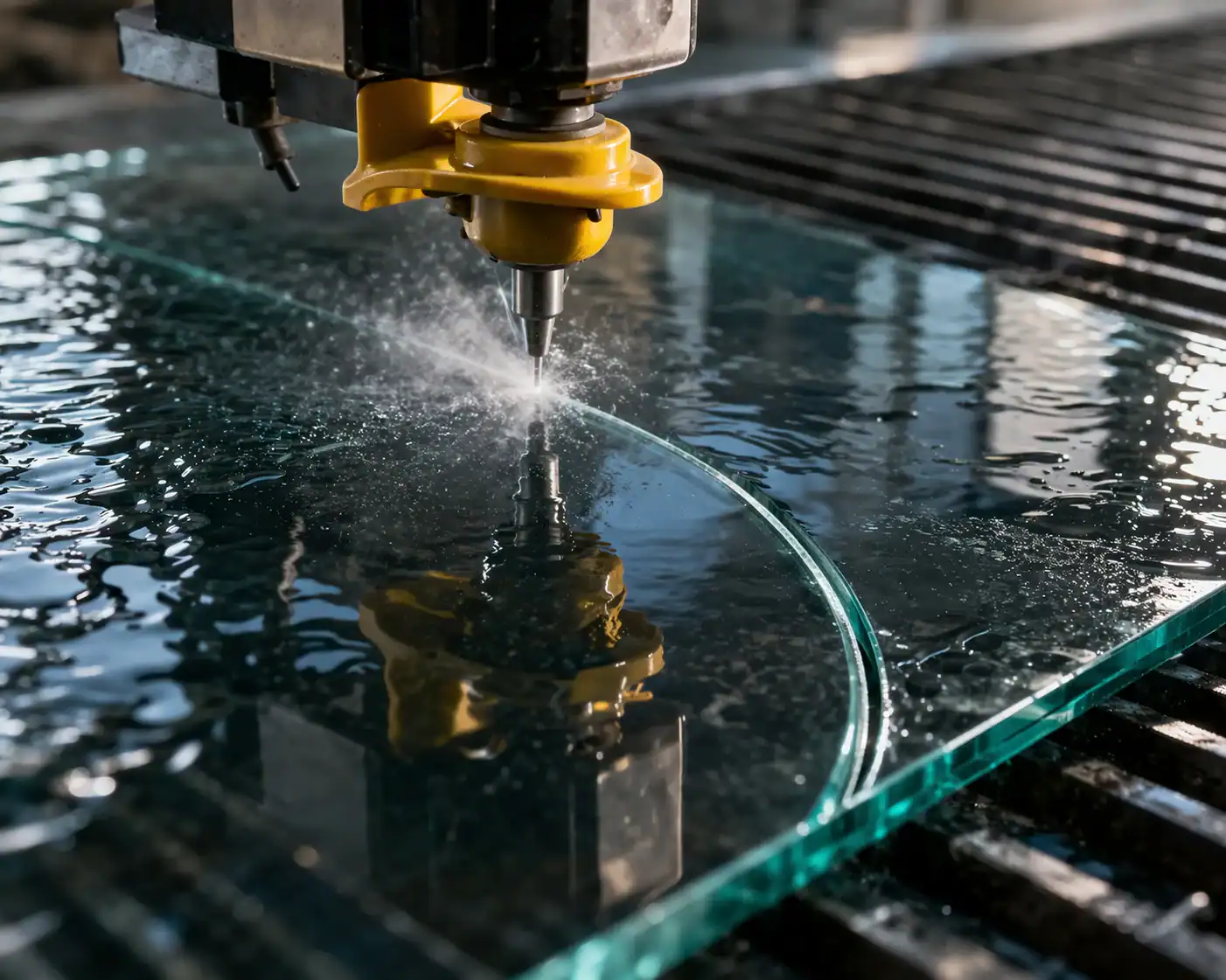
A few years ago, “automation” in waterjet cutting mostly meant a CNC table following a programmed path. That’s still the foundation, but what’s built on top of it has changed considerably. AI-driven motion control, real-time adaptive algorithms, and intelligent nesting software are now standard features in modern cutting systems — and they’re delivering measurable results in material efficiency, cut quality, and machine uptime.
The global waterjet cutting machine market reflects this momentum. Valued at roughly $1.86 billion in 2025, it’s projected to reach $2.39 billion by 2030. Nearly 59% of metal fabrication facilities worldwide now rely on waterjet systems, and the metal fabrication sector alone accounts for more than 30% of that market. The technology isn’t niche anymore — it’s infrastructure.
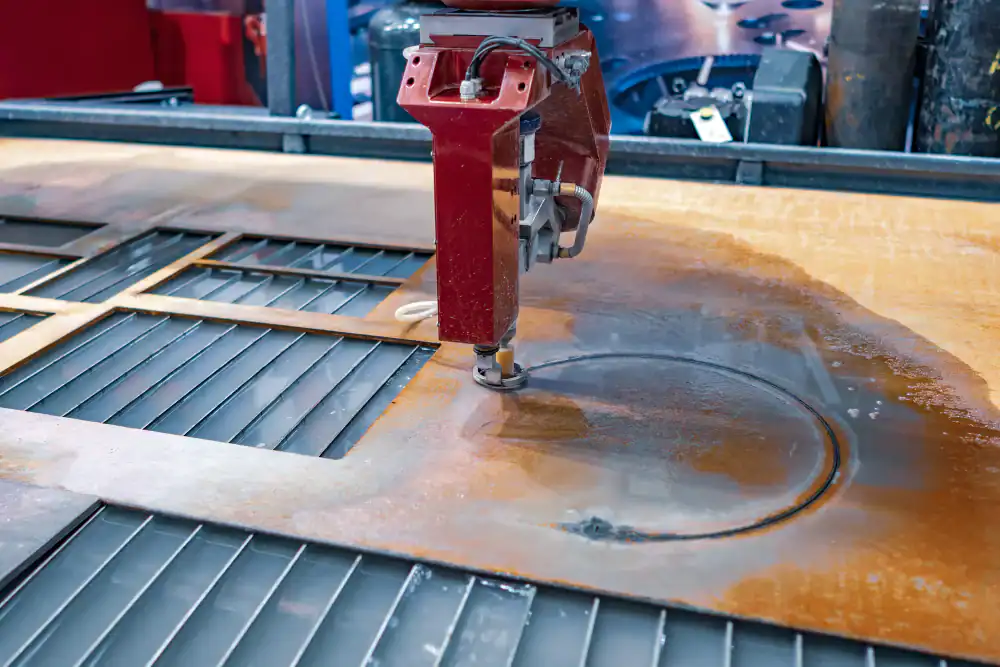
Nesting software has been around for a while, but the AI-assisted version is a different animal. Instead of a technician manually arranging parts on a sheet, the software analyzes your file geometry and calculates the most efficient possible layout — maximizing the number of usable cuts from each sheet and minimizing the scrap that gets left behind.
For common metals like mild steel or aluminum, that efficiency gain is a nice-to-have. For expensive alloys — titanium, Inconel, tool steel — it’s the difference between a job that pencils out and one that doesn’t. When you’re paying for high-grade material, every square inch matters. A shop that nests intelligently isn’t just being tidy; it’s actively reducing your cost per part.
At Tri-State Waterjet, we build intelligent nesting into how we process every job. When you send us your DXF, DWG, or STEP file, we review it before a single cut is made — checking for nesting opportunities, flagging any tolerance concerns based on your material, and making sure the layout is optimized before the machine starts moving. That review step exists because catching a problem on screen costs nothing. Catching it after the cut costs everyone.
The practical impact is straightforward: you get more usable parts per sheet, less material in the scrap bin, and a more predictable cost structure on repeat orders. For Long Island manufacturers running production jobs through the Hauppauge Innovation Park supply chain, where margins are tight and schedules are tighter, that kind of efficiency isn’t optional — it’s the baseline.
CAD/CAM platforms like IGEMS are already demonstrating how automated path optimization and nesting can enhance material utilization in ways that simply weren’t achievable with manual layout. The shops adopting these tools now are building a structural cost advantage over the ones that aren’t.
Five-axis waterjet cutting has been commercially available for years, but robotic integration is pushing the geometry envelope further. Multi-axis robotic waterjet systems can now achieve complex three-dimensional cuts — beveled edges, angled profiles, contoured surfaces — with minimal human intervention and consistent repeatability across high-volume runs.
For most of the industrial metal fabrication work happening on Long Island, a standard CNC waterjet table is still the right tool. But for aerospace suppliers producing flight-critical components, or automotive fabricators building custom chassis geometry, the ability to cut complex angles in a single setup — rather than repositioning the part multiple times — is a real operational advantage. Fewer setups mean fewer opportunities for error and faster throughput.
Recent equipment advances reinforce how quickly this space is moving. KMT Waterjet launched improved high-pressure pump systems in 2025 that increased cutting performance by approximately 26% while reducing system downtime. Hornet Cutting Systems introduced CNC waterjet upgrades the same year that improved precision cutting capability by roughly 23% for complex industrial materials. These aren’t incremental improvements — they’re meaningful jumps in what the equipment can actually do.
The other development worth understanding is the shift toward real-time monitoring and adaptive control. Modern cutting systems can detect changes in material resistance mid-cut and adjust parameters automatically, rather than waiting for an operator to notice a problem. That kind of closed-loop feedback reduces rework, tightens consistency, and keeps the machine running closer to its potential throughout a shift.
For Long Island manufacturers who’ve watched supply chains tighten and reshoring trends accelerate domestic investment, this matters in a practical way. Investing in a local cutting service that runs current equipment isn’t just about quality — it’s about having a supplier who can keep up with your production pace without becoming a bottleneck.
Want live answers?
Connect with a Tri-State Waterjet expert for fast, friendly support.
The comparison between waterjet, laser, and plasma cutting comes up constantly — and the honest answer is that the right choice depends on what you’re cutting, how thick it is, and what the part needs to do afterward. But for a significant portion of the precision metal cutting work happening across Suffolk County and Long Island, waterjet keeps winning for reasons that are pretty concrete.
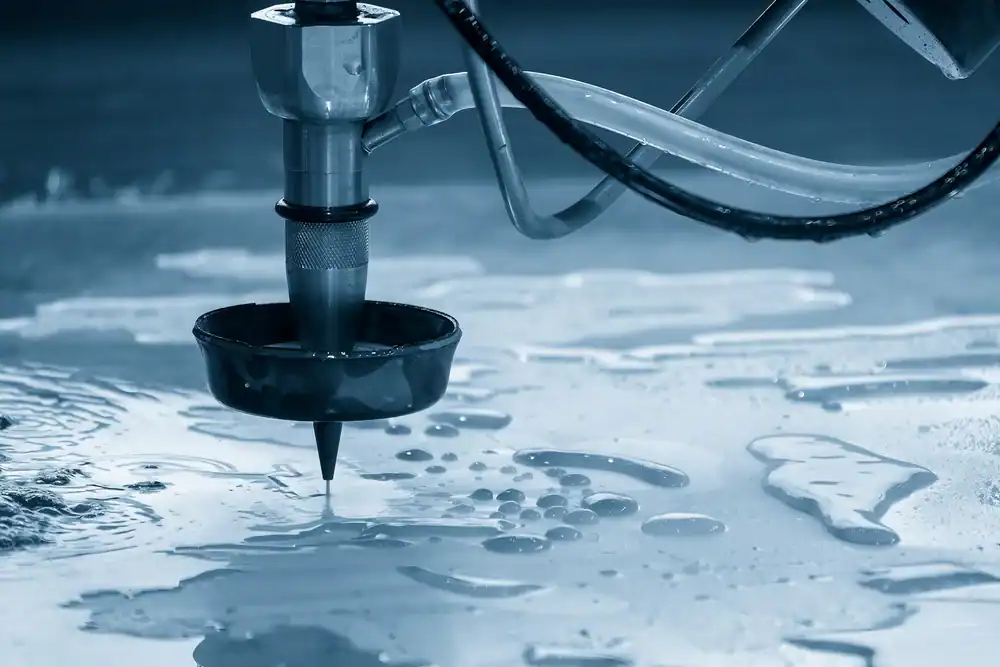
The defining characteristic is the cold-cutting process. Waterjet doesn’t generate heat at the cut edge. No heat-affected zones, no warping, no edge hardening, no discoloration. For materials where thermal damage is a real concern — heat-treated aluminum, titanium, stainless steel, composites — that’s not a minor benefit. It’s the reason waterjet exists.
Laser cutting is fast and precise for thin sheet metal. If you’re cutting mild steel under a quarter inch and edge quality on a heat-affected zone isn’t a concern for your application, laser is a reasonable choice. But the comparison shifts once you move into thicker material, heat-sensitive alloys, or anything reflective.
Laser cutting stainless steel can cause edge hardening and discoloration — a problem if the part needs to maintain its corrosion resistance. Reflective metals like copper and brass can deflect the laser beam, creating inconsistency and potential equipment issues. Composites like carbon fiber are a poor fit for laser entirely; the heat causes delamination and releases hazardous fumes. Waterjet handles all of these without changing equipment, without a secondary finishing step, and without compromising the material at the cut edge.
The tolerance comparison is also worth understanding clearly. CNC waterjet cutting holds tolerances of ±0.005 inches for general work, with ±0.001 inches achievable on complex shapes including tight inside corners. For the aerospace and defense suppliers operating in Long Island’s manufacturing corridor — companies building components that go into aircraft, naval systems, and precision assemblies — that level of accuracy isn’t a selling point, it’s a requirement.
There’s also the thickness question. Waterjet cuts through material up to 8 inches thick with clean, precise edges. Laser cutting becomes increasingly impractical above 1 inch for most metals. If your work involves plate steel, thick aluminum, or stacked material, waterjet is often the only method that produces a finished edge without secondary machining.
The practical takeaway is this: laser has its place, but it’s a narrower window than most people assume. Once your material gets thicker, harder, more heat-sensitive, or more compositionally complex, waterjet is the more capable process — and often the faster one, too.
Long Island’s manufacturing base isn’t generic. The Hauppauge Innovation Park — the second-largest industrial park in the United States — houses 1,350 companies and 55,000 workers generating $13 billion in annual output. A significant portion of those companies are aerospace and defense suppliers, and New York’s aerospace and defense industry as a whole generated approximately $15 billion in total economic output in 2023.
The region has over 350 small- to mid-sized aerospace and defense firms concentrated in Hauppauge and Bethpage — a legacy that traces back to Grumman’s work on the Apollo lunar module and Republic Aviation’s production of the Thunderbolt fighter in Farmingdale. That history isn’t just local pride; it’s the reason Long Island has a workforce and supply chain built around precision manufacturing at a level most regions can’t match.
For the shops and suppliers operating in that ecosystem, waterjet cutting is a natural fit. Flight-critical components fabricated from titanium or Inconel need tolerances that hold to ±0.001 inches without the heat distortion that plasma or laser introduces. Landing gear parts, structural beams, motor cores — these are applications where the cold-cutting process isn’t optional.
The marine industry adds another layer of demand. Long Island’s coastline generates consistent work in stainless steel and aluminum for boat fittings, structural components, and custom fabrications where corrosion resistance is non-negotiable. Laser cutting stainless steel compromises that corrosion resistance at the cut edge. Waterjet doesn’t.
And then there’s the automotive side. Long Island has a strong custom fabrication and restoration culture across Nassau and Suffolk counties. Custom chassis work, bracket fabrication, one-off panels — these jobs need precision cutting that can handle complex geometry without warping thin material or leaving edges that require hours of cleanup.
We work with manufacturers, fabricators, and builders across all of these sectors. When you’re cutting parts for applications where mistakes have real consequences, the process matters as much as the price.
The technology behind waterjet cutting is advancing faster than most buyers realize. AI nesting, robotic systems, adaptive control, and tighter CNC precision are raising the bar for what a quality cutting service should deliver — and the gap between shops running current equipment and those that aren’t is widening.
For Long Island manufacturers, the baseline questions are straightforward: Does the shop review your file before cutting? Can they hold ±0.005 inches consistently, and tighter when your application demands it? Do they use intelligent nesting to protect your material costs? Can they turn your job around in days, not weeks?
If the answers are yes, you’ve found a shop worth working with. We at Tri-State Waterjet are built around exactly those standards — because the manufacturers we work with across Suffolk County and the wider tri-state area can’t afford anything less.
Summary:
Share: