A ±0.001" tolerance on one quote and ±0.005" on another isn't a contradiction. Here's how thickness, taper, and file prep decide what you actually get.
You’ve got a drawing, a deadline, and two quotes that don’t agree. One shop says ±0.001″. Another says ±0.005″. Both sound confident, and neither explains what that means for your part.
If you’re an engineer near Hauppauge, a fabricator in Babylon, NY, or a designer specifying stone for a house out east, you’ve probably been here. Material is expensive, and a part that comes back a few thousandths off, or with a cracked edge, costs you more than money. It costs you the schedule.
Here’s how precision waterjet cutting actually works, what tolerance you should expect at different thicknesses, and how to get parts that fit the first time.
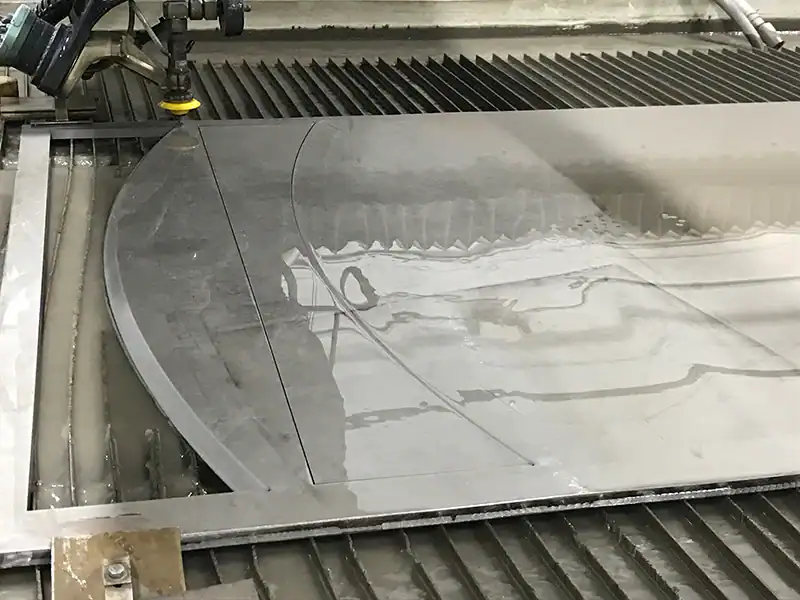
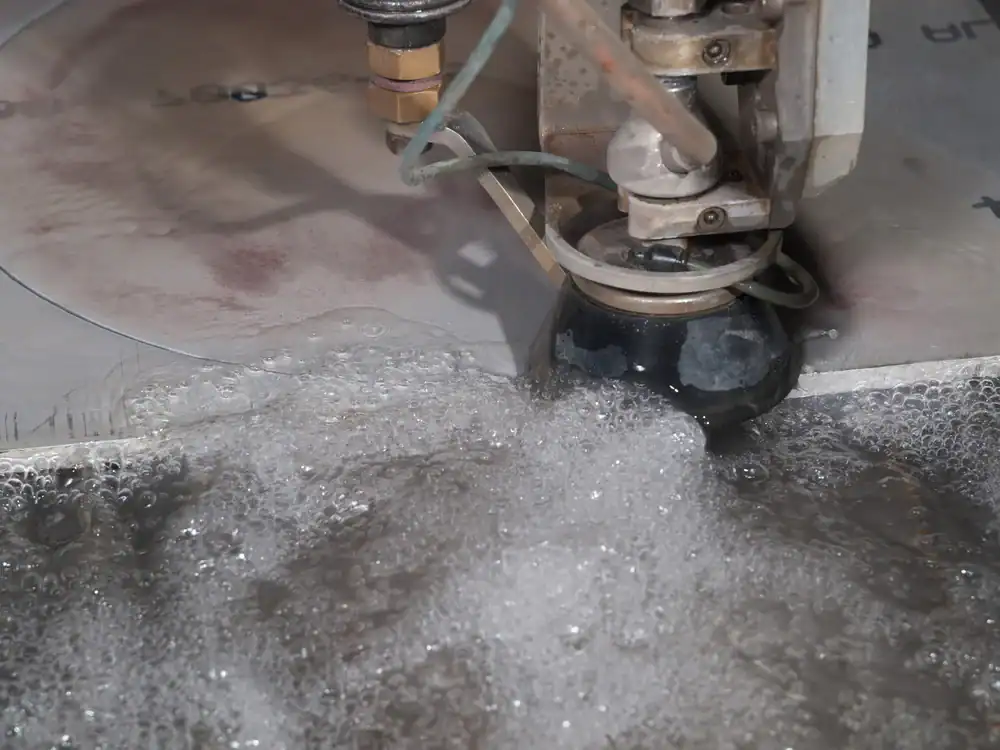
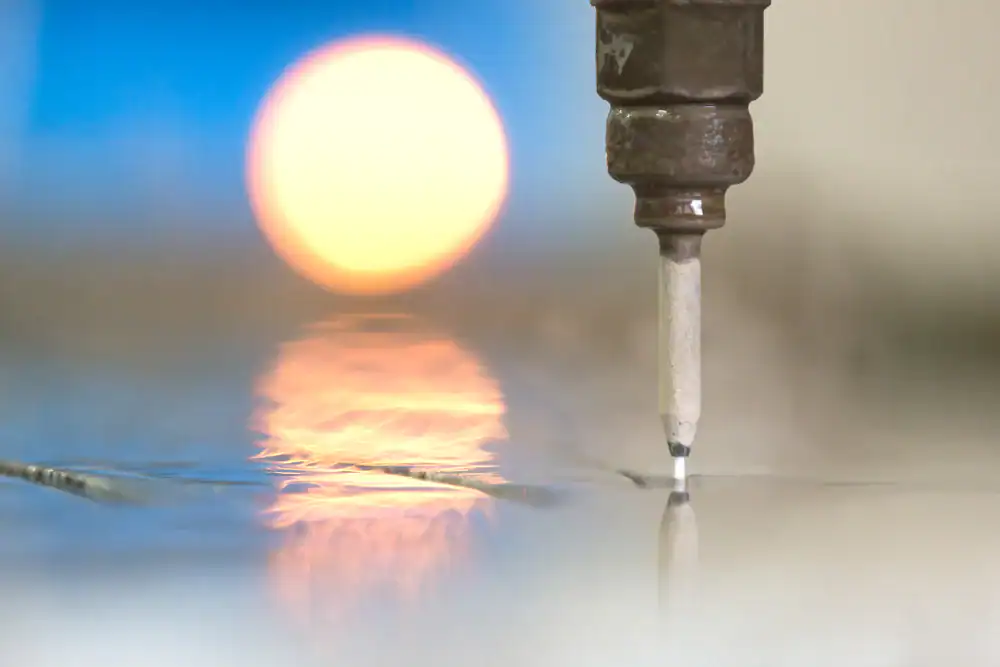
Waterjet cutting pushes water at nearly 60,000 PSI through a tiny nozzle, with garnet abrasive mixed in to do the actual cutting. A CNC controller follows your CAD file, so the path matches what you drew, offset for the width of the cut. That width, called kerf, typically runs between 0.030″ and 0.050″. It’s narrow enough to nest parts tightly and waste less of your stock.
There’s no flame and no arc, so there’s no heat-affected zone. Thin stainless doesn’t warp, titanium keeps its properties, and marble doesn’t crack from thermal stress. The Suffolk County IDA reports over 3,000 manufacturers are based on Long Island, roughly two-thirds of them in Suffolk. That’s a lot of different parts and materials, and cold cutting fits a surprising share of them, from aerospace brackets to architectural screens.
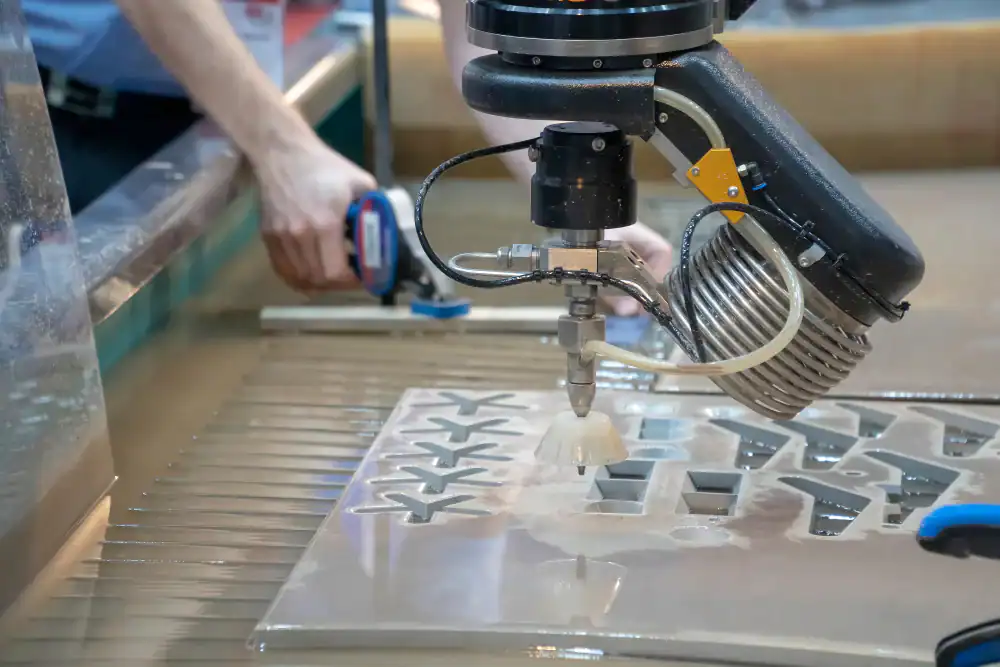
Here’s the part most shop websites skip. A waterjet stream isn’t a perfect cylinder. It widens slightly as it exits the nozzle, so the cut wall tilts a little, and the thicker the material, the more that tilt shows. On material an inch or thicker, uncompensated taper can run roughly half a degree to two degrees. Modern cutting heads tilt to correct for it, but that takes more cycle time, which is one reason a tight tolerance on thick plate costs more than a loose one.
Published tolerance guides tell the story. On 1/8″ aluminum, ±0.002″ is routine. On 1″ steel, ±0.005″ is a standard expectation. At 4″ steel, ±0.010″ to ±0.015″ is realistic. So when one shop quotes ±0.001″ and another quotes ±0.005″, they may both be telling the truth about different jobs.
On our Flow Mach 500, we can hold tolerances as tight as ±0.001″ on thin material, depending on the material and thickness. On stone and general fabrication work, ±0.003″ is the more typical figure. As material gets thicker, expect that to loosen, and we’ll tell you so before you commit. We’d rather you design around what’s possible than find out at inspection.
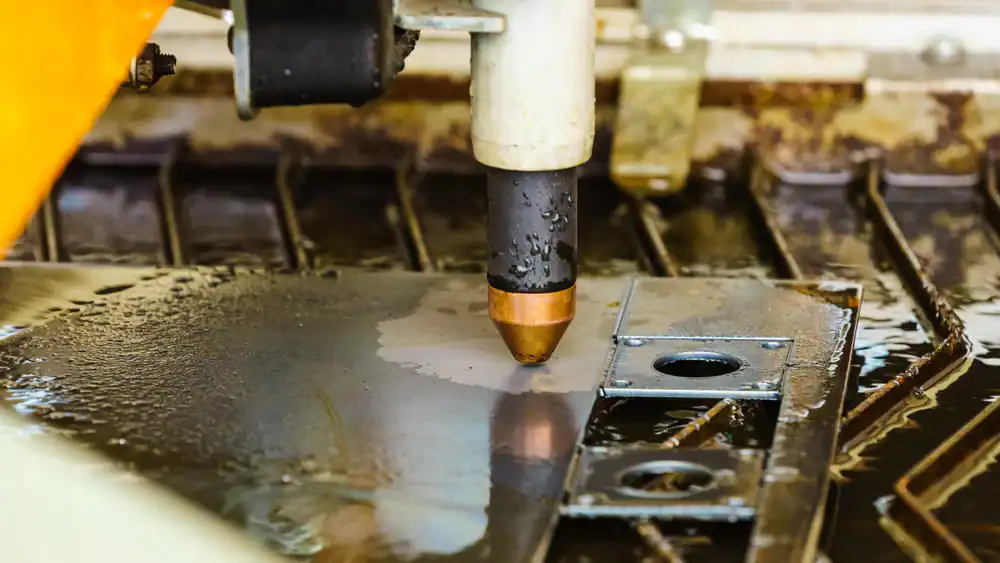
That candor helps when you’re weighing waterjet against plasma, which usually works around ±0.015″. Plasma is faster, and for rough structural work it may be the right call. When the part has to mate with something else, precision waterjet cutting accuracy usually justifies the extra run time.
Long Island has been working expensive metal since the Grumman days, and the defense and aerospace supply chain around Hauppauge still runs on materials that don’t forgive mistakes. Titanium, Inconel, and Hastelloy cost a lot to buy and don’t respond well to heat. Metal waterjet cutting leaves the material’s properties alone, so what you cut is what you specified. Closer to our shop on the South Shore, marine and construction work leans on aluminum like marine-grade 5052, and thin sheet is easy to distort when you add heat.
Stone and glass are unforgiving in a different way. A marble floor medallion or an inlay for a custom home in East Hampton is a one-shot piece. A crack on the last cut means a re-order and a missed install date. Marble waterjet cutting avoids heat cracking and discoloration, holds within about 0.003″, and handles stone up to 12″ thick. Glass waterjet cutting skips the scoring and thermal stress behind chips and micro-fractures, which is why architects and builders from Suffolk into Nassau, including Mineola, NY, send us glass work.
If your project mixes metal, stone, and glass, one process handles all three without changing tooling, and the edges come off clean enough to fit together without filler. That matters when you’re coordinating three materials on one feature wall and the install crew is already on the calendar. Fewer handoffs between shops also means fewer chances for dimensions to drift.
Want live answers?
Connect with a Tri-State Waterjet expert for fast, friendly support.
Precision starts before the water turns on. Custom waterjet cutting runs straight from CAD, and we accept DXF, DWG, and STEP files. But a clean-looking drawing isn’t always a cuttable one, and the machine will faithfully cut whatever errors you hand it.
That’s why our in-house team reviews every file before anything gets programmed. We look for tolerance issues, material conflicts, and design problems while they’re still easy to fix. Then the toolpath is programmed and nested, the part is cut, and it’s inspected and deburred if needed before pickup or delivery. Whether it’s one prototype or a production run, the first part is cut the same way as the hundredth.

Three problems account for most of the files that come back to us with questions. The first is open contours, where a line that looks closed on screen has a tiny gap. The machine can’t tell where the part ends, so it can’t cut it.
The second is overlapping or duplicate lines, which happen when a drawing gets copied or merged. The machine either cuts the same path twice or gets confused about which line is the real one.
The third is scale. A file exported at the wrong size will cut perfectly to the wrong dimensions, and that’s the expensive kind of mistake because nothing looks broken until you hold the part. Export at 1:1, and if you aren’t sure, tell us which dimension you can check with a tape or calipers.
A few other habits help. Keep small features larger than about twice the kerf, since anything finer than that won’t cut cleanly. Tell us the material and thickness up front, because both affect taper and how we set up the cut. Flag which dimensions matter most. If a hole has to be round and a mating edge has to be square, we can compensate for taper where it counts.
This is the same whether you’re a machinist or a designer who has never sent a file to a shop. Architects and homeowners’ contractors around Smithtown and Islip, NY, often show up with a beautiful sketch and no CAD file at all. That’s fine. We can help develop production-ready files, and we’d rather talk it through than guess.
Start with tolerance, and ask for it by material and thickness. A single number on a website tells you very little. If a shop can’t say what it holds on your specific stock, keep looking.
Next, ask whether edges need finishing. In most applications ours come off the machine ready to use, with no grinding or sanding, though anything that needs deburring gets it before pickup. Then ask about price, and expect a straight answer about what drives it: run time, abrasive use, tolerance, and thickness. Tighter tolerance means slower cutting, so it costs more. We’re not the cheapest option on Long Island, and that’s intentional. We focus on getting your part right, not on upselling things you don’t need.
Ask about quantity too. People often assume waterjet is only for production, or only for one-offs. We cut prototypes through full production runs, so a single bracket from a Lindenhurst boat yard gets the same attention as a repeat order from a Hauppauge manufacturer.
Finally, ask about lead time and logistics. We’re upfront about timing, and being local helps. Our shop is at 217 Union Blvd in West Islip, NY, so customers in Babylon, North Babylon, Holtsville, Farmingville, and across Suffolk and Nassau can talk to a real person, review a file in person, and pick up finished parts without waiting on freight. For anything with a hard install date, that conversation early on saves more time than any machine speed ever will.
The takeaway is simple. Tolerance depends on thickness, taper, and file quality, and any shop that quotes one number for everything is skipping the details. Cold cutting protects titanium, marble, glass, and thin metal from the damage heat causes, and a careful file review catches problems before they turn into scrap.
If you’ve got a drawing and a deadline, send it to us at Tri-State Waterjet. We’ll review the file, tell you honestly what tolerance your material and thickness allow, and give you a clear read on timing. Call us at 631-422-0888 or send a DXF, DWG, or STEP file, and we’ll get you answers before any material gets cut.
Summary:
Article details:
Share: