Your marble job is won or lost on the drawing, not the slab. Here's what to send, what we check, and what Long Island projects need.
You have a drawing with a brass strip running through a white Carrara field, or an older foyer with a missing rosette that nobody sells anymore. Your tile installer looked at the corners and said a saw can’t do that. Fair enough. It can’t.
Across Long Island, architects, designers and contractors run into this all the time, and the answer is usually marble waterjet cutting. Whether the job goes smoothly depends less on the stone than on the drawing you hand over. Here’s what to send, what we check, and what to expect from a shop that cuts parts all day.
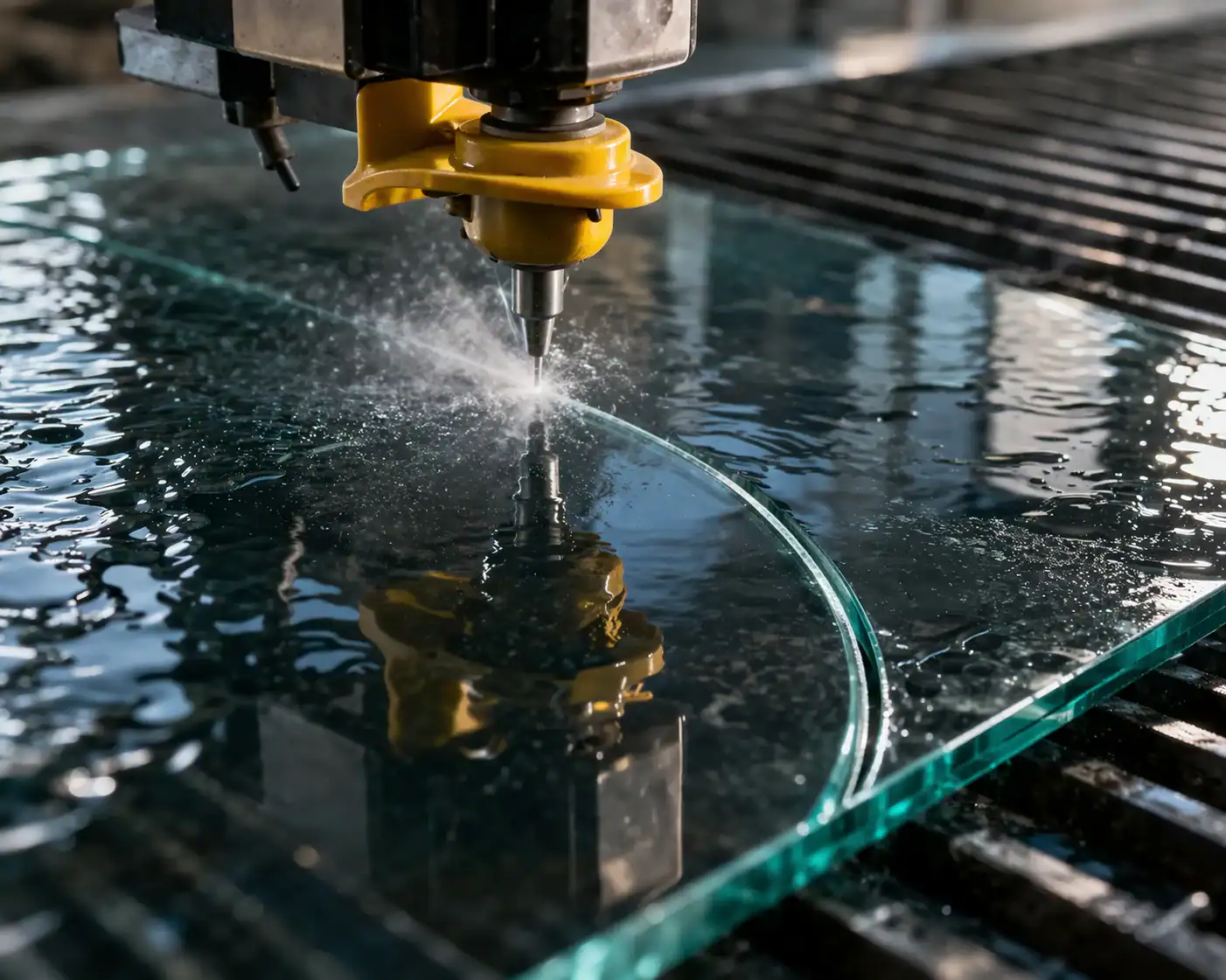
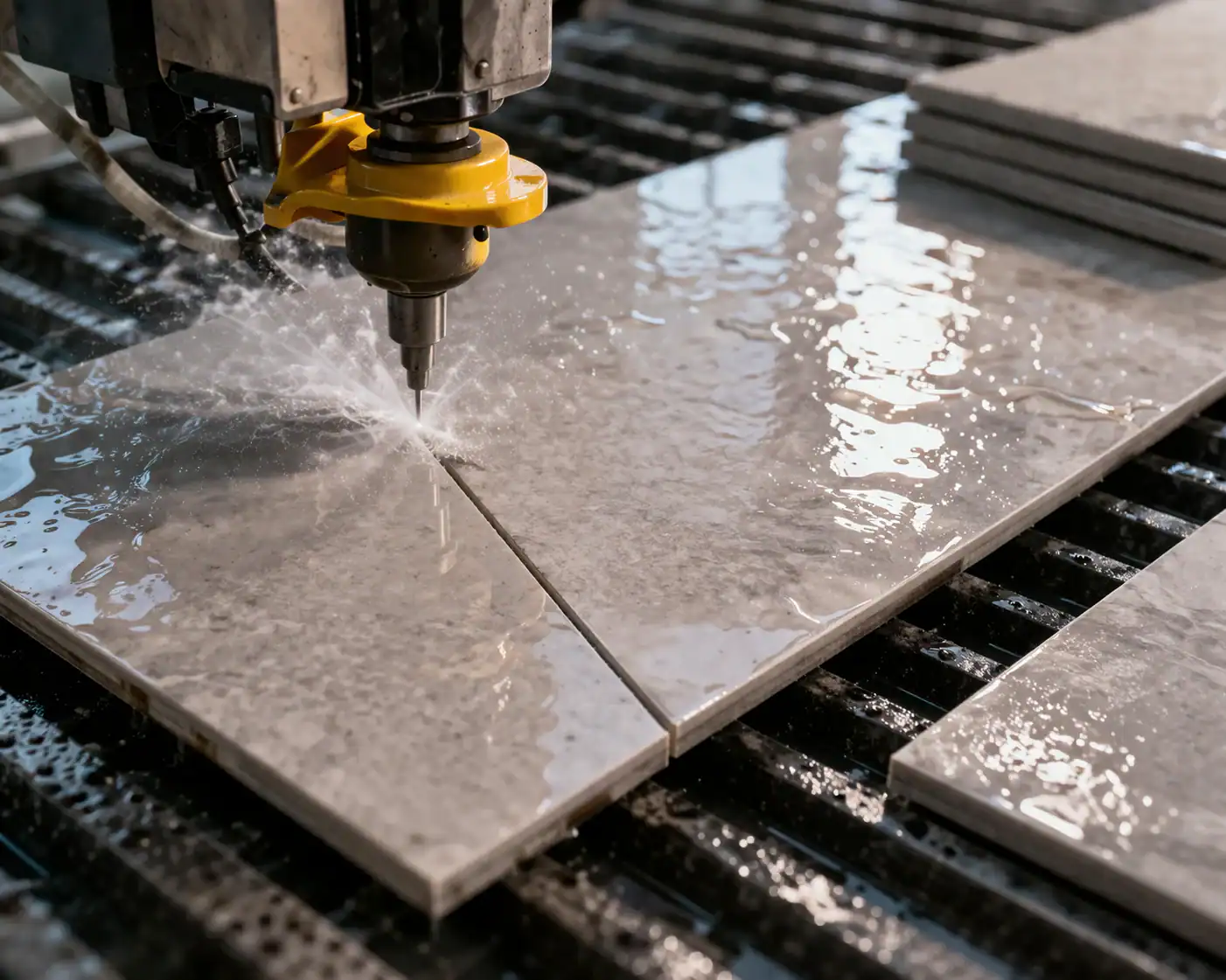
Waterjet cutting uses a thin stream of high-pressure water and garnet to cut shapes straight from a CAD file. On marble, that means curves, sharp inside corners and fine detail that a bridge saw or wet saw can’t follow.
Think floor medallions, decorative inlays, custom backsplashes, architectural panels, multi-piece mosaics and countertop cutouts in stones like Carrara, Calacatta, Emperador and Statuario. It’s custom waterjet cutting in the plainest sense: your drawing goes in, your shape comes out.
We run a Flow Mach 500 CNC waterjet system at our shop in West Islip, and we serve Long Island projects from there. The machine does exactly what the file tells it to do, which is why we spend so much of our time on the file before anything gets cut.
Most marble conversations start with this question. The best answer is a CAD file, ideally DXF, DWG or STEP. If all you have is a sketch or a PDF, call us anyway and we’ll tell you what’s workable.
The file matters so much because once the jet starts, the stone can’t be put back. Before anything gets programmed, our designers go through your drawing looking for the problems that cause trouble on stone. Those include open contours where a shape doesn’t fully close, duplicate lines that make the machine cut the same path twice, a drawing that’s off scale, and tolerances that contradict each other.
Catching those on a screen costs you a few minutes. Catching them on a slab costs you the slab.
Then there’s fit, which is where precision waterjet cutting earns its keep. When you’re setting a brass strip into marble or dropping a medallion into a field of tile, the gap between two pieces is the first thing anyone sees. We can cut to tolerances as tight as ±0.003 inches, and that’s what lets an inlay close up without filler in the seam.
The cut itself also has a width of about 0.03 to 0.04 inches, so it helps to mark which side of a line is the piece you’re keeping and which side is the waste.
You don’t need a perfect file. Our team reviews what you send and flags what needs fixing, though clean files do move faster. A drawing with the material, thickness and finished dimensions noted gives us what we need to quote without a lot of back and forth.
Yes, and it’s one of the better reasons to bring a mixed-material job to us. Brass-and-marble inlay floors are showing up in Hamptons renovations and high-end Long Island homes, and the whole look depends on two materials meeting cleanly.
If the stone comes from one shop and the metal from another, each one is working from its own reading of your drawing. The seam is where any difference shows.
We cut stone, glass, metal and composites on the same machine with no tooling changes. The marble field and a brass or copper inlay can come from the same drawing, so the edge you drew once is the edge both pieces follow. The same goes for a marble backsplash with glass accents, or a field tile with a few contrasting pieces.
In those jobs, metal waterjet cutting and glass waterjet cutting sit right alongside the marble, and you have one place to call about all of it. There’s no tooling or die fee either. Your CAD file is the tool.
That’s what makes a single custom medallion reasonable to order, and it’s why one piece and a hundred identical pieces come off the same program. If you’re finishing a multi-unit project and need the same inlay repeated, the hundredth matches the first.
If you’re not sure your design suits a mixed-material cut, send it over before anything is ordered. Working out where the pieces meet is much easier before either material is on a truck.
Want live answers?
Connect with a Tri-State Waterjet expert for fast, friendly support.
The process is simpler than most people expect. You send the file, we review it, and we quote the job. Once you approve, we program the Flow Mach 500, which pushes water at roughly 60,000 PSI mixed with garnet through a fine nozzle and follows your drawing through the stone.
Marble can run from thin tile up to multi-inch architectural pieces, and we’ll confirm what works for your specific piece when we see the drawing. It’s a cold cut, so there’s no heat damage to the marble.
After cutting, we inspect each piece before it goes back to you.
We don’t print a per-inch number, and you should be a little wary of any shop that gives you one without seeing your drawing. Price on marble comes down to the type of stone, its thickness, the total length of the cut, how complicated the shapes are, how many times the jet has to start a fresh hole in the stone, and how much setup the file needs.
Complexity matters more than people expect. Around tight corners and small curves the cutting head slows down, so an ornate medallion takes longer than a straight-edged panel of the same size. A clean file takes less setup than one we have to fix, which is another reason the review step pays off.
For long straight cuts, a saw is often the cheaper tool, and we’ll tell you that. Waterjet earns its place when the shape is complicated, when you need a number of identical pieces, or when fit matters. It also takes less out of your slab. The jet’s stream removes under a millimeter of stone, while a saw blade takes about 3 to 5 millimeters per cut.
On a slab of Calacatta, that adds up, especially when the layout lets pieces share a cut line and you get more parts out of the same stone.
Timing is part of the price conversation too. On many projects we turn work around in days, not weeks, and we can talk about rush options. If you have an install date, tell us when you call and we’ll say plainly whether it’s realistic. For Long Island jobs, the best habit is to plan your cut files before the slab is ordered, so nothing about the stone is locked in before the drawing is sorted.
Often, yes. Older buildings across Long Island have marble details that went in decades ago. When one cracks or goes missing, the supplier that made it is usually long gone.
Rosettes, trim pieces and decorative inlays are the kind of work where waterjet is often the best option, because the original pattern can be measured, traced or redrawn, turned into a file, and cut as a replacement that fits the opening already there.
Matching comes down to an accurate drawing. If you’re in Seaford, Malverne, Wantagh or anywhere else on Long Island, send us measurements, a tracing or clear photos of the original with dimensions, and we’ll tell you what we can work from. Color and veining are a separate question. The cut gives you the shape, and finding stone that sits right next to old marble is something to settle with your stone supplier.
People also ask whether thin or detailed parts will chip or crack. Waterjet doesn’t push sideways on the stone the way a blade does, which cuts down on chipping in veined marble. It isn’t magic, though. Stone can have hidden inclusions that vary in hardness, thin sections are fragile, and the start of a cut needs care.
That’s why it matters that the shop doing your cut works in stone regularly and not only metal. If a design has a spot we think is risky, we’ll tell you before we cut it, not after.
If you take one thing from all this, make it the drawing. Get the file right, tell us the material and thickness, and the cutting is the easy part. That holds whether you’re setting brass into Carrara in a Long Island renovation, adding glass accents to a backsplash, or replacing a rosette so it matches what’s already on the wall.
We’d rather answer your questions before you order the stone than after. Call us at 631-422-0888, Monday through Friday, 7:30am to 5pm, or send over your drawing and we’ll tell you what we see. You’ll get straight answers from people who cut parts all day, with no pressure.
Summary:
Article details:
Share: