Not all glass cutting methods are equal. Here's what actually separates waterjet cutting from traditional methods — and why it matters for your project.
If you’ve ever had a piece of glass crack mid-cut, come back with rough edges, or simply not fit the way it was supposed to — you already know the frustration. Traditional glass cutting works well enough for simple, straight-line jobs. But once you’re dealing with custom shapes, tight tolerances, or glass that’s too valuable to risk, the margin for error shrinks fast.
Glass waterjet cutting solves a lot of those problems. Not because it’s newer technology, but because it approaches the material completely differently. Here’s an honest look at both methods — what each one does well, where each one falls short, and how to figure out which one your project actually needs.
Traditional glass cutting relies on a scored line and controlled fracture. A hardened wheel or diamond-tipped tool scores the surface, and then mechanical pressure snaps the glass along that line. For standard rectangular panels and simple shapes, it’s fast and cost-effective. Most glass shops on Long Island handle this kind of work every day.
The problem is that the process is fundamentally limited by how glass fractures. You’re not cutting the material — you’re directing a break. That distinction matters enormously when your design has curves, tight radii, cutouts, or any shape that doesn’t follow a straight line. And even on straight cuts, the edge quality is inconsistent. Chipping, micro-fractures, and rough texture are common, which means additional grinding and polishing before the piece is usable.

The core issue with conventional glass cutting isn’t technique — it’s physics. When you score and snap glass, you’re applying sudden mechanical force to propagate a fracture along a predetermined line. That force doesn’t stay perfectly contained. Micro-fractures form along the cut edge, stress concentrates at corners and curves, and the risk of the piece breaking in an unintended direction increases with every deviation from a straight line.
For simple window panes or standard rectangular panels, this rarely matters. But if you’re cutting a decorative glass panel for a Hamptons renovation, a custom architectural inlay for a commercial build-out in Nassau County, or a precision component for an industrial application in the Hauppauge corridor — the stakes are different. A cracked piece of custom architectural glass doesn’t just cost you the material. It costs you time, delays your installation, and sometimes means starting the design process over.
Diamond saw cutting introduces a different set of problems. The saw generates heat, and glass doesn’t handle heat well during cutting. That heat creates a heat-affected zone along the cut edge — an area of internal stress that isn’t always visible but can cause delayed cracking under load or temperature change. You might install a piece that looks perfect, only to have it fail weeks later because of stress introduced during cutting.
Secondary finishing compounds the issue. Most traditionally cut glass needs significant edge work — grinding, seaming, or polishing — before it’s ready for use in any application where the edge is visible or structural. That adds labor, adds time, and adds another opportunity for the piece to break during handling.
This is where the real limitation shows up for architects, designers, and contractors. A traditional glass cutter — whether handheld or mechanized — is constrained by how glass fractures. Gentle curves are possible with skill and the right tooling. Tight curves, complex geometric patterns, cutouts, interlocking shapes, and organic designs are not. At least not with any reliability or repeatability.
If your project involves a decorative glass panel with an intricate pattern, a custom logo cutout, an architectural inlay with precise geometry, or any shape that deviates meaningfully from a straight line — traditional cutting either can’t produce it or produces it so inconsistently that the reject rate makes it impractical. Custom glass fabrication for high-end residential and commercial projects on Long Island has grown significantly in recent years, and the designs being specified by architects and interior designers have grown more ambitious alongside it. The tools haven’t always kept pace.
There’s also the repeatability problem. If you need multiple matching pieces — say, a series of decorative glass panels for a restaurant build-out in Nassau County or a set of custom glass partitions for a commercial office renovation — hand-guided cutting introduces variability that accumulates across every piece. Two panels that should be identical rarely are, and the difference shows in the finished installation.
Waterjet cutting sidesteps all of this. Because the cut is guided by CNC programming from a digital file, the machine follows the same path with the same precision every single time. Any shape that can be drawn in a CAD file can be cut accurately, whether you’re making one piece or twenty.
Want live answers?
Connect with a Tri-State Waterjet expert for fast, friendly support.
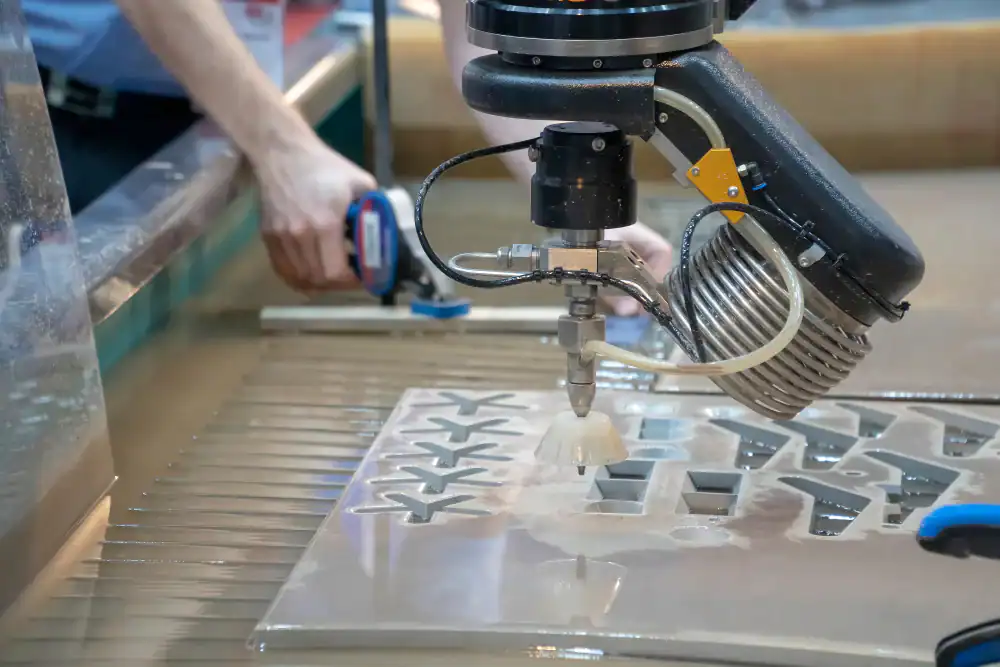
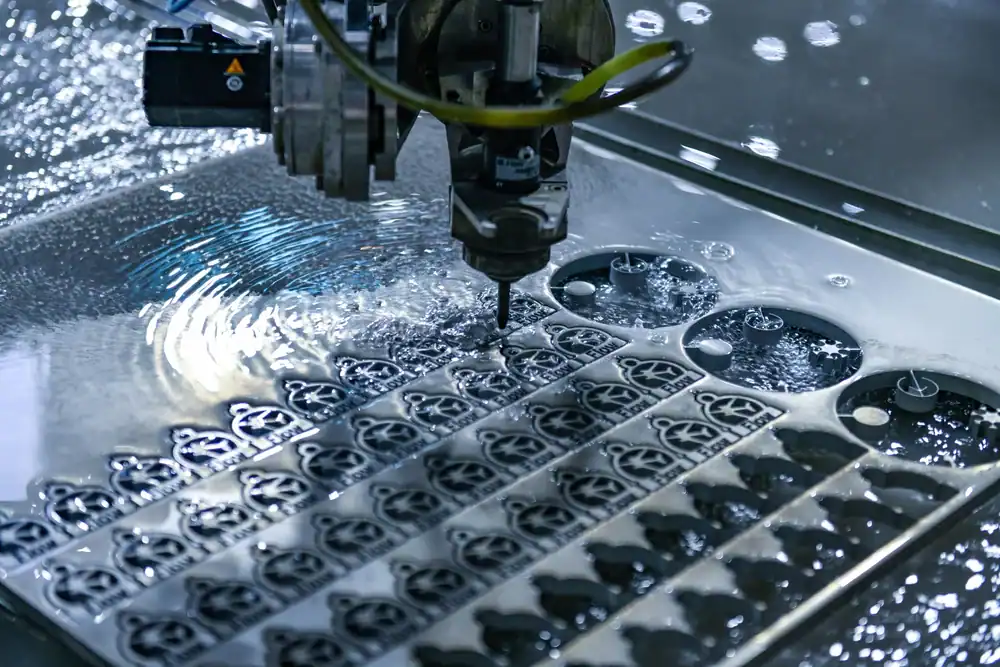
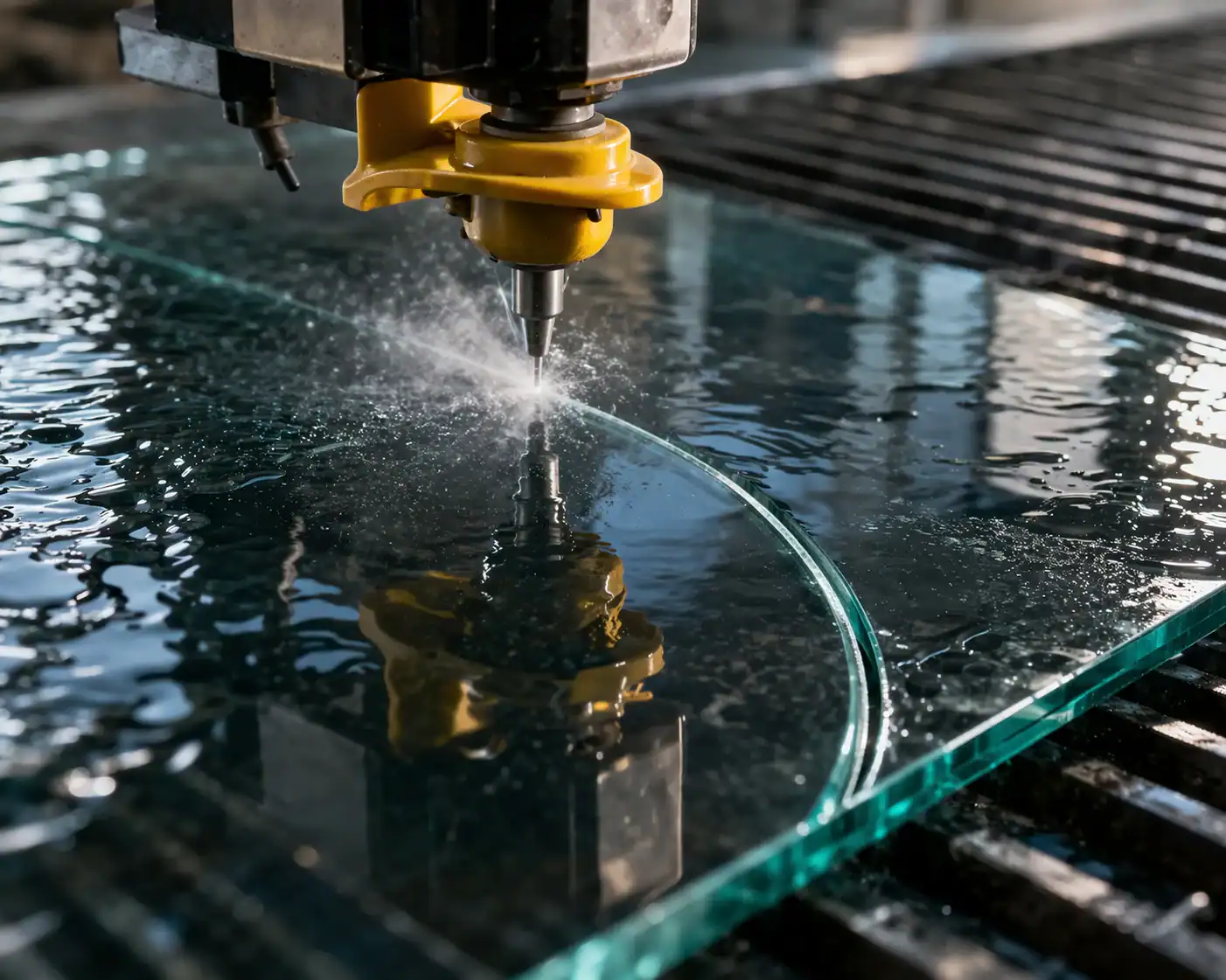
Waterjet cutting uses a high-pressure stream of water mixed with fine abrasive particles — typically garnet — to erode material along a CNC-programmed path. For glass, this happens at pressures around 60,000 PSI, controlled precisely enough to cut through the material without introducing mechanical shock or heat.
The critical difference is that waterjet cutting is a cold process. There’s no heat-affected zone, no thermal stress, and no sudden mechanical force applied to the glass. The abrasive stream erodes material gradually and continuously, following a path defined by your CAD file down to tolerances of ±0.001 to ±0.005 inches. The result is a clean edge, a shape that matches your design, and a piece that typically needs little to no secondary finishing before installation.
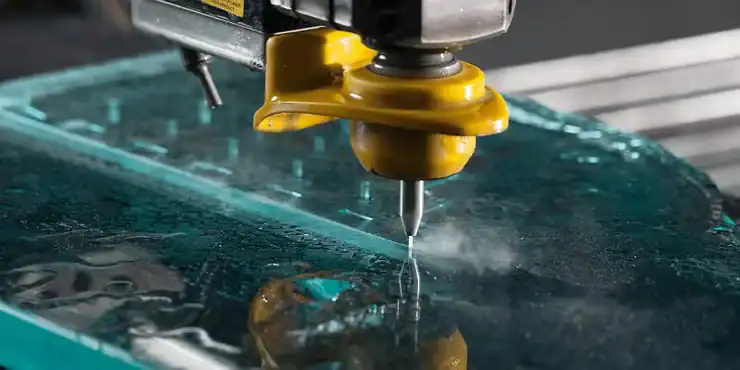
The edge produced by abrasive waterjet cutting has a satin-like texture — smooth, consistent, and free of the chipping and micro-fractures that conventional cutting leaves behind. For most architectural and decorative applications, that edge is ready to use as-is. It doesn’t need grinding. It doesn’t need seaming. You can take it off the machine and put it into the installation.
When a polished edge is required — for glass where the edge itself is part of the visual presentation, or for applications where a mirror-bright finish is specified — the waterjet cut provides an excellent starting point that reduces polishing time significantly compared to edges produced by traditional methods. You’re refining a clean surface rather than correcting a damaged one.
Edge quality also matters structurally, not just aesthetically. Micro-fractures along a cut edge are stress concentration points. Under load, temperature change, or vibration, those micro-fractures can propagate. Glass that looks fine when installed can fail later because of damage introduced during cutting. Waterjet cutting eliminates that risk by removing material gradually rather than fracturing it.
For laminated glass — which is commonly specified in Long Island construction for safety glazing applications in shower enclosures, doors, and low-sill windows — waterjet cutting at controlled pressure reduces the risk of delamination between layers. That’s a specific technical challenge that traditional cutting handles poorly and waterjet handles well, provided the pressure settings are dialed in correctly for the specific laminate stack.
Our Flow Dynamic Waterjet systems include taper compensation, which corrects for the natural angle of the waterjet stream as it exits the nozzle. Without taper compensation, cuts in thicker glass can have a slight bevel — imperceptible in some applications, but a real problem when glass needs to fit flush in a frame or assembly. Taper compensation produces near-perfectly vertical cut edges, which matters for any precision architectural glass application.
Waterjet cutting works on standard annealed glass, laminated safety glass, low-iron glass, patterned glass, and most specialty architectural glass. We can handle glass up to several inches thick and can cut through stacked sheets simultaneously — something no traditional method can replicate. For the range of glass types that architects, contractors, and designers on Long Island typically work with, waterjet cutting is broadly applicable.
The one exception worth knowing about upfront: tempered glass cannot be cut by any method after tempering. Not by waterjet, not by diamond saw, not by any tool. The internal stress that makes tempered glass strong is also what causes it to shatter completely when cut. If your project requires tempered glass, the cutting has to happen before the tempering process — on annealed glass, which is then sent for tempering after the cut is complete. This is standard industry practice, and it’s something we walk clients through when they’re planning a project that requires safety glazing.
This is worth mentioning because it’s one of the most common misconceptions we encounter, particularly from contractors and designers who are newer to specifying custom glass. Knowing it upfront saves a lot of confusion later.
For decorative glass cutting — intricate patterns, custom shapes, architectural inlays, logo cutouts — waterjet is the method that makes custom glass fabrication practical. The CNC-guided process follows your design file precisely, which means the finished piece matches the design intent rather than approximating it. For projects in the Hamptons, along Long Island’s Gold Coast in Nassau County, or in commercial spaces throughout Suffolk County where the glass is a visible, intentional design element, that accuracy is what separates a finished installation that looks exactly right from one that almost does.
We review every file before we cut. That step matters more than it might sound. It’s how we catch dimension errors, flag designs that might present challenges with a specific glass type, and confirm that what you’ve submitted will produce the piece you’re expecting. It costs nothing and prevents the kind of expensive mistakes that happen when a shop just runs the file without looking at it.
For simple, straight-line cuts in standard sizes, traditional glass cutting is fast and economical. There’s no reason to overcomplicate a job that doesn’t need it. But the moment your project involves a custom shape, a tight tolerance, an intricate design, or glass that’s too valuable to risk cracking — waterjet cutting is the better choice by a meaningful margin. No thermal damage, no micro-fractures, no rough edges that need hours of grinding, and no guesswork about whether the piece will fit.
We’ve been cutting parts on Long Island since 1981. That’s a long time to learn what works and what doesn’t, and a long time to build a reputation with the architects, contractors, fabricators, and manufacturers who can’t afford to redo a job. Our certifications — including SAE AS9100 and ISO Q9000 — aren’t marketing language. They’re the documented proof that our process is controlled, traceable, and consistent.
If you have a glass project coming up and you’re not sure which approach makes sense, reach out to us. We’re straightforward about what waterjet cutting can and can’t do, and we’ll give you an honest answer before you commit to anything.
Summary:
Share: