When traditional glass cutting hits its limits, waterjet takes over — delivering intricate shapes, clean edges, and zero cracking on even the most demanding projects.
If you’ve ever had glass crack mid-cut — or been told your design is “too complicated” for a local shop to handle — you already know the frustration. Traditional glass cutting is fast and affordable for straight lines. The moment you introduce a curve, a tight inside corner, or an intricate pattern, the options get thin quickly.
That’s where waterjet cutting earns its reputation. It’s not a workaround or a specialty niche — it’s the most reliable way to cut complex glass shapes cleanly, accurately, and without the risk of losing material to a bad cut. Here’s what you need to know about how it works and where it makes the most sense for your Long Island project.
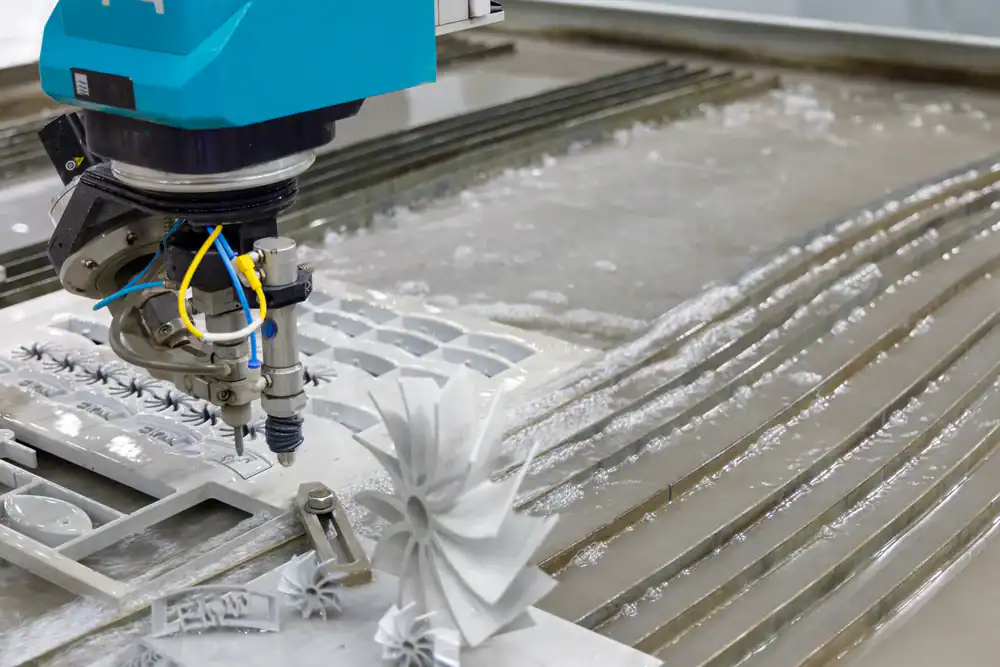
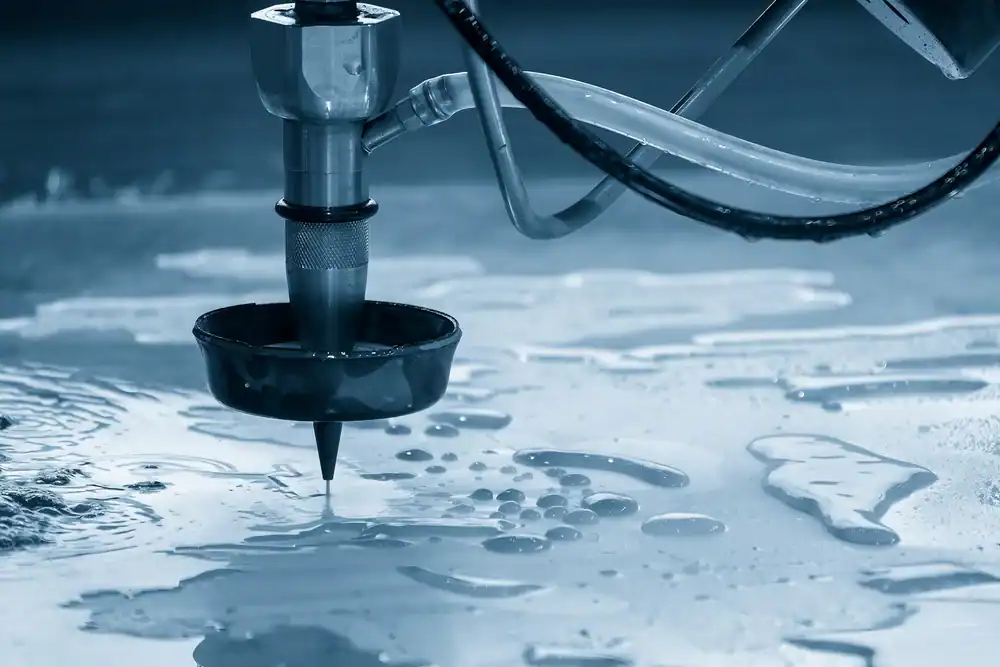
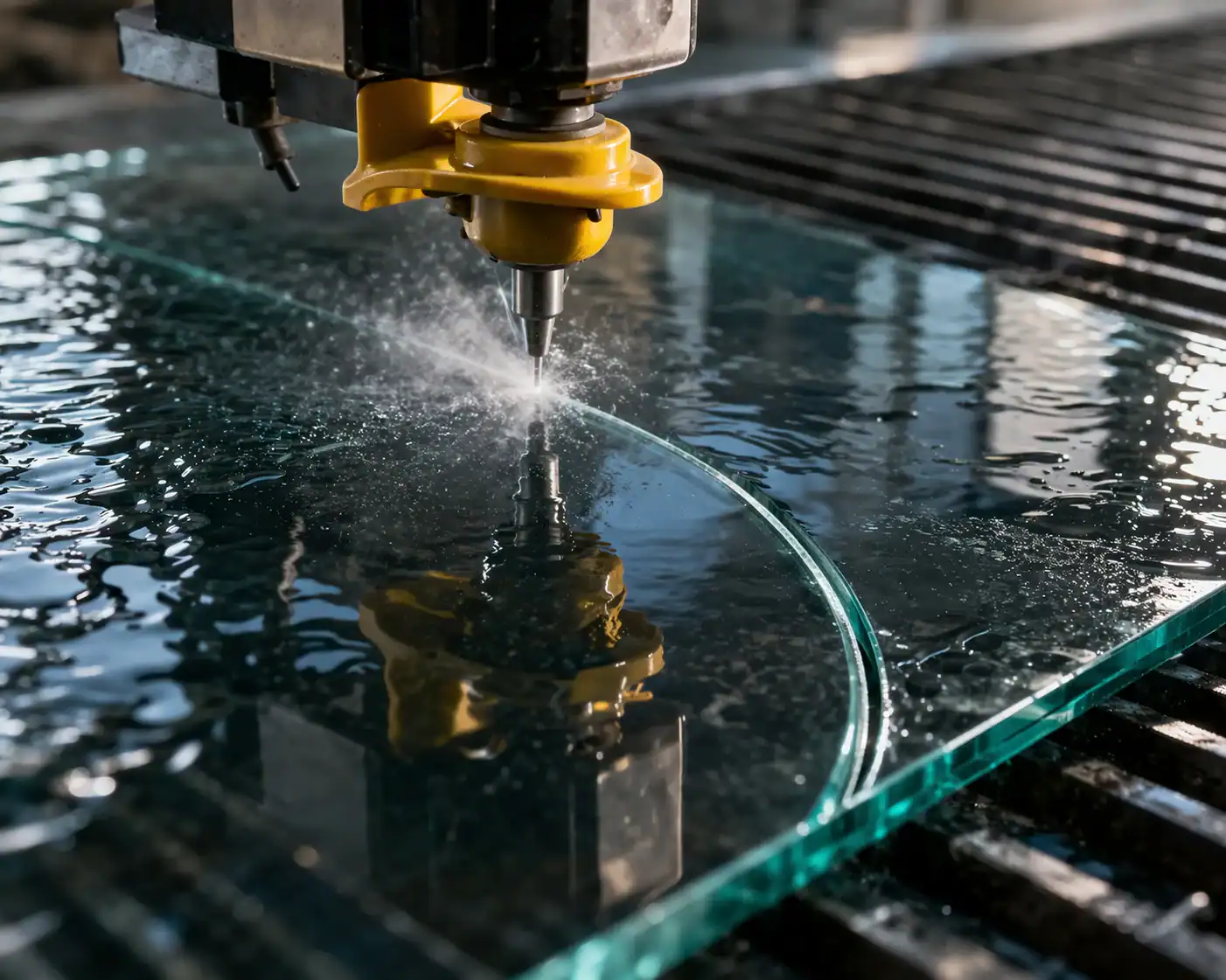
Waterjet cutting uses a high-pressure stream of water mixed with a fine abrasive to cut through glass — no heat, no saw blade, no scoring wheel. The process is entirely cold, which matters more for glass than almost any other material.
Heat is what causes glass to crack during cutting. Even small amounts of thermal stress can create micro-fractures that aren’t visible until the piece breaks later. Waterjet eliminates that risk entirely. The cut happens without raising the temperature of the material, so the glass stays structurally intact from the moment the cut starts to the moment the finished piece comes off the table.
The result is a smooth, frosted edge that requires little to no secondary finishing for most applications — no grinding, no deburring, no cleanup pass before the piece is ready to use.

Traditional glass cutting — scoring and breaking — works by creating a controlled stress fracture along a straight line. It’s a proven method for simple shapes, but it has hard limits. You can’t score a curve with real precision, you can’t cut a hole in the middle of a panel, and anything with tight geometry or an intricate pattern is either impossible or requires expensive specialty tooling that most shops don’t have.
Waterjet doesn’t have those limits. The cutting stream follows a CNC-controlled path, which means it can trace any shape a CAD file describes — curves, cutouts, decorative patterns, custom silhouettes, holes for hardware. If the design can be drawn, it can be cut.
The kerf — the width of material removed during cutting — is extremely narrow, as small as a few thousandths of an inch. This allows the cutting path to follow tight geometry without losing detail and minimizes material waste, which is a real consideration when you’re working with expensive architectural or specialty glass.
For buyers who have experienced cracked panels or wasted sheets from traditional cutting, this is the part that changes the math. Fewer failed cuts, less material loss, and no secondary finishing on most jobs means the total cost of a waterjet-cut piece often competes directly with methods that look cheaper on paper but carry more risk.
One important caveat: waterjet cannot cut tempered glass. Tempered glass is engineered to shatter on impact — that’s the whole point of it — and no cutting method, waterjet included, can get through it cleanly after tempering. If your project involves tempered glass, the tempering has to happen after the cutting is done, not before. It’s a straightforward sequencing issue, but it’s worth knowing upfront.
Waterjet produces a smooth, frosted edge. It’s not a raw, chipped edge like you’d get from a bad mechanical cut, and it’s not a polished, mirror-bright edge either. It sits in between: clean, consistent, and finished enough that most applications don’t require any additional processing. For structural glass, industrial components, or pieces that will be set into a frame or sealed with hardware, the waterjet edge is typically ready to use as-is.
For applications where a polished edge is part of the aesthetic — a glass tabletop, a decorative inlay, a visible architectural feature — some additional edge finishing may be needed. But the starting point matters. A clean waterjet edge requires far less finishing work than an edge that came off a mechanical cutter with chips and irregularities.
The precision behind that edge is also worth understanding. Our waterjet glass cutting holds tolerances of ±0.001″ to ±0.005″ depending on the material, thickness, and application. That level of accuracy means panels fit where they’re supposed to fit, inlays align with their surroundings, and hardware lines up with the holes cut for it — without field adjustment or shimming. For contractors and fabricators working on a schedule, that matters as much as the quality of the cut itself.
We run a design review on every CAD file before the machine runs. That step catches geometry issues — tight corners that need adjustment, dimensions that don’t match the spec, nesting opportunities that reduce material waste — before they become expensive problems. It’s a straightforward part of the process, but it’s the difference between a shop that runs your file and a shop that actually understands your project.
Want live answers?
Connect with a Tri-State Waterjet expert for fast, friendly support.
Long Island’s construction and design market creates demand for precision glass fabrication across a wide range of applications. Nassau and Suffolk counties account for 41% of regional manufacturing spending — the highest share in New York State — and the region’s residential market is among the most active in the country, with luxury new construction booming across towns like Manhasset, Huntington, Wantagh, and East Meadow heading into 2025.
That kind of market produces real, specific demand for custom glass work. High-end residential builds on Long Island’s North Shore are increasingly specifying architectural glass features — large panels, custom-shaped shower enclosures, decorative inlays — that require the kind of precision waterjet delivers. Commercial renovations across Nassau and Suffolk counties need custom glass components that fit exact openings, match specific design specs, and arrive on a schedule that doesn’t hold up the rest of the job.
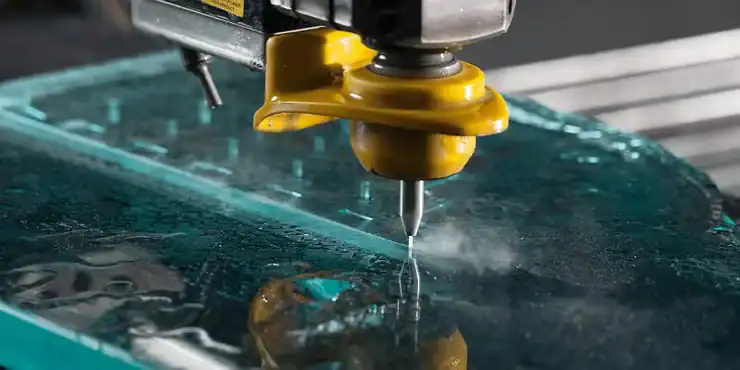
The range of applications for waterjet-cut glass is broader than most people expect. On the architectural side, it includes custom glass panels for partitions and facades, glass railings and balustrades, decorative floor inlays, custom-shaped windows, and glass stair treads. These are components where fit, edge quality, and structural integrity all matter — and where a bad cut means a delay, not just a redo.
On the decorative side, waterjet opens up design possibilities that simply don’t exist with traditional cutting. Intricate patterns, custom silhouettes, glass art installations, and stained glass work with complex geometry are all achievable because the CNC-controlled cutting path isn’t limited by a scoring wheel or a saw blade. Designers working on residential interiors on Long Island’s North Shore — where custom is the expectation, not the upgrade — have increasingly turned to waterjet fabrication to execute designs that their clients are actually asking for.
Specialty applications include retail display glass, hospitality interiors, custom signage glass, and glass components for manufactured products. A curved glass shelf, a logo cut into a glass panel, a custom-shaped glass countertop — these aren’t exotic requests anymore, and waterjet is the straightforward answer for all of them.
For Long Island fabricators and contractors sourcing glass components, the practical advantage is proximity. Working with us means shorter lead times, easier communication when a design needs a last-minute adjustment, and no shipping risk for fragile material. A custom glass panel that has to travel from a national fulfillment center introduces risk that a locally fabricated piece simply doesn’t carry.
The process is more straightforward than most first-time customers expect. If you have a CAD file — DXF, DWG, or STEP format — that’s all you need to start a conversation. Send the file, describe the glass type and thickness you’re working with, and we’ll review the geometry before anything runs on the machine.
That review step is where experience shows up. We look at the design for issues that could affect the cut — inside corners that need a small radius adjustment, dimensions that don’t account for kerf width, nesting opportunities that reduce the amount of material you need to purchase. Most files come through clean, but catching a problem at the review stage costs nothing.
If you don’t have a CAD file yet, that’s not a dead end. We can work from drawings, sketches, or measurements — and we have AI-assisted CAD capability in-house to help translate a design concept into a cuttable file. For architects and designers who work in formats that don’t export directly to waterjet-ready files, this removes a step that can otherwise slow a project down.
Most standard jobs are complete within one to three business days. Simple cuts with material in stock can be same-day or next-day. Complex projects — thicker glass, highly intricate patterns, large production runs — typically run three to five days. Rush service is available when the schedule demands it. We’ve been operating out of West Islip since 1981, serving manufacturers, contractors, architects, and fabricators across Long Island and the broader tri-state area, and lead time matters as much to our clients as the quality of the cut itself.
For straight cuts on standard shapes, traditional methods work fine. But the moment your project involves a curve, a cutout, an intricate pattern, or a design that needs to fit precisely — waterjet is the more reliable path. It eliminates the heat and vibration that cause glass to crack, produces clean edges that typically need no secondary finishing, and holds tolerances tight enough that your parts fit the first time.
Long Island’s construction and design market is as active as it’s been in years. Architects, contractors, and fabricators across Nassau and Suffolk counties are specifying custom glass features that require this level of precision — and the shops that can deliver it, on time and without wasted material, are the ones worth calling.
If you have a project in mind, Tri-State Waterjet is worth a conversation. Send your file, describe what you’re working on, and we’ll tell you exactly what’s involved.
Summary:
Article details:
Share: